CAT-00003
Fraser Island (K'gari) apple
Acronychia imperforata
Catalog fields
- Genus
- Acronychia
- Photo
- Not recorded
- Edible
- Yes
- layout
- double
- Habitat
- Grows in coastal and inland rainforest, to 900 m altitude.
- Published
- Yes
- Food group
- Fruit
- Latin name
- Acronychia imperforata
- Fruit photo
- Not recorded
- Plant title
- Fraser Island (K'gari) apple
- Source URLs
- https://profiles.ala.org.au/opus/foa/profile/Acronychia%20imperforata | https://www.whichplantwhere.com.au/plant/acronychia-imperforata?p=1 | https://www.coolumnatives.com/plantinformation/acronychia-imperforata---fraser-island-apple Open source ↗ Open source 2 ↗ Open source 3 ↗
- Catalogue ID
- CAT-00003
- Mature width
- 3-4 m cultivated
- Native range
- Occurs from near Somerset, NE Queensland, to Port Macquarie, east-central New South Wales.
- Plant family
- Rutaceae
- Supplier SKU
- ACRIMP
- Listing group
- Original garden variety
- Mature height
- 5-8 m cultivated; to 15 m wild
- Native states
- NSW, QLD
- Original list
- Yes
- Research date
- 10/10/2026
- Research notes
- Cultivated sizes used; seasons are regional, not verified across all growing regions. Seasons vary with climate, location, cultivar and plant maturity.
- Evidence status
- Nursery food-use source; preparation detail review pending
- Fruiting season
- Summer-autumn reported; variable
- Background photo
- Not recorded
- Edible component
- Fruit flesh
- Flowering season
- Mainly summer-autumn; variable
- Brief description
- Evergreen coastal tree; glossy leaves; cream-yellow flowers.
- Drought tolerance
- High once established (Which Plant Where).
- Preparation notes
- Confirm species identification, the specified edible part, ripeness and species-specific preparation before use.
- Flower description
- Small cream flowers in clusters.
- General cultivation
- General guidance (qualitative): Sun-part shade; well-drained soil; protect young plants from frost.
- Botanical description
- Shrub, or tree to 10 m high. Internodes of young branchlets terete or slightly compressed. Leaves simple; petiole 0.3–2.5 cm long, glabrous or nearly so; lamina elliptic to obovate, or narrowly so, 3.3–13 cm long, 1.6–6 cm wide, rounded to obtusely acuminate, with acumen to 0.5 cm long, glabrous. Inflorescences usually few-flowered, axillary and/or infrafoliar, 2–5 cm long; pedicels 1.5–4.5 (–7) mm long, glabrous to puberulous. Flower buds obtuse. Sepals 1.5–2.5 mm wide, glabrous adaxially. Petals 5.5–9 mm long. Gynoecium syncarpous, 4-loculed; ovary sparsely pubescent at apex or glabrous, like fruit without septicidal fissures. Fruit syncarpous, 4-loculed, pyriform to subglobose, 9–16 mm long, without stylar beak, with a few apical trichomes or glabrous; dried fruit as seen in medial transverse section with outer part of pericarp 0.7–1 mm thick, with fleshy exocarp and woody mesocarp; endocarp cartilaginous. Seeds 4–6 mm long.
- Other botanical names
- Not recorded
- Attracts birds and bugs
- Fruit-eating birds; bees, butterflies and other pollinators.
- Flora of Australia profile
- https://profiles.ala.org.au/opus/foa/profile/Acronychia%20imperforata Open source ↗
- Fruit type and description
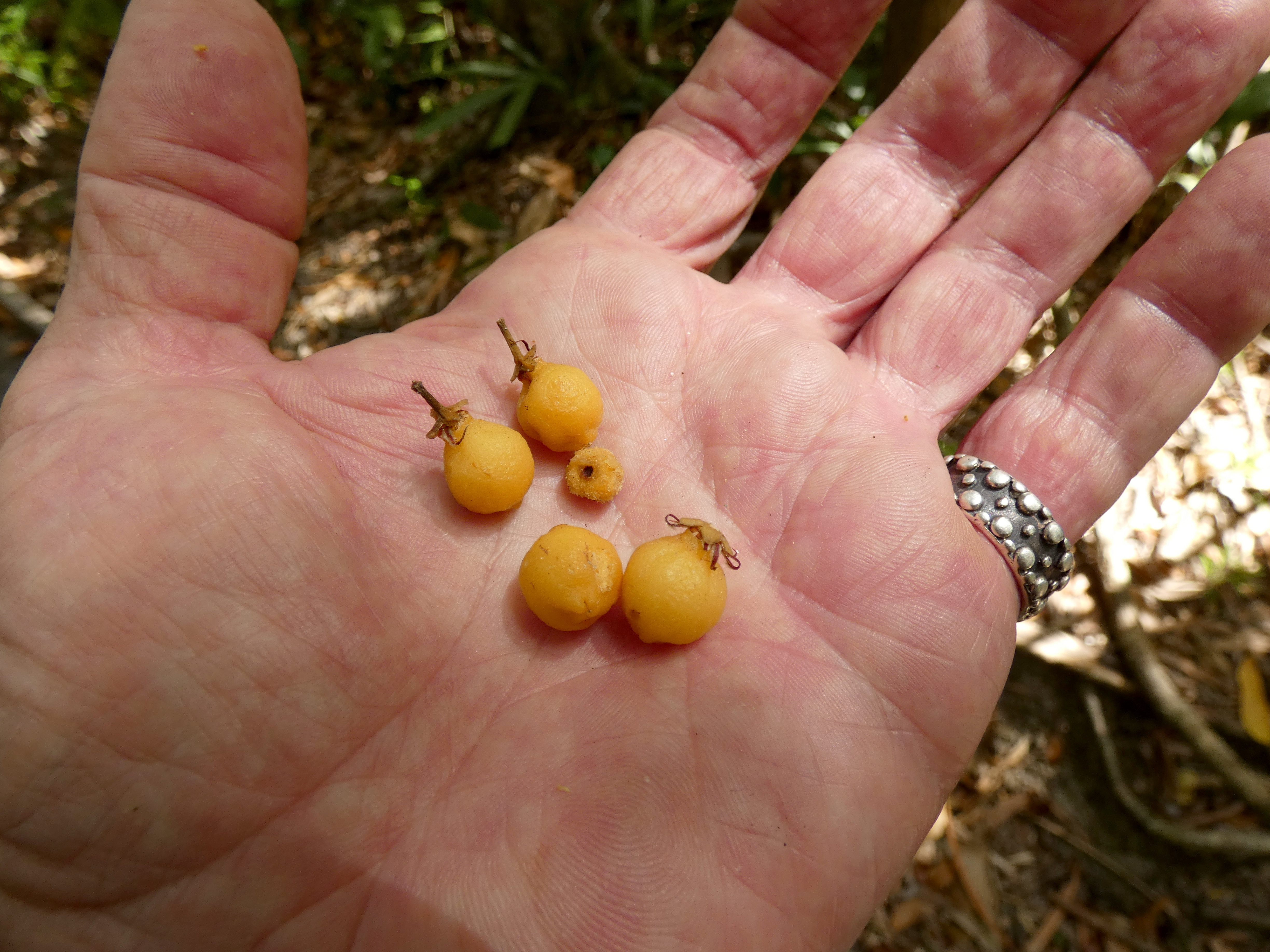
- Small yellow-orange fleshy drupes; rounded to pear-shaped.
- Flora of Australia citation
- T.G. Hartley. Acronychia imperforata. Flora of Australia, Australian Biological Resources Study, Department of Climate Change, Energy, the Environment and Water, Canberra. https://profiles.ala.org.au/opus/foa/profile/Acronychia%20imperforata (accessed 2026-10-14). Copyright Commonwealth of Australia; CC BY 4.0 (https://creativecommons.org/licenses/by/4.0/). HTML formatting removed; species-level context added where noted. Open source ↗ Open source 2 ↗
- Flora of Australia retrieved
- 14/10/2026