CAT-00008
Native redback ginger
Alpinia caerulea (redback form)
Catalog fields
- Genus
- Alpinia
- Photo
- Not recorded
- Edible
- Yes
- layout
- single
- Habitat
- Species-level information for Alpinia caerulea, not a cultivar/form-specific description. Cultivated selections have no separate wild range. Common along streamsides in rainforest.
- Published
- Yes
- Food group
- Herb / spice
- Latin name
- Alpinia caerulea (redback form)
- Fruit photo
- Not recorded
- Plant title
- Native redback ginger
- Source URLs
- https://profiles.ala.org.au/opus/foa/profile/Alpinia%20caerulea | https://resources.austplants.com.au/plant/alpinia-caerulea/ | https://www.nparks.gov.sg/florafaunaweb/flora/5/7/5712 | https://mary-cairncross.sunshinecoast.qld.gov.au/learn/plants/native-ginger; https://powo.science.kew.org/taxon/urn%3Alsid%3Aipni.org%3Anames%3A795224-1; https://plantnet.rbgsyd.nsw.gov.au/cgi-bin/NSWfl.pl?lvl=sp&name=Alpinia~caerulea&page=nswfl Open source ↗ Open source 2 ↗ Open source 3 ↗ Open source 4 ↗ Open source 5 ↗ Open source 6 ↗
- Catalogue ID
- CAT-00008
- Mature width
- 1-2 m; clumps expand
- Native range
- Species-level information for Alpinia caerulea, not a cultivar/form-specific description. Cultivated selections have no separate wild range. Occurs from just N of Newcastle, N.S.W., through eastern Qld to the islands of Torres Strait. Perhaps also in New Guinea.
- Plant family
- Zingiberaceae
- Supplier SKU
- ALPCAE
- Listing group
- Original garden variety
- Mature height
- About 2 m in gardens; to 3 m
- Native states
- NSW, QLD
- Original list
- Yes
- Research date
- 10/10/2026
- Research notes
- Redback form retained without assuming a formal cultivar; APS classifies fruit as capsules. Seasons vary with climate, location, cultivar and plant maturity. Native states refer to the parent species, or both parent species for the garden hybrid; the cultivated selection has no separate wild range. Flower descriptions use species-level information where cultivar-specific details are unavailable.
- Evidence status
- Original variety; food-use detail review pending
- Fruiting season
- After flowering; regional timing not yet confirmed
- Background photo
- Not recorded
- Edible component
- Young shoot centres; rhizome; fruit pulp
- Flowering season
- Spring in NSW flora; cultivar-specific timing not confirmed.
- Brief description
- Clumping rainforest perennial; red leaf undersides; white flower clusters.
- Drought tolerance
- Low (inferred); maintain moisture and water in dry spells.
- Preparation notes
- Culinary leaf/rhizome flavouring; use a species-specific recipe.
- Flower description
- Flowers with yellow inner petals, carried on upright branched clusters; species-level description.
- General cultivation
- General guidance (qualitative): Light-full shade; moist soil; frost protection; remove old spent stems.
- Botanical description
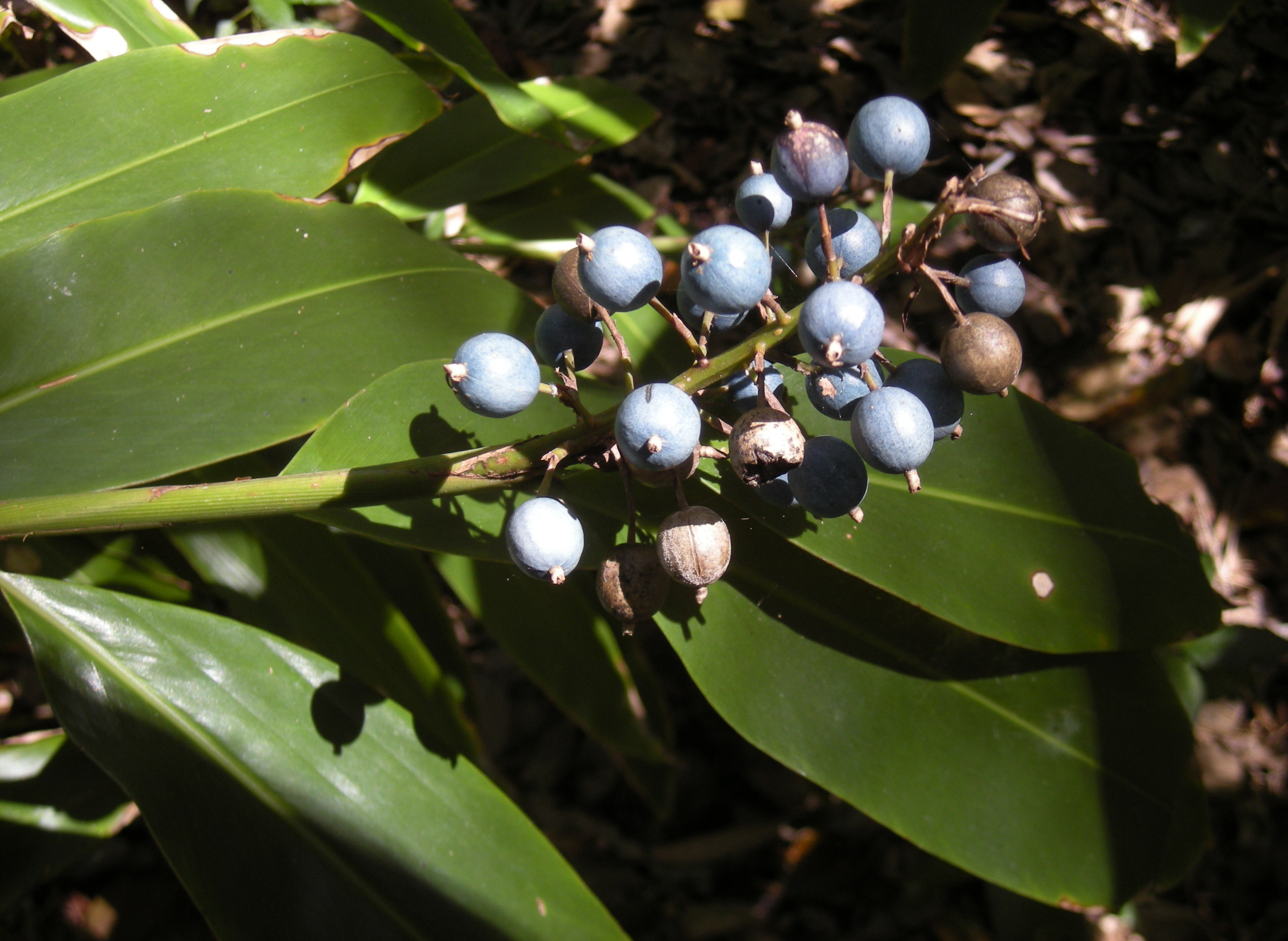
- Species-level information for Alpinia caerulea, not a cultivar/form-specific description. Cultivated selections have no separate wild range. Plant to 2 m tall. Leaves shortly petiolate or sessile, glabrous; lamina lanceolate, acuminate, to 40 cm long, 3.5–10 cm wide; ligule to 15 mm long, entire or shallowly emarginate. Inflorescence 12–30 cm long, usually shortly pubescent; bracts narrowly lanceolate, 15–20 mm long, each subtending a cincinnus of up to 6 flowers; bracteoles 5–15 mm long; pedicels 1–2 cm long. Calyx c. 10 mm long. Corolla tube c. 12–14 mm long; lobes 5–8 mm long. Labellum orbicular, shortly clawed, shortly bilobed, c. 1 cm diam., purplish. Lateral staminodes 1 mm long. Filament 2–3 mm long; anther 2–3 mm long; crest 1–2 mm long, entire. Ovary to 6 mm long, usually pubescent, trilocular. Capsule indehiscent, c. 1 cm diam.
- Other botanical names
- Not recorded
- Attracts birds and bugs
- Bees and butterflies; host for banded demon butterfly caterpillars.
- Flora of Australia profile
- https://profiles.ala.org.au/opus/foa/profile/Alpinia%20caerulea Open source ↗
- Fruit type and description
- Blue berry-like capsules about 1 cm; white pulp surrounding dark seeds.
- Flora of Australia citation
- R.M. Smith. Alpinia caerulea. Flora of Australia, Australian Biological Resources Study, Department of Climate Change, Energy, the Environment and Water, Canberra. https://profiles.ala.org.au/opus/foa/profile/Alpinia%20caerulea (accessed 2026-10-14). Copyright Commonwealth of Australia; CC BY 4.0 (https://creativecommons.org/licenses/by/4.0/). HTML formatting removed; species-level context added where noted. Open source ↗ Open source 2 ↗
- Flora of Australia retrieved
- 14/10/2026