CAT-00012
Fragrant saltbush 'Grey Edge'
Rhagodia parabolica 'Grey Edge'
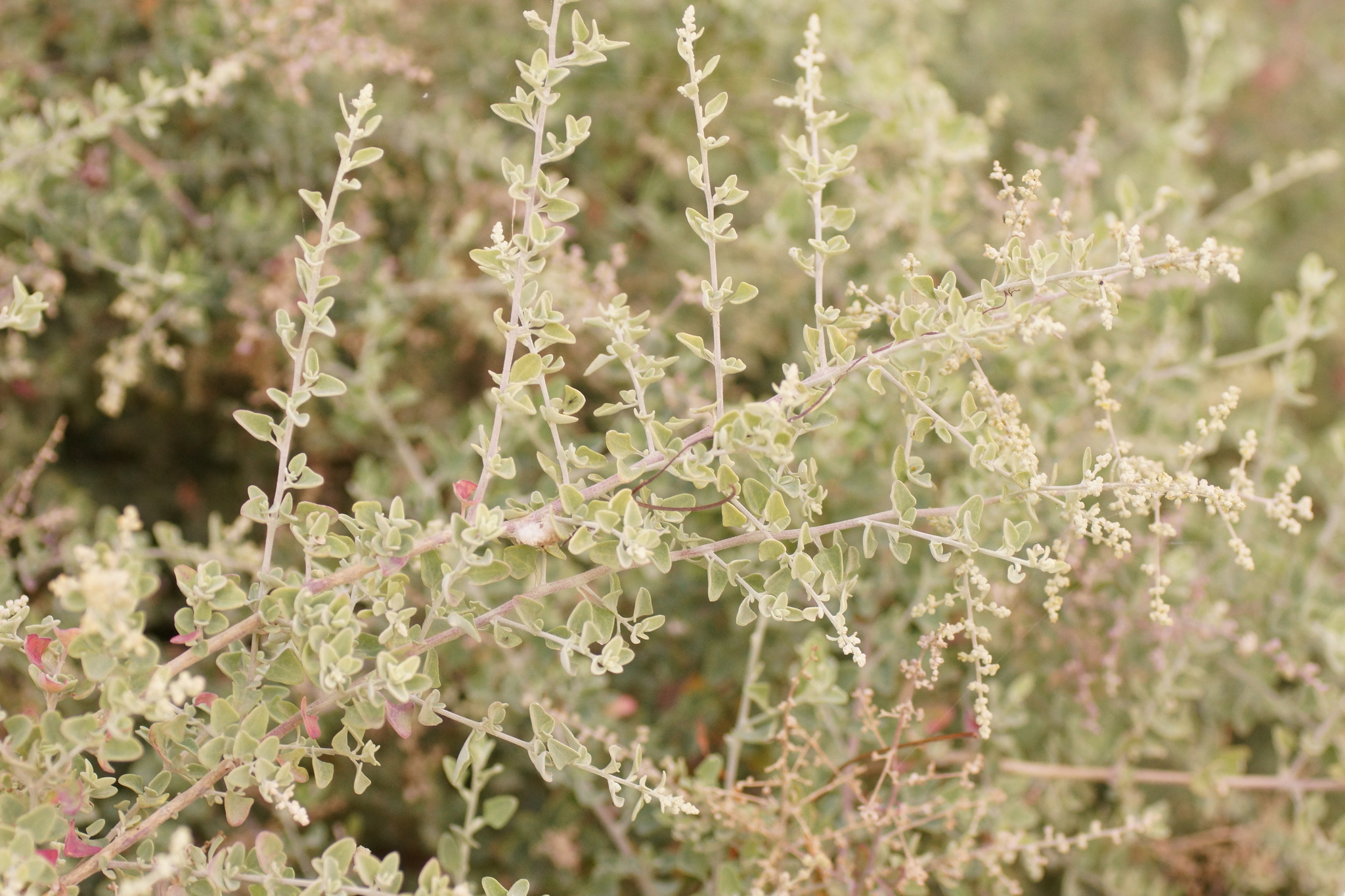
Catalog fields
- Genus
- Rhagodia
- Photo
- Not recorded
- Edible
- Yes
- layout
- single
- Habitat
- Species-level information for Rhagodia parabolica, not a cultivar/form-specific description. Cultivated selections have no separate wild range. Growing principally on rocky hillsides and creek banks.
- Published
- Yes
- Food group
- Leaf vegetable
- Latin name
- Rhagodia parabolica 'Grey Edge'
- Fruit photo
- Not recorded
- Plant title
- Fragrant saltbush 'Grey Edge'
- Source URLs
- https://profiles.ala.org.au/opus/foa/profile/Rhagodia%20parabolica | https://acra.biodiversity.services/info/rdetail/2110; https://npgsweb.ars-grin.gov/gringlobal/taxon/taxonomydetail?id=466029; https://vicflora.rbg.vic.gov.au/flora/taxon/a328d023-a527-4b3c-afe1-8a3822a4f1ad Open source ↗ Open source 2 ↗ Open source 3 ↗ Open source 4 ↗
- Catalogue ID
- CAT-00012
- Mature width
- About 2 m
- Native range
- Species-level information for Rhagodia parabolica, not a cultivar/form-specific description. Cultivated selections have no separate wild range. Found in south-eastern Qld, north-eastern N.S.W., southern Vic., southern S.A. and central Australia.
- Plant family
- Amaranthaceae
- Supplier SKU
- RHAGRE
- Listing group
- Original garden variety
- Mature height
- About 1 m
- Native states
- NSW, NT, QLD, SA, VIC
- Original list
- Yes
- Research date
- 10/10/2026
- Research notes
- ACRA registered name; species also treated as Chenopodium parabolicum. Seasons vary with climate, location, cultivar and plant maturity. Native states refer to the parent species, or both parent species for the garden hybrid; the cultivated selection has no separate wild range. Flower descriptions use species-level information where cultivar-specific details are unavailable.
- Evidence status
- Provisional food-use report; confirm before use
- Fruiting season
- After flowering; regional timing not yet confirmed
- Background photo
- Not recorded
- Edible component
- Leaves after suitable preparation; fruit reported
- Flowering season
- September-January for the parent species in VicFlora; cultivar-specific timing not confirmed.
- Brief description
- Spreading grey-green shrub; tiny fragrant green flowers.
- Drought tolerance
- High; registry describes it as drought hardy.
- Preparation notes
- Cultivar food use not verified; retained from original list. Verify edible part and preparation before food use.
- Flower description
- Tiny flowers in branching clusters; parent-species description, cultivar details unconfirmed.
- General cultivation
- General guidance (qualitative): Very good drainage; light shade tolerated; protect in heavily frosted sites; prune for density.
- Botanical description
- Species-level information for Rhagodia parabolica, not a cultivar/form-specific description. Cultivated selections have no separate wild range. Rounded shrub to 2 m high. Leaves mostly opposite; lamina thin, very broadly elliptic to broadly or very broadly ovate, rarely obtusely hastate, acute to rounded at apex, apiculate; lamina 1.5–4 cm long, truncate to cuneate at base and passing into slender petiole half to as long as lamina, minutely mealy, becoming reddish brown with age. Inflorescence a broad pyramidal panicle 5–8 cm long. Perianth mealy, c. 1 mm diam. Male flowers: filaments united into a cupular disc densely woolly on margin. Female flower: staminodes in terminal flowers united into a cupular disc densely woolly within, in lateral flowers reduced or absent. Seed c. 1.8 mm diam.; testa with faint radial ribbing.
- Other botanical names
- Not recorded
- Attracts birds and bugs
- Food and refuge for small birds, lizards and small mammals.
- Flora of Australia profile
- https://profiles.ala.org.au/opus/foa/profile/Rhagodia%20parabolica Open source ↗
- Fruit type and description
- Small deep-red fleshy fruit.
- Flora of Australia citation
- Paul G. Wilson. Rhagodia parabolica. Flora of Australia, Australian Biological Resources Study, Department of Climate Change, Energy, the Environment and Water, Canberra. https://profiles.ala.org.au/opus/foa/profile/Rhagodia%20parabolica (accessed 2026-10-14). Copyright Commonwealth of Australia; CC BY 4.0 (https://creativecommons.org/licenses/by/4.0/). HTML formatting removed; species-level context added where noted. Open source ↗ Open source 2 ↗
- Flora of Australia retrieved
- 14/10/2026