CAT-00031
Large-leaved tamarind
Diploglottis australis
Catalog fields
- Genus
- Diploglottis
- Photo
- Not recorded
- Edible
- Yes
- layout
- single
- Habitat
- Grows in rainforest.
- Published
- Yes
- Food group
- Fruit
- Latin name
- Diploglottis australis
- Fruit photo
- Not recorded
- Plant title
- Large-leaved tamarind
- Source URLs
- https://profiles.ala.org.au/opus/foa/profile/Diploglottis%20australis | https://tuckerbush.com.au/large-leaf-tamarind-diploglottis-australis/ Open source ↗ Open source 2 ↗
- Catalogue ID
- CAT-00031
- Mature width
- 5-8m
- Native range
- Occurs from southeastern Queensland to the Illawarra district, New South Wales; possibly also New Guinea based on records reported by Leenhouts (1988: 197), however the status of these records requires further investigation.
- Plant family
- Sapindaceae
- Supplier SKU
- Not recorded
- Listing group
- Nursery-listed / regional edible
- Mature height
- 8-12m
- Native states
- NSW, QLD
- Original list
- No
- Research date
- 10/10/2026
- Research notes
- Profile enriched from botanical/nursery sources. Dimensions are unpruned regional estimates where available; missing measurements remain explicit. Seasons are regional guides and vary with climate, location, cultivar and plant maturity. Drought and cultivation guidance are qualitative garden inferences, not measured ratings.
- Evidence status
- Nursery food-use source; preparation detail review pending
- Fruiting season
- Species-specific ripening period not yet confirmed.
- Background photo
- Not recorded
- Edible component
- Aril around seed
- Flowering season
- Spring reported by nursery.
- Brief description
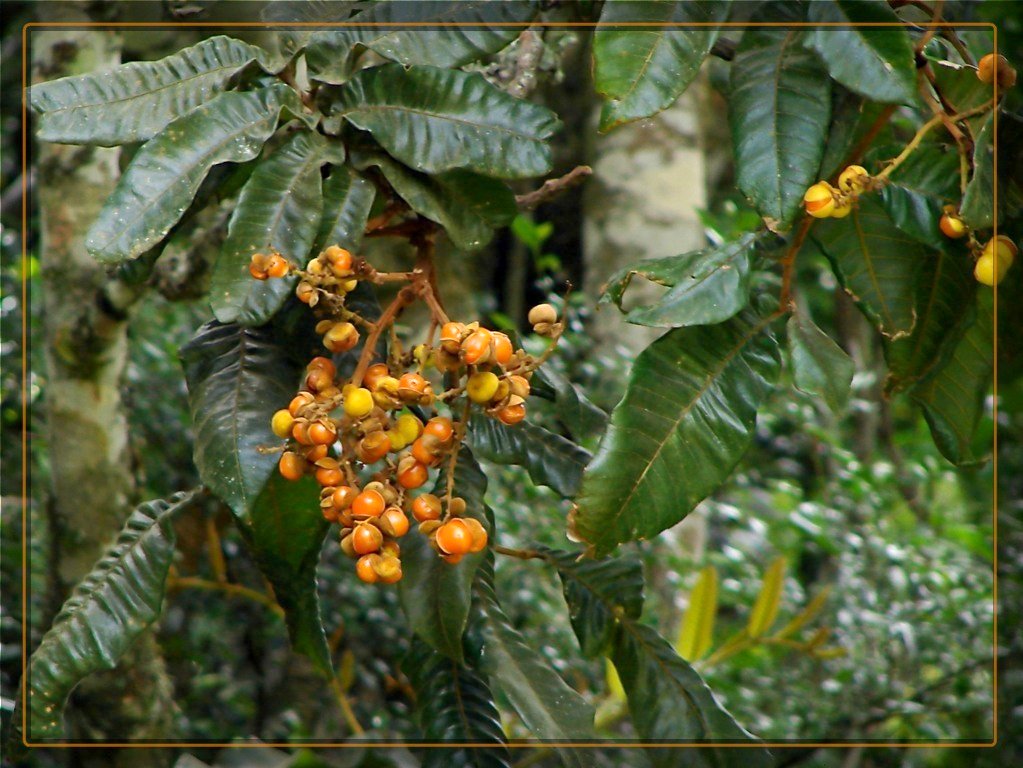
- Large rainforest tree with hairy leaves and conspicuous fruit capsules.
- Drought tolerance
- Low to moderate; responds to regular moisture.
- Preparation notes
- Use orange aril surrounding the seed; separate and discard seed and capsule.
- Flower description
- Small cream-brown flowers in branching clusters.
- General cultivation
- General guidance (qualitative): Suitable for a larger sheltered garden; protect juveniles from frost.
- Botanical description
- Tree to 35 m high. Branchlets, leaf axes and peduncles rusty-tomentose. Leaf rachis 10–35 cm long [Harden (2002) describes leaves up to 120 cm long]; leaflets 3–6 pairs, rarely 8, oblong to elliptic-oblong, obtuse to rounded or bluntly pointed at apex (rarely acute), unequal and truncate at base (rarely obtuse), 8–33 (–50) cm long, 3.5–12 cm wide, glabrous above except hairy along midrib and other veins, usually rusty-hairy below; petiolules 2–15 mm long; petiole 5–15 cm long. Panicle 12–50 cm long; peduncle stout; flowers 4–6 mm diam.; pedicels c. 6 mm long. Calyx lobes ovate, 2–3 mm long, villous outside. Petals 4, rarely a reduced 5th, as long as calyx. Disc incomplete. Fruit subglobose or transversely ellipsoidal, 1–1.5 cm long, 2.5–3 cm wide, 2- or 3-sulcate, yellow-orange; valves rusty velvety outside, sparsely silky inside. Aril orange-yellow or orange-red, acidic.
- Other botanical names
- Not recorded
- Attracts birds and bugs
- Native bees and flies pollinate; fruit arils attract small birds.
- Flora of Australia profile
- https://profiles.ala.org.au/opus/foa/profile/Diploglottis%20australis Open source ↗
- Fruit type and description
- Brown capsules open to reveal seeds surrounded by tangy orange arils.
- Flora of Australia citation
- S.T. Reynolds, P.G. Kodela. Diploglottis australis. Flora of Australia, Australian Biological Resources Study, Department of Climate Change, Energy, the Environment and Water, Canberra. https://profiles.ala.org.au/opus/foa/profile/Diploglottis%20australis (accessed 2026-10-14). Copyright Commonwealth of Australia; CC BY 4.0 (https://creativecommons.org/licenses/by/4.0/). HTML formatting removed; species-level context added where noted. Open source ↗ Open source 2 ↗
- Flora of Australia retrieved
- 14/10/2026