CAT-00034
Illawarra plum
Podocarpus elatus
Catalog fields
- Genus
- Podocarpus
- Photo
- Not recorded
- Edible
- Yes
- layout
- single
- Habitat
- Occurs in rainforest.
- Published
- Yes
- Food group
- Fruit
- Latin name
- Podocarpus elatus
- Fruit photo
- Not recorded
- Plant title
- Illawarra plum
- Source URLs
- https://profiles.ala.org.au/opus/foa/profile/Podocarpus%20elatus | https://tuckerbush.com.au/illawarra-plum-podocarpus-elatus/ Open source ↗ Open source 2 ↗
- Catalogue ID
- CAT-00034
- Mature width
- 4-7m
- Native range
- Occurs in coastal and subcoastal rainforests in north-eastern and south-eastern Qld and eastern N.S.W.; also reported from New Guinea. Widespread and locally common in the south of the range, apparently less common and restricted to drier rainforests in northern Qld.
- Plant family
- Podocarpaceae
- Supplier SKU
- Not recorded
- Listing group
- Nursery-listed / regional edible
- Mature height
- 8-12m
- Native states
- NSW, QLD
- Original list
- No
- Research date
- 10/10/2026
- Research notes
- Profile enriched from botanical/nursery sources. Dimensions are unpruned regional estimates where available; missing measurements remain explicit. Seasons are regional guides and vary with climate, location, cultivar and plant maturity. Drought and cultivation guidance are qualitative garden inferences, not measured ratings.
- Evidence status
- Nursery food-use source; preparation detail review pending
- Fruiting season
- March-July reported by nursery.
- Background photo
- Not recorded
- Edible component
- Fleshy swollen stalk; not the attached seed
- Flowering season
- Not applicable: produces cones rather than true flowers; cone timing not yet confirmed.
- Brief description
- Evergreen conifer; male and female reproductive structures occur on separate trees.
- Drought tolerance
- Moderate once established; water young plants.
- Preparation notes
- Eat only the ripe purple fleshy seed stalk; remove the attached hard seed.
- Flower description
- No true flowers: a conifer producing pollen cones and seed structures, usually on separate plants.
- General cultivation
- General guidance (qualitative): Promising with room; fruit production requires suitable sex and pollination.
- Botanical description
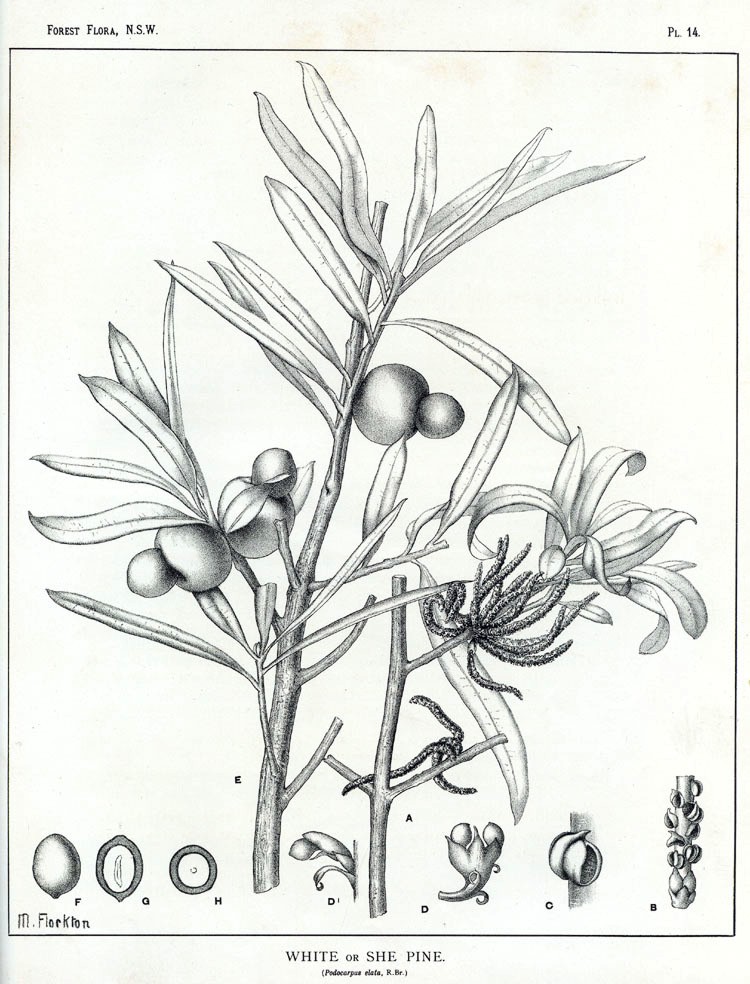
- Tree to 30 m high. Bark thin, brown, finely fibrous. Resting leaf buds small, conical, 1.5–2.5 mm long, 1.5–2 times longer than broad; scales triangular, acute, not involute; appressed with tips spreading or recurved. Adult leaves shortly petiolate, linear-lanceolate, 5–15 cm long, 7.5–16 mm wide, acute or obtuse, glossy dark green; midrib broad, slightly prominent above, narrow below; 3 resin ducts present below vascular bundle; upper hypodermis continuous. Male cones cylindrical, 30–50 mm long, 4–5 mm diam., sessile, axillary in groups of 2–4; microsporophylls imbricate, broadly triangular, shortly apiculate. Female cones of 1 fertile scale with 1 (or 2) ovules, axillary on thick peduncles 3–10 mm long; receptacle 15–25 mm long, fleshy, black or purple at maturity, pruinose, with 2 deciduous, subtending bracts. Mature seed 14–22 mm long, 12–15 mm diam.
- Other botanical names
- Not recorded
- Attracts birds and bugs
- Seeds dispersed by birds (figbirds, currawongs); wind pollinated.
- Flora of Australia profile
- https://profiles.ala.org.au/opus/foa/profile/Podocarpus%20elatus Open source ↗
- Fruit type and description
- Edible purple fleshy seed stalk with an attached hard seed; seed is not the food part.
- Flora of Australia citation
- K.D. Hill. Podocarpus elatus. Flora of Australia, Australian Biological Resources Study, Department of Climate Change, Energy, the Environment and Water, Canberra. https://profiles.ala.org.au/opus/foa/profile/Podocarpus%20elatus (accessed 2026-10-14). Copyright Commonwealth of Australia; CC BY 4.0 (https://creativecommons.org/licenses/by/4.0/). HTML formatting removed; species-level context added where noted. Open source ↗ Open source 2 ↗
- Flora of Australia retrieved
- 14/10/2026