CAT-00057
Quandong
Santalum acuminatum
Catalog fields
- Genus
- Santalum
- Photo
- Not recorded
- Edible
- Yes
- layout
- full
- Habitat
- Grows in many habitats including coastal dunes, gravelly plains, granitic outcrops and creek banks. Largely dispersed by emu that eat the fruit (Rippey & Rowland 1995: 213).
- Published
- Yes
- Food group
- Fruit
- Latin name
- Santalum acuminatum
- Fruit photo
- Not recorded
- Plant title
- Quandong
- Source URLs
- https://profiles.ala.org.au/opus/foa/profile/Santalum%20acuminatum | https://www.daleysfruit.com.au/bushfoodintro.htm; https://plantnet.rbgsyd.nsw.gov.au/cgi-bin/NSWfl.pl?lvl=sp&name=Santalum~acuminatum&page=nswfl Open source ↗ Open source 2 ↗ Open source 3 ↗
- Catalogue ID
- CAT-00057
- Mature width
- Not confirmed; allow spread appropriate to growth habit
- Native range
- Widespread though often intermittent in southern Australia except wetter regions, extending into southern N.T. and Qld.
- Plant family
- Santalaceae
- Supplier SKU
- Not recorded
- Listing group
- Common bush-food crop
- Mature height
- Up to 6 m
- Native states
- NSW, NT, QLD, SA, WA
- Original list
- No
- Research date
- 10/10/2026
- Research notes
- Source is a nursery catalogue overview; detailed species verification remains. Profile enriched from botanical/nursery sources. Dimensions are unpruned regional estimates where available; missing measurements remain explicit. Seasons are regional guides and vary with climate, location, cultivar and plant maturity. Drought and cultivation guidance are qualitative garden inferences, not measured ratings.
- Evidence status
- Nursery food-use listing; species detail review pending
- Fruiting season
- Species-specific ripening period not yet confirmed.
- Background photo
- Not recorded
- Edible component
- Red fruit flesh
- Flowering season
- Can flower throughout the year.
- Brief description
- Small root-hemiparasitic tree with sparse pale foliage.
- Drought tolerance
- High with suitable hosts.
- Preparation notes
- Confirm species identification, the specified edible part, ripeness and species-specific preparation before use.
- Flower description
- Very small flowers in numerous terminal branching clusters.
- General cultivation
- General guidance (qualitative): Specialist trial requiring host plants and excellent drainage; humidity and wet roots are concerns.
- Botanical description
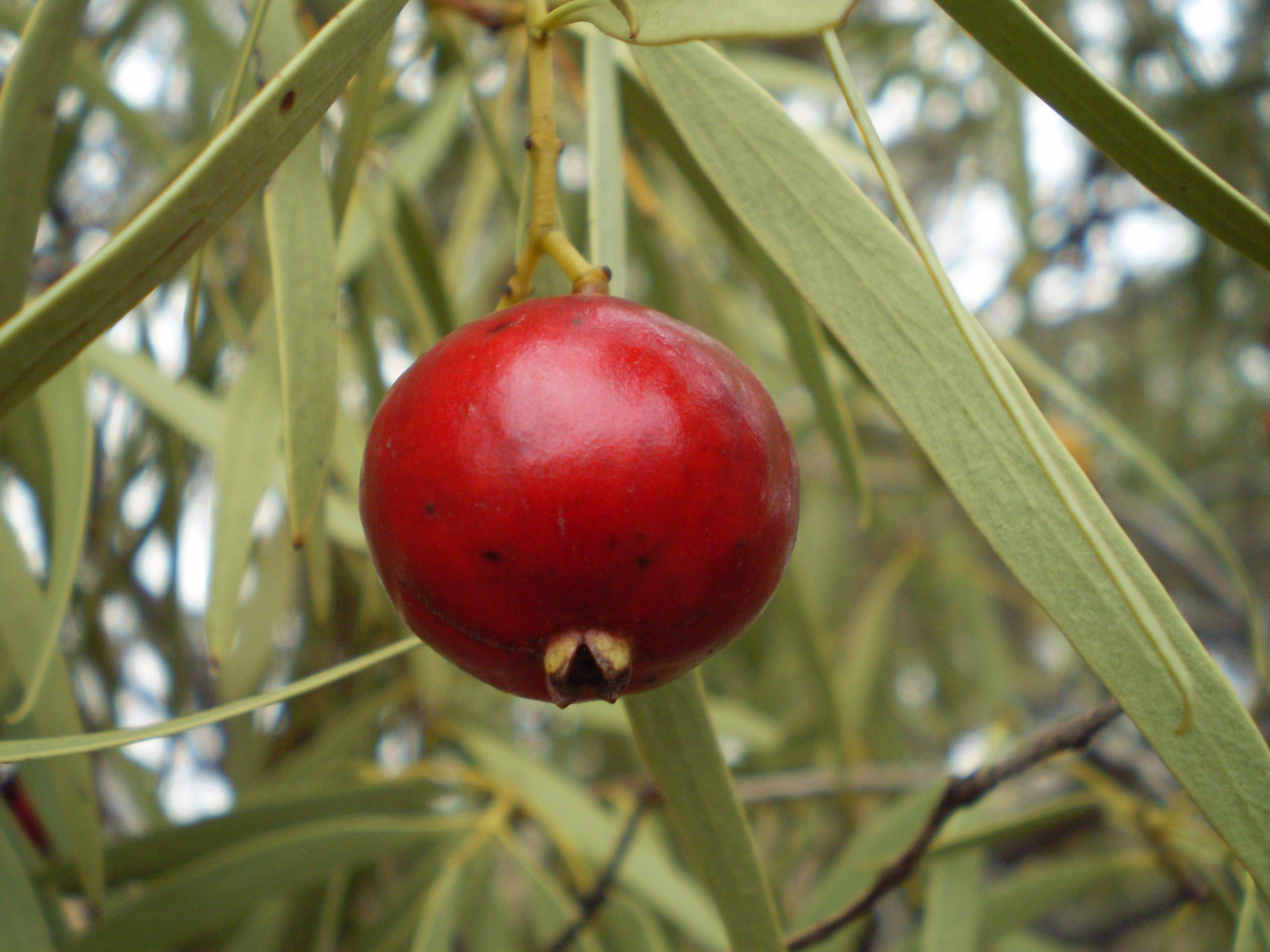
- Shrub or small tree to 6 m, sometimes forming clones by means of underground stolons. Bark rough, dark grey. Branchlets spreading to pendulous. Leaves lanceolate, often falcate, flat, acute; lamina 3–9 cm long, 3–15 mm wide, concolorous, yellowish-green; petiole 3–8 mm long. Flowers numerous in panicles; peduncle 5–10 mm long; pedicels 1–2 mm long. Receptacle 1 mm long. Tepals ovate-triangular, 1–2 mm long, scurfy inside, green or orange, persistent in fruit. Disc shortly lobed. Style c. 0.5 mm long; stigma bilobed. Drupe 15–25 mm diam.; epicarp bright shining red, rarely yellow; mesocarp firm, easily freed from endocarp when ripe; endocarp rugose.
- Other botanical names
- Not recorded
- Attracts birds and bugs
- Native bees and insects visit flowers; canopy shelters birds.
- Flora of Australia profile
- https://profiles.ala.org.au/opus/foa/profile/Santalum%20acuminatum Open source ↗
- Fruit type and description
- Red drupe with tangy flesh around a large deeply pitted stone.
- Flora of Australia citation
- A.S. George. Santalum acuminatum. Flora of Australia, Australian Biological Resources Study, Department of Climate Change, Energy, the Environment and Water, Canberra. https://profiles.ala.org.au/opus/foa/profile/Santalum%20acuminatum (accessed 2026-10-14). Copyright Commonwealth of Australia; CC BY 4.0 (https://creativecommons.org/licenses/by/4.0/). HTML formatting removed; species-level context added where noted. Open source ↗ Open source 2 ↗
- Flora of Australia retrieved
- 14/10/2026