CAT-00085
Chocolate lily
Arthropodium strictum
Catalog fields
- Genus
- Arthropodium
- Photo
- Not recorded
- Edible
- Yes
- layout
- single
- Habitat
- Grows on rocky hillsides, in open woodland, banksia scrub, sandy heathland, limestone, sandstone and on red sand dunes.
- Published
- Yes
- Food group
- Root / tuber
- Latin name
- Arthropodium strictum
- Fruit photo
- Not recorded
- Plant title
- Chocolate lily
- Source URLs
- https://profiles.ala.org.au/opus/foa/profile/Arthropodium%20strictum | https://tuckerbush.com.au/plants/vegetable-plants/; https://tuckerbush.com.au/chocolate-lily-arthropodium-strictum/; https://vicflora.rbg.vic.gov.au/flora/taxon/994436f9-653f-4531-a0cb-81a13e86e52a Open source ↗ Open source 2 ↗ Open source 3 ↗ Open source 4 ↗
- Catalogue ID
- CAT-00085
- Mature width
- 0.3m
- Native range
- Occurs in southwestern Northern Territory, northwestern and southeastern South Australia, eastern Queensland, Great Dividing Ra. and isolated western localities in New South Wales, south-central Victoria, and Tasmania; ?also in New Guinea.
- Plant family
- Asparagaceae
- Supplier SKU
- Not recorded
- Listing group
- Nursery-listed / regional edible
- Mature height
- 0.5m
- Native states
- NSW, SA, TAS, VIC
- Original list
- No
- Research date
- 10/10/2026
- Research notes
- Profile enriched from botanical/nursery sources. Dimensions are unpruned regional estimates where available; missing measurements remain explicit. Seasons are regional guides and vary with climate, location, cultivar and plant maturity. Drought and cultivation guidance are qualitative garden inferences, not measured ratings. Native states follow botanical flora; nursery descriptions include additional states not confirmed by VicFlora/Kew.
- Evidence status
- Nursery food-use source; preparation detail review pending
- Fruiting season
- Capsules after flowering.
- Background photo
- Not recorded
- Edible component
- Cooked tuberous roots
- Flowering season
- September-December regional guide.
- Brief description
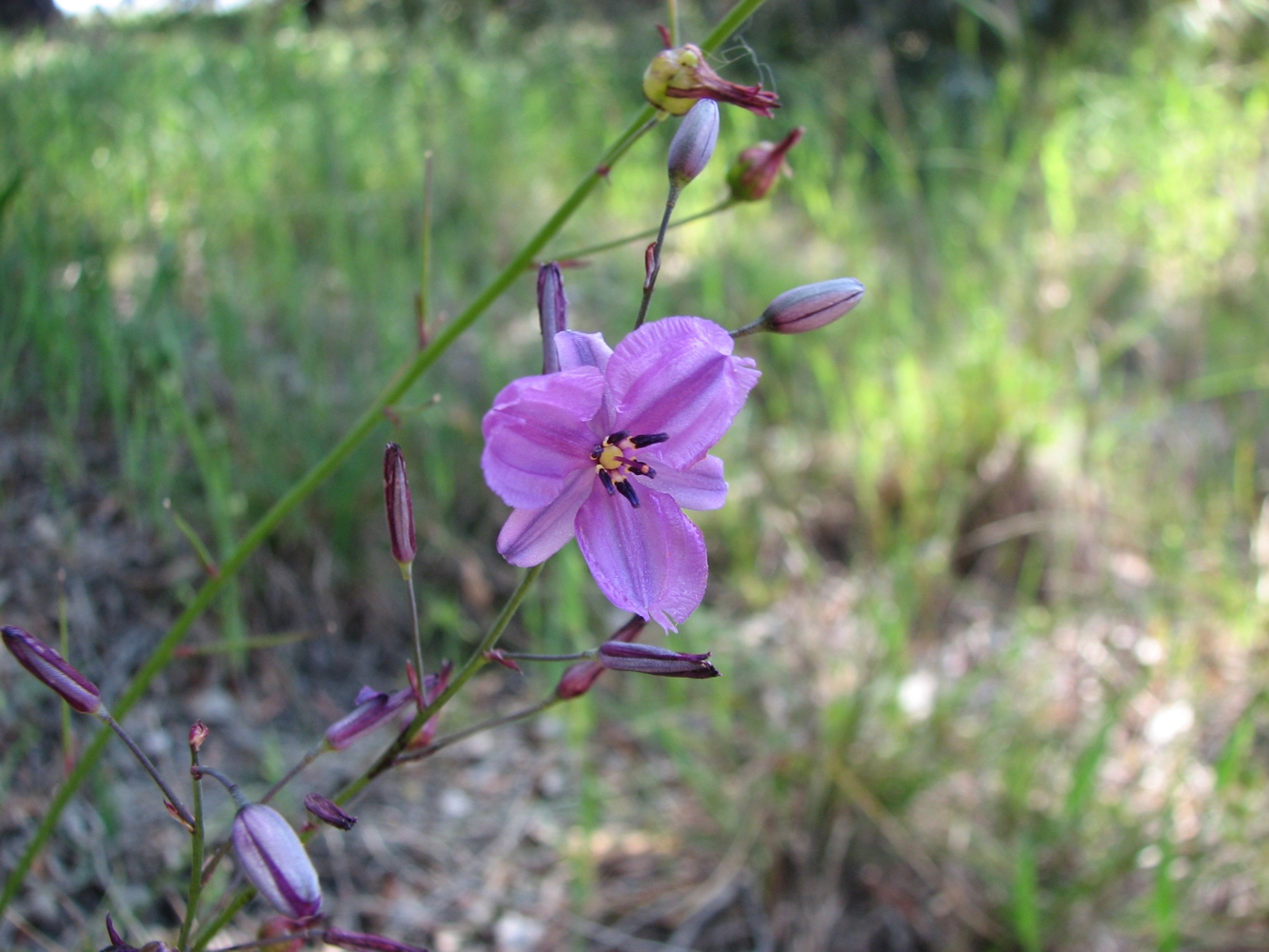
- Tufted perennial with chocolate-scented blue-violet flowers and small tubers.
- Drought tolerance
- Moderate to high; can become summer dormant.
- Preparation notes
- Use correctly identified young tubers, commonly cooked; nursery also records raw use. Tubers can become bitter with age.
- Flower description
- Blue-violet flowers with a chocolate-like scent, carried on slender stems.
- General cultivation
- General guidance (qualitative): Promising seasonal perennial in drainage; avoid excess watering when dormant.
- Botanical description
- Tubers c. 15 mm long, c. 9 mm wide, 3–5 cm from rootstock. Leaves 2–12, 9–65 cm long, 1–10 mm wide, surrounded by leaf fibres. Inflorescence racemose, 25–100 cm long; sterile bracts absent or lanceolate, 5.5–14 mm long. Flowers 1 per node; pedicels 13–37 mm long, erect, articulated to 2 mm from flower; bracts usually 6–15 mm long. Perianth segments 6–14 mm long. Sepals broadly linear, 2–4 mm wide. Petals elliptic, 4–8 mm wide. Anthers 3–4.5 mm long, usually purple; appendages 2, 0.5–1.5 mm long, usually yellow; filaments 1.7–3 mm long, straight. Ovary 1–1.5 mm diam.; style 3.5–6 mm long. Capsule ± spherical, 4–7 mm diam., initially enclosed by perianth. Seeds tetrahedral, c. 2 mm diam.
- Other botanical names
- Not recorded
- Attracts birds and bugs
- Native bees and insects visit flowers; canopy shelters birds.
- Flora of Australia profile
- https://profiles.ala.org.au/opus/foa/profile/Arthropodium%20strictum Open source ↗
- Fruit type and description
- Dry capsules; tuberous roots are the main food component.
- Flora of Australia citation
- N.H. Brittan, P.G. Kodela. Arthropodium strictum. Flora of Australia, Australian Biological Resources Study, Department of Climate Change, Energy, the Environment and Water, Canberra. https://profiles.ala.org.au/opus/foa/profile/Arthropodium%20strictum (accessed 2026-10-14). Copyright Commonwealth of Australia; CC BY 4.0 (https://creativecommons.org/licenses/by/4.0/). HTML formatting removed; species-level context added where noted. Open source ↗ Open source 2 ↗
- Flora of Australia retrieved
- 14/10/2026