CAT-00086
Vanilla lily
Arthropodium milleflorum
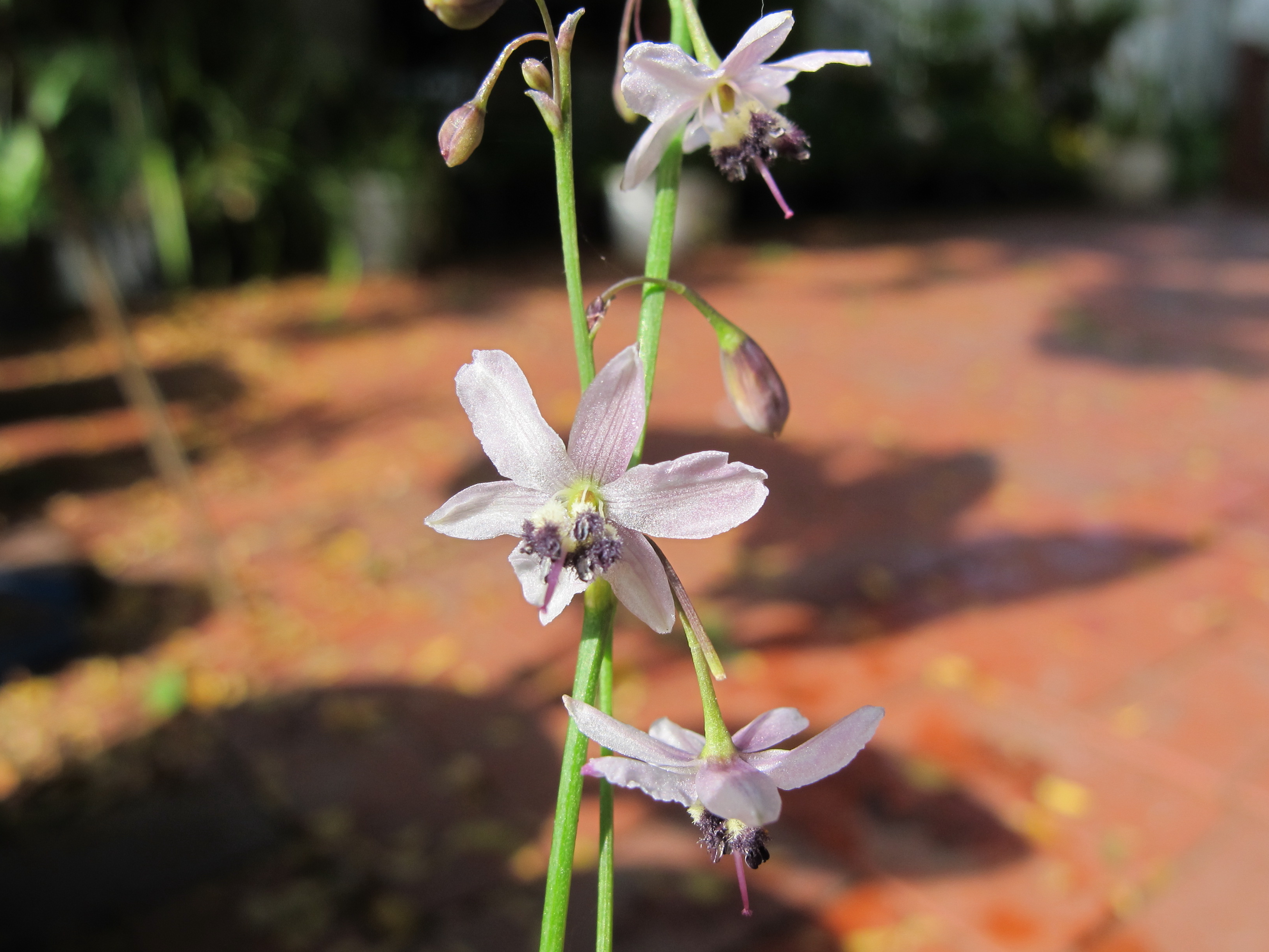
Catalog fields
- Genus
- Arthropodium
- Photo
- Not recorded
- Edible
- Yes
- layout
- single
- Habitat
- Grows in a diversity of habitats.
- Published
- Yes
- Food group
- Root / tuber
- Latin name
- Arthropodium milleflorum
- Fruit photo
- Not recorded
- Plant title
- Vanilla lily
- Source URLs
- https://profiles.ala.org.au/opus/foa/profile/Arthropodium%20milleflorum | https://tuckerbush.com.au/plants/vegetable-plants/; https://tuckerbush.com.au/vanilla-lily-arthropodium-milleflorum/; https://powo.science.kew.org/taxon/530910-1 Open source ↗ Open source 2 ↗ Open source 3 ↗ Open source 4 ↗
- Catalogue ID
- CAT-00086
- Mature width
- 0.3m
- Native range
- Occurs in southeastern South Australia, southeastern Queensland, in eastern New South Wales, the Australian Capital Territory, southern and southeastern Victoria and Tasmania.
- Plant family
- Asparagaceae
- Supplier SKU
- Not recorded
- Listing group
- Nursery-listed / regional edible
- Mature height
- 1m
- Native states
- NSW, QLD, SA, TAS, VIC
- Original list
- No
- Research date
- 10/10/2026
- Research notes
- Profile enriched from botanical/nursery sources. Dimensions are unpruned regional estimates where available; missing measurements remain explicit. Seasons are regional guides and vary with climate, location, cultivar and plant maturity. Drought and cultivation guidance are qualitative garden inferences, not measured ratings.
- Evidence status
- Nursery food-use source; preparation detail review pending
- Fruiting season
- Capsules follow flowering.
- Background photo
- Not recorded
- Edible component
- Cooked tuberous roots
- Flowering season
- September-December regional guide.
- Brief description
- Tufted perennial with vanilla-scented white to pink flowers.
- Drought tolerance
- Moderate; seasonal dormancy helps survival.
- Preparation notes
- Use correctly identified tubers, commonly cooked; older tubers may be bitter.
- Flower description
- White to pale-pink or mauve flowers with a vanilla-like scent.
- General cultivation
- General guidance (qualitative): Promising with well-drained soil and watering during active growth.
- Botanical description
- Tubers ellipsoidal, 2–3 cm long, 3–5 mm wide, 2–8 cm from root stock. Leaves 1–17, 3–60 cm long, 1–17 mm wide, ± erect, persistent or withering early. Scape usually simple to 4-branched, 24–117 cm long; sterile bracts to 14 cm long. Flowers usually 2–9 per node; pedicels erect to spreading, 5–15 mm long, articulated 1.5–6 mm from base; bracts ± scarious, 1.5–8 mm long. Perianth segments 4–9 mm long, white to pale blue. Sepals linear, 1.3–3.5 mm wide. Petals elliptic, 2.5–6 mm wide. Anthers 1–2 mm long, occasionally recurved after shedding pollen; filaments 2–4.5 mm long, densely covered with erect hairs for 1–3 mm from anther. Ovary ± spherical, 0.8–1.5 mm diam.; style 3.5–6 mm long. Capsule 4–5 mm diam.; perianth persistent, later deciduous. [This description from the Arthropodium treatment in the Flora of Australia Volume 45 (Brittan 1987) requires revision as it includes A. pendulum which was treated as a synonym of A. in the Flora but now considered an accepted species following the Australian Plant Census (accessed 31 May 2022) - Editor.]
- Other botanical names
- Not recorded
- Attracts birds and bugs
- Native bees and insects visit flowers; canopy shelters birds.
- Flora of Australia profile
- https://profiles.ala.org.au/opus/foa/profile/Arthropodium%20milleflorum Open source ↗
- Fruit type and description
- Dry capsules; tuberous roots are the food component.
- Flora of Australia citation
- N.H. Brittan, P.G. Kodela. Arthropodium milleflorum. Flora of Australia, Australian Biological Resources Study, Department of Climate Change, Energy, the Environment and Water, Canberra. https://profiles.ala.org.au/opus/foa/profile/Arthropodium%20milleflorum (accessed 2026-10-14). Copyright Commonwealth of Australia; CC BY 4.0 (https://creativecommons.org/licenses/by/4.0/). HTML formatting removed; species-level context added where noted. Open source ↗ Open source 2 ↗
- Flora of Australia retrieved
- 14/10/2026