CAT-00087
Warrine / warran yam
Dioscorea hastifolia
Catalog fields
- Genus
- Dioscorea
- Photo
- Not recorded
- Edible
- Yes
- layout
- single
- Habitat
- Grows in granitic and basaltic soil in open forest, woodland and shrub communities.
- Published
- Yes
- Food group
- Root / tuber
- Latin name
- Dioscorea hastifolia
- Fruit photo
- Not recorded
- Plant title
- Warrine / warran yam
- Source URLs
- https://profiles.ala.org.au/opus/foa/profile/Dioscorea%20hastifolia | https://tuckerbush.com.au/plants/vegetable-plants/; https://tuckerbush.com.au/warrine-dioscorea-hastifolia/ Open source ↗ Open source 2 ↗ Open source 3 ↗
- Catalogue ID
- CAT-00087
- Mature width
- 0.4m
- Native range
- Occurs in near-coastal southwestern Western Australia from the Murchison River to the Darling Ra., S of Perth.
- Plant family
- Dioscoreaceae
- Supplier SKU
- Not recorded
- Listing group
- Nursery-listed / regional edible
- Mature height
- 0.4-1.5m
- Native states
- WA
- Original list
- No
- Research date
- 10/10/2026
- Research notes
- Profile enriched from botanical/nursery sources. Dimensions are unpruned regional estimates where available; missing measurements remain explicit. Seasons are regional guides and vary with climate, location, cultivar and plant maturity. Drought and cultivation guidance are qualitative garden inferences, not measured ratings.
- Evidence status
- Nursery food-use source; preparation detail review pending
- Fruiting season
- Capsules around October in WA guidance.
- Background photo
- Not recorded
- Edible component
- Cooked tuber
- Flowering season
- May-July in WA nursery guidance.
- Brief description
- Twining perennial yam with underground tubers.
- Drought tolerance
- Seasonally drought adapted.
- Preparation notes
- Use correctly identified tuber with verified yam preparation; do not generalise to other Dioscorea species.
- Flower description
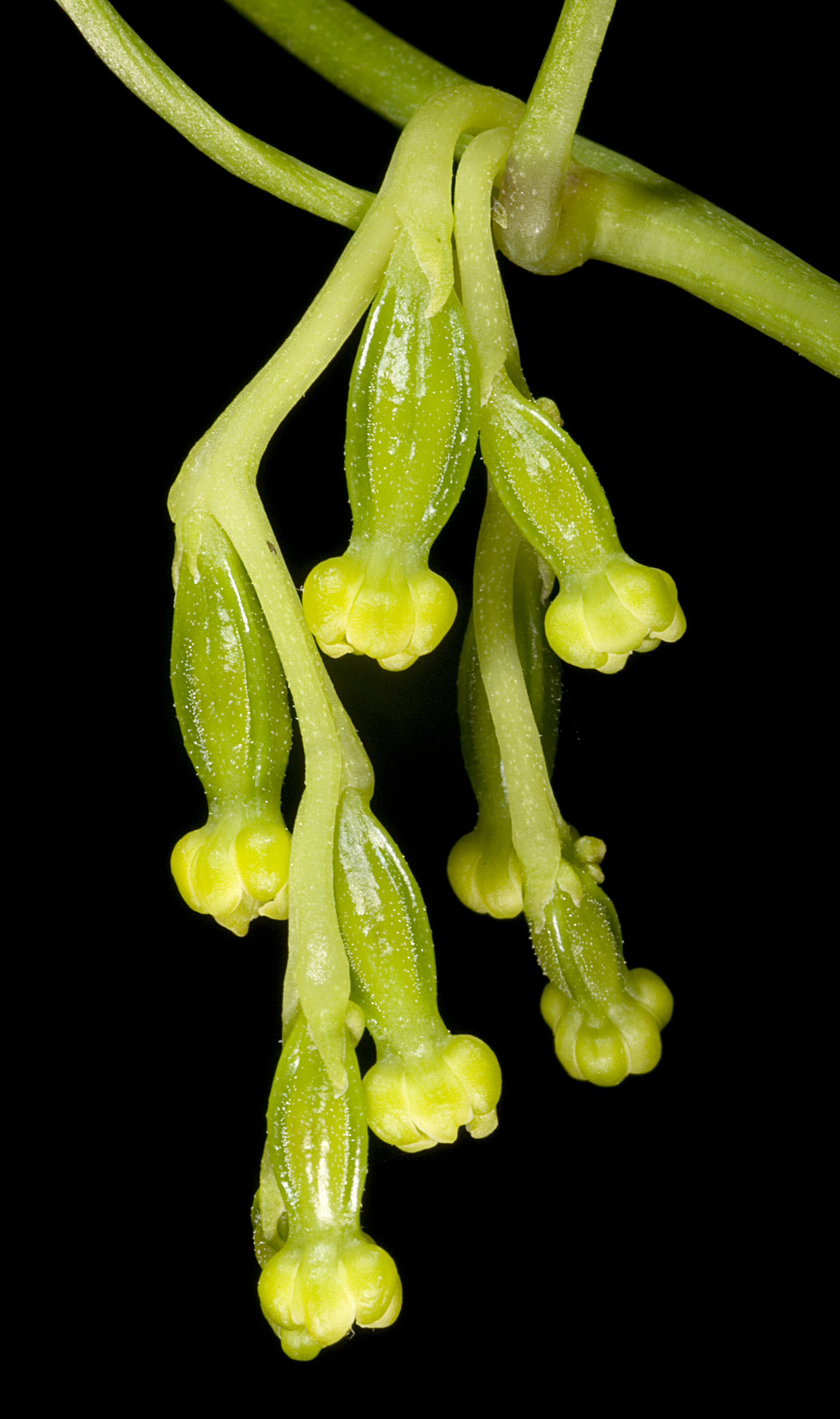
- Small yellow flowers.
- General cultivation
- General guidance (qualitative): Specialist winter-growing trial; avoid wet dormant tubers and provide a climbing support.
- Botanical description
- Tuber cylindroidal, 10–25 cm long, to 1.5 cm diam., sometimes branched. Stems twining, to 2 m long, terete, glabrous. Bulbils absent. Leaves: lamina linear to narrowly triangular, 15–90 mm long, 1.5–20 mm wide, usually hastate or rounded at base (rarely truncate or cuneate), acute at apex, 1–5-veined, glabrous; petiole 1–4 mm long. Male flowers: spikes 1–3 per axil, to 10 cm long, sometimes branched; sepals and petals ovate, 1–2 mm long, yellow; stamens 6. Female flowers: racemes 1 or 2 per axil, to 9 cm long; perianth slightly smaller than male; staminodes 6. Capsule suborbicular to broadly ovate in lateral view, truncate or rounded at apex, rarely obcordate, 12–23 mm long; lobes 7–12 mm wide. Seeds 3.5–4 mm long; wing 1–3 mm wide.
- Other botanical names
- Not recorded
- Attracts birds and bugs
- Native bees and insects visit flowers; canopy shelters birds.
- Flora of Australia profile
- https://profiles.ala.org.au/opus/foa/profile/Dioscorea%20hastifolia Open source ↗
- Fruit type and description
- Dry winged seed capsules; tuber is the food component.
- Flora of Australia citation
- I.R.H. Telford. Dioscorea hastifolia. Flora of Australia, Australian Biological Resources Study, Department of Climate Change, Energy, the Environment and Water, Canberra. https://profiles.ala.org.au/opus/foa/profile/Dioscorea%20hastifolia (accessed 2026-10-14). Copyright Commonwealth of Australia; CC BY 4.0 (https://creativecommons.org/licenses/by/4.0/). HTML formatting removed; species-level context added where noted. Open source ↗ Open source 2 ↗
- Flora of Australia retrieved
- 14/10/2026