CAT-00089
Red-eyed wattle
Acacia cyclops
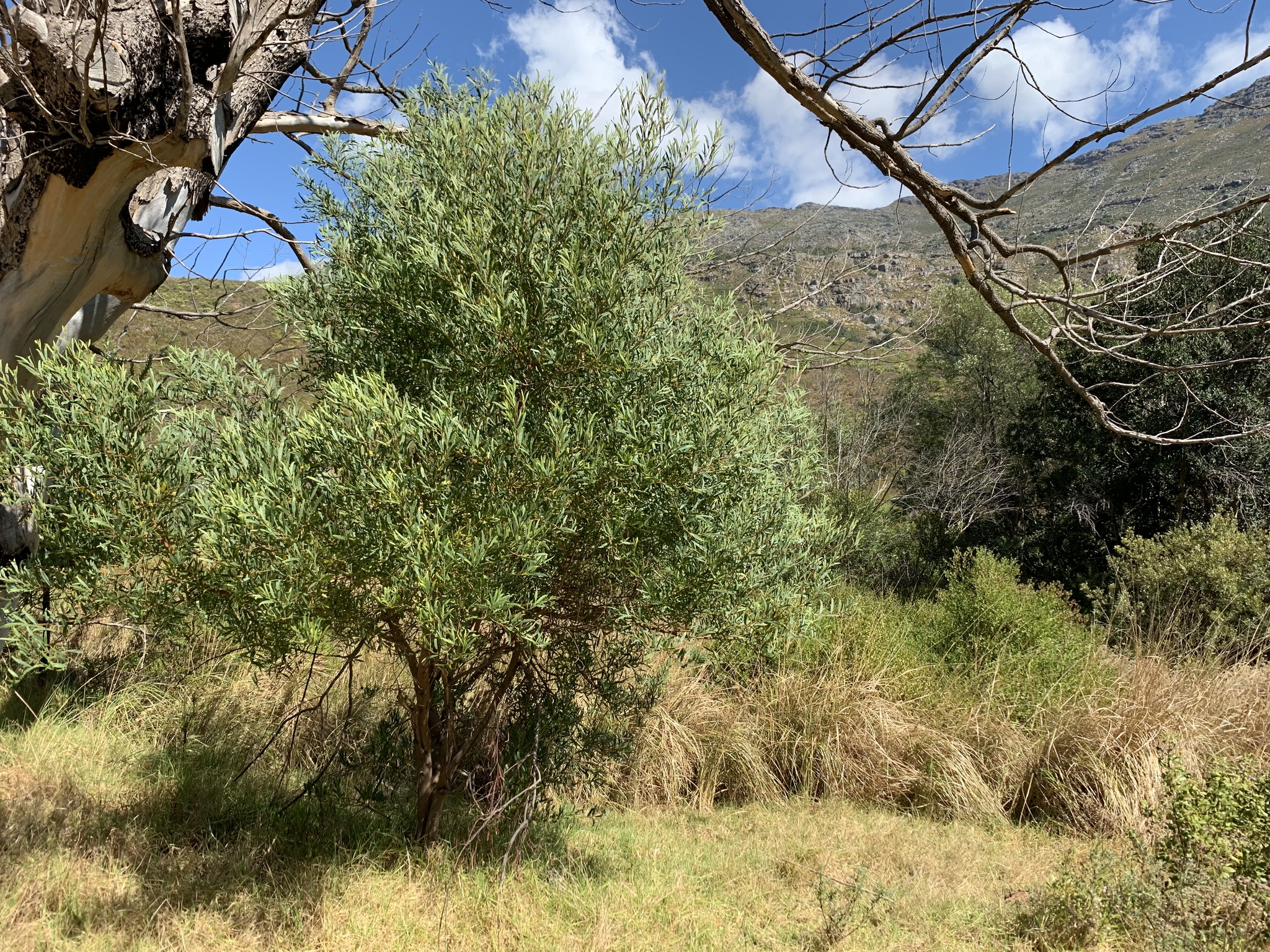
Catalog fields
- Genus
- Acacia
- Photo
- photos/CAT-00089-A.jpg
- Edible
- Yes
- layout
- single
- Habitat
- Grows mainly in coastal heath or scrubland in loam or sand (often over limestone). Acacia cyclops is as drought-tolerant as A. saligna, and is more tolerant to sea spray. It is tolerant of highly saline soils, fide N. Marcar et al., Trees for Saltland 30 (1995). Further information on the biological and ecological features of this species is given in B.R. Maslin & M.W. McDonald, AcaciaSearch: Evaluation of Acacia as a woody crop option for southern Australia, RIRDC Publication No. 30/017, 54–58 (2004). Like Acacia saligna, this species is a major environmental weed in South Africa, fide C.H. Stirton, Plant Invaders 40–43 (1978). Acacia cyclops is also a potential weed in parts of Australia (Reid & Murphy 2008, Messina 2016, Richardson et al. 2016), it has invaded areas outside its natural range after being planted on roadsides and in gardens.
- Published
- Yes
- Food group
- Nut / seed
- Latin name
- Acacia cyclops
- Fruit photo
- photos/CAT-00089-F.jpg
- Plant title
- Red-eyed wattle
- Source URLs
- https://profiles.ala.org.au/opus/foa/profile/Acacia%20cyclops | https://tuckerbush.com.au/red-eyed-wattle-acacia-cyclops/ Open source ↗ Open source 2 ↗
- Catalogue ID
- CAT-00089
- Mature width
- 3m
- Native range
- Widespread and seemingly discontinuous in coastal and near-coastal areas mainly between Denmark and Israelite Bay in southwestern Western Australia, ranging N to Leeman in Western Australia and E to near Yorketown and Yorke Peninsula in South Australia. A few collections E of Yorke Peninsula and on Kangaroo Island, South Australia, are doubtfully native. Acacia cyclops is occasionally naturalised in parts of South Australia and it is incipiently adventive in SE Victoria, and the distribution map reflects this.
- Plant family
- Fabaceae
- Supplier SKU
- Not recorded
- Listing group
- Nursery-listed / regional edible
- Mature height
- 3m
- Native states
- SA, WA
- Original list
- No
- Research date
- 10/10/2026
- Research notes
- Profile enriched from botanical/nursery sources. Dimensions are unpruned regional estimates where available; missing measurements remain explicit. Seasons are regional guides and vary with climate, location, cultivar and plant maturity. Drought and cultivation guidance are qualitative garden inferences, not measured ratings.
- Evidence status
- Nursery food-use source; preparation detail review pending
- Fruiting season
- October-January pods
- Background photo
- photos/CAT-00089-B.jpg
- Edible component
- Processed mature seeds
- Flowering season
- Summer peak; intermittent flowering possible.
- Brief description
- Dense coastal wattle with bright seed arils.
- Drought tolerance
- High once established.
- Preparation notes
- Species-specific edible seed use; mature seeds generally processed/roasted. Do not generalise to other wattles.
- Flower description
- Golden-yellow flowers in rounded heads.
- General cultivation
- General guidance (qualitative): Trial sunny drainage; confirm seed processing and manage self-seeding.
- Botanical description
- Shrub to small tree 1–6 m high. Branchlets ±compressed apically, glabrous. Phyllodes ascending, narrowly oblong to elliptic or obovate, ±inequilateral, slightly recurved, 4–9.5 (–11) cm long, (4–) 6–15 (–22) mm wide, obtuse or acute, apiculate, coriaceous, glabrous, with 3 or 4 distant main veins occasionally anatomosing with secondary veins. Inflorescences 2-headed racemes; raceme axes 3–20 mm long, somewhat compressed, glabrous or appressed-puberulous; peduncles mostly 4–12 (–19) mm long, glabrous; heads globular, 5–7 mm diam., often 60–75-flowered, golden. Flowers 5-merous; sepals ½–¾-united. Pods linear, slightly raised over seeds, arcuate before dehiscence, to 15 cm long, 7–16 mm wide, thickly coriaceous, glabrous, persistent after seed-fall. Seeds longitudinal, elliptic, 5–7 mm long, dark brown to black, glossy; funicle enlarged, encircling seed in two folds, orange to scarlet.
- Other botanical names
- Not recorded
- Attracts birds and bugs
- Native bees and insects visit flowers; canopy shelters birds.
- Flora of Australia profile
- https://profiles.ala.org.au/opus/foa/profile/Acacia%20cyclops Open source ↗
- Fruit type and description
- Dry pods with black seeds surrounded by conspicuous red arils.
- Flora of Australia citation
- R.S. Cowan & B.R. Maslin. Acacia cyclops. Flora of Australia, Australian Biological Resources Study, Department of Climate Change, Energy, the Environment and Water, Canberra. https://profiles.ala.org.au/opus/foa/profile/Acacia%20cyclops (accessed 2026-10-14). Copyright Commonwealth of Australia; CC BY 4.0 (https://creativecommons.org/licenses/by/4.0/). HTML formatting removed; species-level context added where noted. Open source ↗ Open source 2 ↗
- Flora of Australia retrieved
- 14/10/2026