CAT-00090
Coastal pigface
Carpobrotus glaucescens
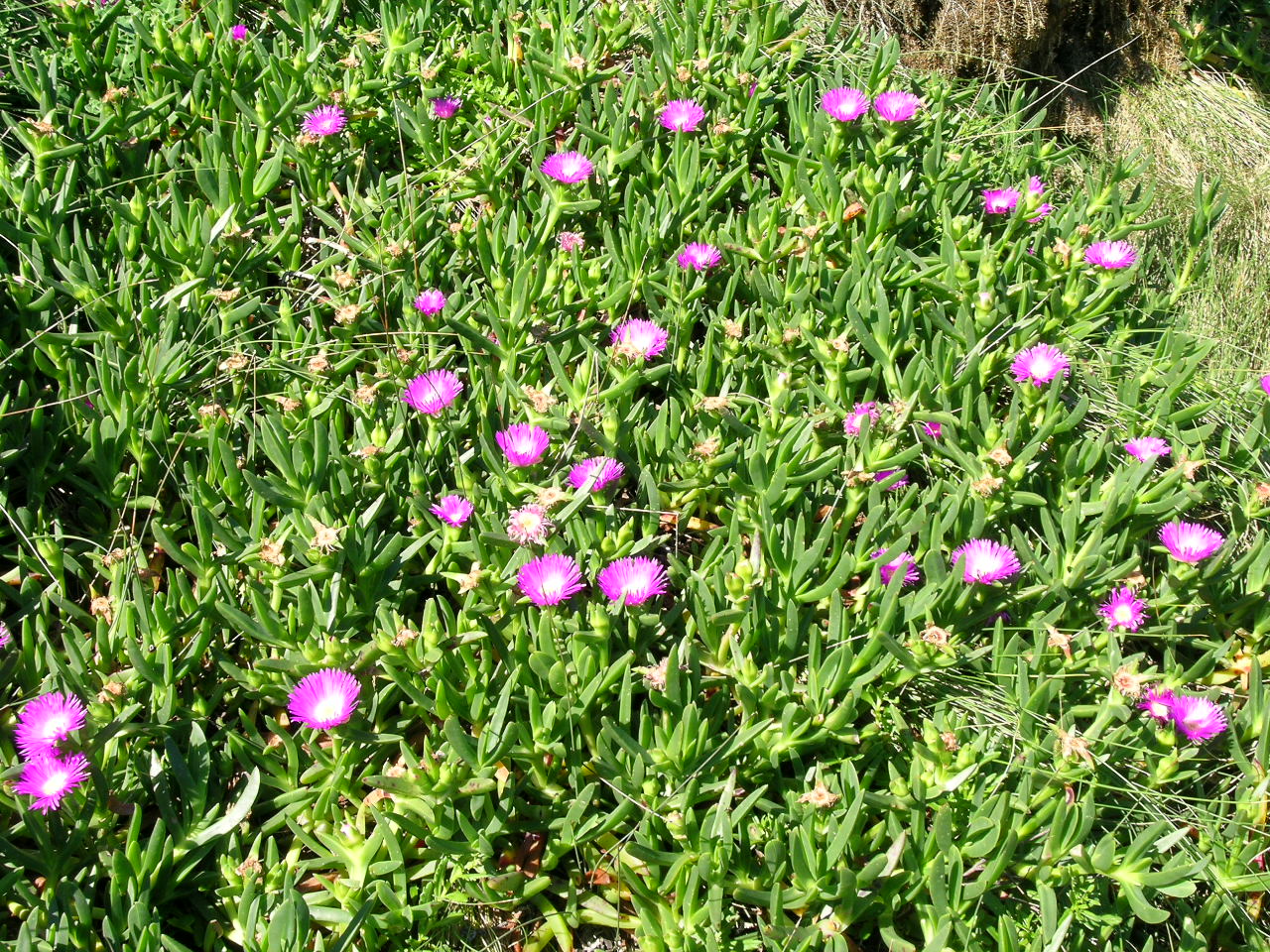
Catalog fields
- Genus
- Carpobrotus
- Photo
- photos/CAT-00090-A.jpg
- Edible
- Yes
- layout
- full
- Habitat
- Grows in sandy and rocky situations. Contributes to stabilising beach foredunes and other sandy sites. Growing in coastal areas the plant is salt tolerant, able to withstand salt spray, strong winds and sand blasting.
- Published
- Yes
- Food group
- Fruit
- Latin name
- Carpobrotus glaucescens
- Fruit photo
- photos/crops/CAT-00090-F-009058433a283fce5aaee961.png
- Plant title
- Coastal pigface
- Source URLs
- https://profiles.ala.org.au/opus/foa/profile/Carpobrotus%20glaucescens | https://www.anbg.gov.au/gardens/visiting/exploring/aboriginal-trail/; https://plantnet.rbgsyd.nsw.gov.au/cgi-bin/NSWfl.pl?lvl=sp&name=Carpobrotus~glaucescens&page=nswfl Open source ↗ Open source 2 ↗ Open source 3 ↗
- Catalogue ID
- CAT-00090
- Mature width
- Spreading stems to 2 m
- Native range
- Found along the coast of eastern Australia; also on Lord Howe and Norfolk Islands.
- Plant family
- Aizoaceae
- Supplier SKU
- Not recorded
- Listing group
- Regional / traditional food plant
- Mature height
- Prostrate; stems to 2 m
- Native states
- NSW, QLD, VIC
- Original list
- No
- Research date
- 10/10/2026
- Research notes
- Profile enriched from botanical/nursery sources. Dimensions are unpruned regional estimates where available; missing measurements remain explicit. Seasons are regional guides and vary with climate, location, cultivar and plant maturity. Drought and cultivation guidance are qualitative garden inferences, not measured ratings.
- Evidence status
- Published food use; preparation detail review pending
- Fruiting season
- After flowers
- Background photo
- Not recorded
- Edible component
- Ripe fruit pulp
- Flowering season
- Species-specific flowering period not yet confirmed.
- Brief description
- Prostrate succulent with long stems and showy purple flowers.
- Drought tolerance
- High once established.
- Preparation notes
- Confirm species identification, the specified edible part, ripeness and species-specific preparation before use.
- Flower description
- Large pink-purple flowers with numerous narrow rays.
- General cultivation
- General guidance (qualitative): Promising sunny groundcover with excellent drainage.
- Botanical description
- Stems prostrate, to 2 m long. Leaves 35–100 mm long, 9–15 mm wide, equilateral near middle, somewhat glaucous; adaxial and lateral surfaces flat, convex towards base; keel crenulate in upper portion, smooth below. Flowers 4–6 cm diam.; pedicels 20–30 mm long. Petal-like staminodes purple, white at base, streaked only near midline when dry; stamens 300–400, 5–6-seriate. Styles 7–10, free; ovary conical or oblong, compressed, 2-ribbed, concave on top. (Venning 1984: 26) Stems prostrate, to 2 m long. Leaves 30–100 cm long, 8–15 mm wide, slightly glaucous; adaxial and lateral faces flat, becoming convex towards base; keel crenulate in upper part, smooth below. Flowers 4–6 cm diam.; pedicels 10–30 mm long. Petals magenta, white at base. Stamens 300–400, in 5 or 6 series. Styles 7–10. Fruit ellipsoidal, 20–30 mm long, reddish, tasting like salty strawberry jam. (Green 1994: 77) See also Ross (1983) for SE Qld, Jacobs & Highet (1990) for N.S.W., Walsh (1996) for Vic.
- Other botanical names
- Not recorded
- Attracts birds and bugs
- Native bees and insects visit flowers; canopy shelters birds.
- Flora of Australia profile
- https://profiles.ala.org.au/opus/foa/profile/Carpobrotus%20glaucescens Open source ↗
- Fruit type and description
- Red-purple fleshy fruit about 2-3 cm long with many seeds.
- Flora of Australia citation
- J. Venning, P.S. Green, P.G. Kodela. Carpobrotus glaucescens. Flora of Australia, Australian Biological Resources Study, Department of Climate Change, Energy, the Environment and Water, Canberra. https://profiles.ala.org.au/opus/foa/profile/Carpobrotus%20glaucescens (accessed 2026-10-14). Copyright Commonwealth of Australia; CC BY 4.0 (https://creativecommons.org/licenses/by/4.0/). HTML formatting removed; species-level context added where noted. Open source ↗ Open source 2 ↗
- Flora of Australia retrieved
- 14/10/2026