CAT-00109
Soapbush wattle
Acacia holosericea
Catalog fields
- Genus
- Acacia
- Photo
- Not recorded
- Edible
- Yes
- layout
- single
- Habitat
- Grows in sometimes gravelly sand or loam, commonly forming communities along watercourses. Fast-growing.
- Published
- Yes
- Food group
- Nut / seed
- Latin name
- Acacia holosericea
- Fruit photo
- Not recorded
- Plant title
- Soapbush wattle
- Source URLs
- https://profiles.ala.org.au/opus/foa/profile/Acacia%20holosericea | https://www.fao.org/4/V5360E/v5360e0b.htm; https://powo.science.kew.org/taxon/urn%3Alsid%3Aipni.org%3Anames%3A470538-1; https://apps.lucidcentral.org/wattle/text/entities/acacia_holosericea.htm Open source ↗ Open source 2 ↗ Open source 3 ↗ Open source 4 ↗
- Catalogue ID
- CAT-00109
- Mature width
- Not confirmed; allow spread appropriate to growth habit
- Native range
- Widespread in northern Australia extending from near Derby, Western Australia, E across the Northern Territory to near Rockhampton in eastern Queensland. Also found in scattered localities in arid regions at Hamersley Ra. National Park, Western Australia, through central Northern Territory and to SW of Blackall, Queensland.
- Plant family
- Fabaceae
- Supplier SKU
- Not recorded
- Listing group
- Regional / traditional food plant
- Mature height
- 3-9 m
- Native states
- NT, QLD, WA
- Original list
- No
- Research date
- 10/10/2026
- Research notes
- Profile enriched from botanical/nursery sources. Dimensions are unpruned regional estimates where available; missing measurements remain explicit. Seasons are regional guides and vary with climate, location, cultivar and plant maturity. Drought and cultivation guidance are qualitative garden inferences, not measured ratings.
- Evidence status
- Provisional seed-food entry; distinguish from Acacia colei and review food suitability
- Fruiting season
- Species-specific period not yet confirmed.
- Background photo
- Not recorded
- Edible component
- Processed mature seeds
- Flowering season
- Species-specific period not yet confirmed.
- Brief description
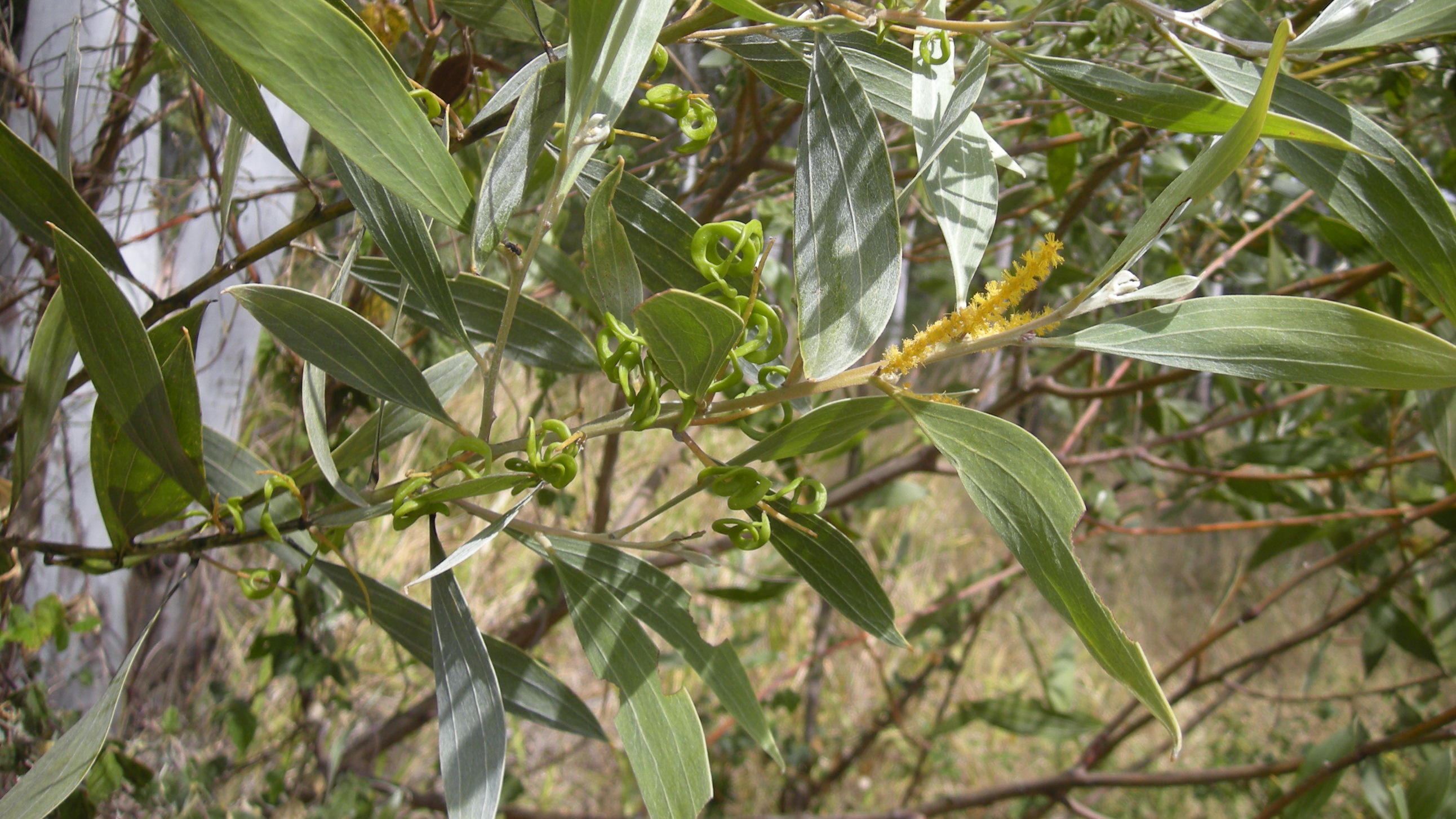
- Fast-growing silver-leaved wattle.
- Drought tolerance
- Moderate to high once established.
- Preparation notes
- WATTLE notes limited human-food potential compared with Acacia colei. Do not use as interchangeable wattleseed; retain for further species-specific review.
- Flower description
- Golden-yellow flowers in cylindrical spikes.
- General cultivation
- General guidance (qualitative): Warm-site trial; distinguish from Acacia colei and verify seed-use evidence.
- Botanical description
- Shrub or tree 3–8 m high. Branchlets acutely angled but normally ± terete by 20–30 cm below apex, usually sericeous, sometimes glabrous. Young shoots silvery sericeous, sometimes glabrous. Phyllodes obliquely narrowly elliptic, 10–20 cm long, normally 2–5 cm wide, with unequal base, usually sericeous; mucro 1–3 mm long; normally 3 prominent veins per face confluent and contiguous with abaxial margin at base; minor veins forming a somewhat open longitudinally orientated reticulum; glands basal and at base of mucro on at least some phyllodes. Inflorescences rudimentary racemes with axes to 0.5 mm long; peduncles 3–7 mm long, sericeous, sometimes glabrous; spikes normally 2–4 cm long, golden; bracteoles linear-spathulate, 1–1.5 mm long. Flowers 5-merous; sepals united. Pods tightly and often somewhat irregularly coiled, 2.5–4 mm wide, thinly crustaceous to coriaceous-crustaceous, ± glabrous, remaining as entangled clumps following dehiscence. Seeds longitudinal, oblong-elliptic, 3.5 mm long, dark brown, shiny; aril bright yellow.
- Other botanical names
- Not recorded
- Attracts birds and bugs
- Native bees and insects visit flowers; canopy shelters birds.
- Flora of Australia profile
- https://profiles.ala.org.au/opus/foa/profile/Acacia%20holosericea Open source ↗
- Fruit type and description
- Tightly coiled dry pods with seeds; food-use suitability needs closer review.
- Flora of Australia citation
- B.R. Maslin. Acacia holosericea. Flora of Australia, Australian Biological Resources Study, Department of Climate Change, Energy, the Environment and Water, Canberra. https://profiles.ala.org.au/opus/foa/profile/Acacia%20holosericea (accessed 2026-10-14). Copyright Commonwealth of Australia; CC BY 4.0 (https://creativecommons.org/licenses/by/4.0/). HTML formatting removed; species-level context added where noted. Open source ↗ Open source 2 ↗
- Flora of Australia retrieved
- 14/10/2026