CAT-00118
Bush banana
Leichhardtia australis
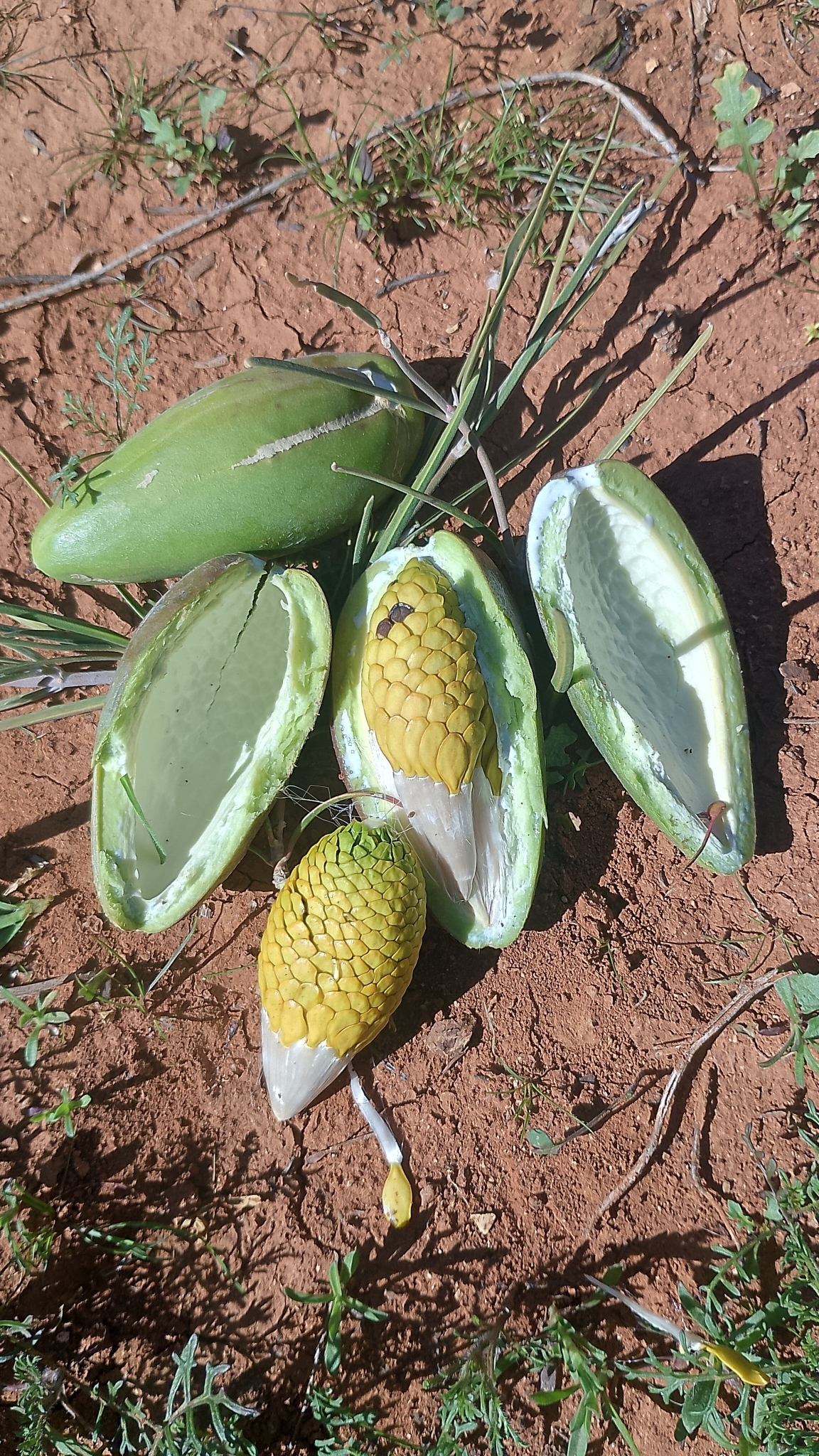
Catalog fields
- Genus
- Leichhardtia
- Photo
- Not recorded
- Edible
- Yes
- layout
- single
- Habitat
- Grows in inland areas in a range of desert communities, dominated by Acacia species.
- Published
- Yes
- Food group
- Vegetable
- Latin name
- Leichhardtia australis
- Fruit photo
- Not recorded
- Plant title
- Bush banana
- Source URLs
- https://profiles.ala.org.au/opus/foa/profile/Leichhardtia%20australis | https://aiatsis.gov.au/sites/default/files/research_pub/Diet%20and%20dust%20in%20the%20desert%20-%20AIATSIS.pdf; https://vicflora.rbg.vic.gov.au/flora/taxon/3a01430e-f09b-4f7b-9e2f-f3c4e00fe417; https://anpsa.org.au/plant_profiles/marsdenia-australis/ Open source ↗ Open source 2 ↗ Open source 3 ↗ Open source 4 ↗
- Catalogue ID
- CAT-00118
- Mature width
- Depends on support
- Native range
- Endemic to Australia, occurring in all mainland states.
- Plant family
- Apocynaceae
- Supplier SKU
- Not recorded
- Listing group
- Regional / traditional food plant
- Mature height
- Climbing stems to about 4 m
- Native states
- NSW, NT, QLD, SA, VIC, WA
- Original list
- No
- Research date
- 10/10/2026
- Research notes
- Profile enriched from botanical/nursery sources. Dimensions are unpruned regional estimates where available; missing measurements remain explicit. Seasons are regional guides and vary with climate, location, cultivar and plant maturity. Drought and cultivation guidance are qualitative garden inferences, not measured ratings.
- Evidence status
- Published food use; preparation detail review pending
- Fruiting season
- After flowers
- Background photo
- Not recorded
- Edible component
- Young pods and flowers; species-specific traditional use
- Flowering season
- Late spring-summer.
- Brief description
- Slender dry-country climber with narrow leaves.
- Drought tolerance
- High once established.
- Preparation notes
- Traditional vegetable use; exact edible parts and preparation require species-specific confirmation.
- Flower description
- Cream-white to yellow flowers in clusters.
- General cultivation
- General guidance (qualitative): Trial sunny drainage with support; confirm the exact edible stage and preparation.
- Botanical description
- Woody vine; latex white. Roots tuberous. Indumentum colourless. Leaves with petiole 5–15 mm long; lamina linear to lanceolate, to 12 cm long, to 3 cm wide, cordate to cuneate at base, obtuse, with scattered to sparse trichomes below, not triveined at base; venation obscure below; colleters absent. Inflorescences umbelliform. Flowers 5–8.5 mm long, 4–6 mm diam.; pedicels 5–9 mm long. Corolla urceolate, pale yellow to white; tube 4–6 mm long, 3.5–6 mm diam.; lobes lanceolate-ovate to obtuse, 1.5–4 mm long, 1.4–2 mm wide, internally glabrous. Corolline corona absent. Staminal corona of 5 auriculate lobes shorter than staminal column, peltate; lobes 1–2 mm long, 1.2–1.5 mm wide. Anther appendages lanceolate. Style-head conical-globose. Pollinia oblong, c. 1 mm long. Follicles ovoid-oblong, 4–10 cm long.
- Other botanical names
- Marsdenia australis
- Attracts birds and bugs
- Native bees and insects visit flowers; canopy shelters birds.
- Flora of Australia profile
- https://profiles.ala.org.au/opus/foa/profile/Leichhardtia%20australis Open source ↗
- Fruit type and description
- Thick ovoid follicles about 4-10 cm; young fruits are the recorded food part.
- Flora of Australia citation
- P.I. Forster. Leichhardtia australis. Flora of Australia, Australian Biological Resources Study, Department of Climate Change, Energy, the Environment and Water, Canberra. https://profiles.ala.org.au/opus/foa/profile/Leichhardtia%20australis (accessed 2026-10-15). Copyright Commonwealth of Australia; CC BY 4.0 (https://creativecommons.org/licenses/by/4.0/). HTML formatting removed; species-level context added where noted. Open source ↗ Open source 2 ↗
- Flora of Australia retrieved
- 15/10/2026