CAT-00130
Tasmanian apple berry
Billardiera longiflora
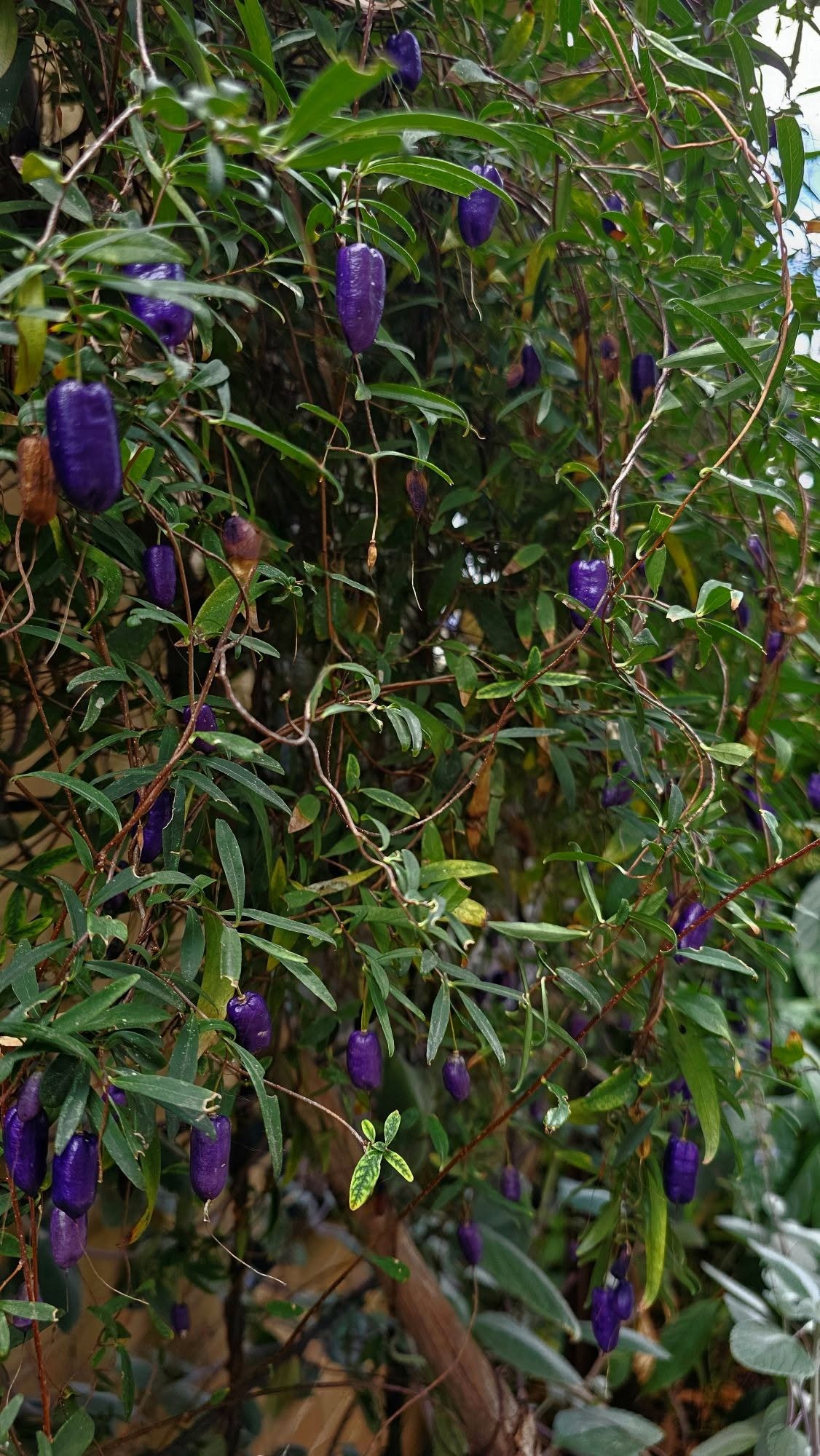
Catalog fields
- Genus
- Billardiera
- Photo
- photos/CAT-00130-A.jpg
- Edible
- Yes
- layout
- single
- Habitat
- A forest and woodland species, mainly in southern open eucalypt forest (Eucalyptus obliqua, E. viminalis and E. amygdalina at lower altitudes, E. delegatensis at higher altitudes). An altitudinal cline is present with the plants with the widest and longest leaves and largest flowers and fruits on lengthy stalks occurring in near coastal woodland habitats, all plant parts reducing in size on the dolerite scree slopes in higher E. delegatensis forests.
- Published
- Yes
- Food group
- Fruit
- Latin name
- Billardiera longiflora
- Fruit photo
- photos/CAT-00130-F.jpg
- Plant title
- Tasmanian apple berry
- Source URLs
- https://profiles.ala.org.au/opus/foa/profile/Billardiera%20longiflora | https://www.anbg.gov.au/apu/plants/billscan.html; https://powo.science.kew.org/taxon/urn%3Alsid%3Aipni.org%3Anames%3A684268-1 Open source ↗ Open source 2 ↗ Open source 3 ↗
- Catalogue ID
- CAT-00130
- Mature width
- Not confirmed; allow spread appropriate to growth habit
- Native range
- Tasmania only. The closely related species at higher altitudes in mainland southeastern Australia is its sister taxon, Billardiera macrantha.
- Plant family
- Pittosporaceae
- Supplier SKU
- Not recorded
- Listing group
- Regional / traditional food plant
- Mature height
- Not confirmed; habit described in brief description
- Native states
- TAS
- Original list
- No
- Research date
- 10/10/2026
- Research notes
- Profile enriched from botanical/nursery sources. Dimensions are unpruned regional estimates where available; missing measurements remain explicit. Seasons are regional guides and vary with climate, location, cultivar and plant maturity. Drought and cultivation guidance are qualitative garden inferences, not measured ratings.
- Evidence status
- Published food use; preparation detail review pending
- Fruiting season
- Species-specific timing not verified.
- Background photo
- Not recorded
- Edible component
- Fully ripe fruit
- Flowering season
- Species-specific timing not verified.
- Brief description
- Woody twining shrub with tubular flowers; often confused with Billardiera macrantha.
- Drought tolerance
- Low to moderate; cool moist habitat.
- Preparation notes
- Confirm species identification, the specified edible part, ripeness and species-specific preparation before use.
- Flower description
- Greenish-yellow tubular flowers with purplish tips; description from the older, broader species treatment.
- General cultivation
- General guidance (qualitative): Challenging summer trial; confirm nursery identification and keep a cool moist root zone.
- Botanical description
- Woody twiner; new shoots medium hairy with thick based uniseriate hairs, but fairly rapidly glabrescent. Adult leaves clustering on short shoots, becoming alternate on twining branches; leaf shape very variable apparently related to developmental stage and altitude: intermediate leaves, adult leaves at lower altitudes narrowly obovate to narrow, 18–25 mm long, 5–6 mm wide; higher altitude forms (over 400 m) approaching linear 15–35 mm long, 2–3 mm wide; petioles sheathing, 1–2 mm. Dark glossy green upper surfaces, lower paler. Inflorescences of solitary, bisexual, tubular flowers; buds yellow with bright green tips (blue in herbarium specimens), peduncles as long as the flowers, slender, nodding glabrous, 10–14 mm long. Sepals very unequal and variable, 3–5 mm long, ovate; purple-blue, outer surface glabrescent, inner hairy. Petals 16–24 mm, persisting cohering in the throat at anthesis, not recurving, initially green-yellow with navy spots on margins, eventually stained navy blue from blotching from the throat and margins at sex phase change. Stamens free, with filaments much longer than anthers, tapering, eventually blue; anthers white with mauve pollen. Pistil with vestigial basal nectary; ovary 5–8 mm long, ridged, dense hairy; style slender, 17–20 mm long. Fruit appearing unilocular, berry-like with seeds in separate dry cells, ovate, 13–20 mm long, 10 mm diam., glossy purple; pericarp flexible, thin, not pithy. Seeds free, c. 1.8 mm long, surface ridged, swirled striate.
- Other botanical names
- Not recorded
- Attracts birds and bugs
- Native bees and insects visit flowers; canopy shelters birds.
- Flora of Australia profile
- https://profiles.ala.org.au/opus/foa/profile/Billardiera%20longiflora Open source ↗
- Fruit type and description
- Purple berry-like fruit; older accounts may refer to a broader species concept.
- Flora of Australia citation
- Lindy Cayzer. Billardiera longiflora. Flora of Australia, Australian Biological Resources Study, Department of Climate Change, Energy, the Environment and Water, Canberra. https://profiles.ala.org.au/opus/foa/profile/Billardiera%20longiflora (accessed 2026-10-15). Copyright Commonwealth of Australia; CC BY 4.0 (https://creativecommons.org/licenses/by/4.0/). HTML formatting removed; species-level context added where noted. Open source ↗ Open source 2 ↗
- Flora of Australia retrieved
- 15/10/2026