CAT-00131
Sweet apple berry
Billardiera cymosa
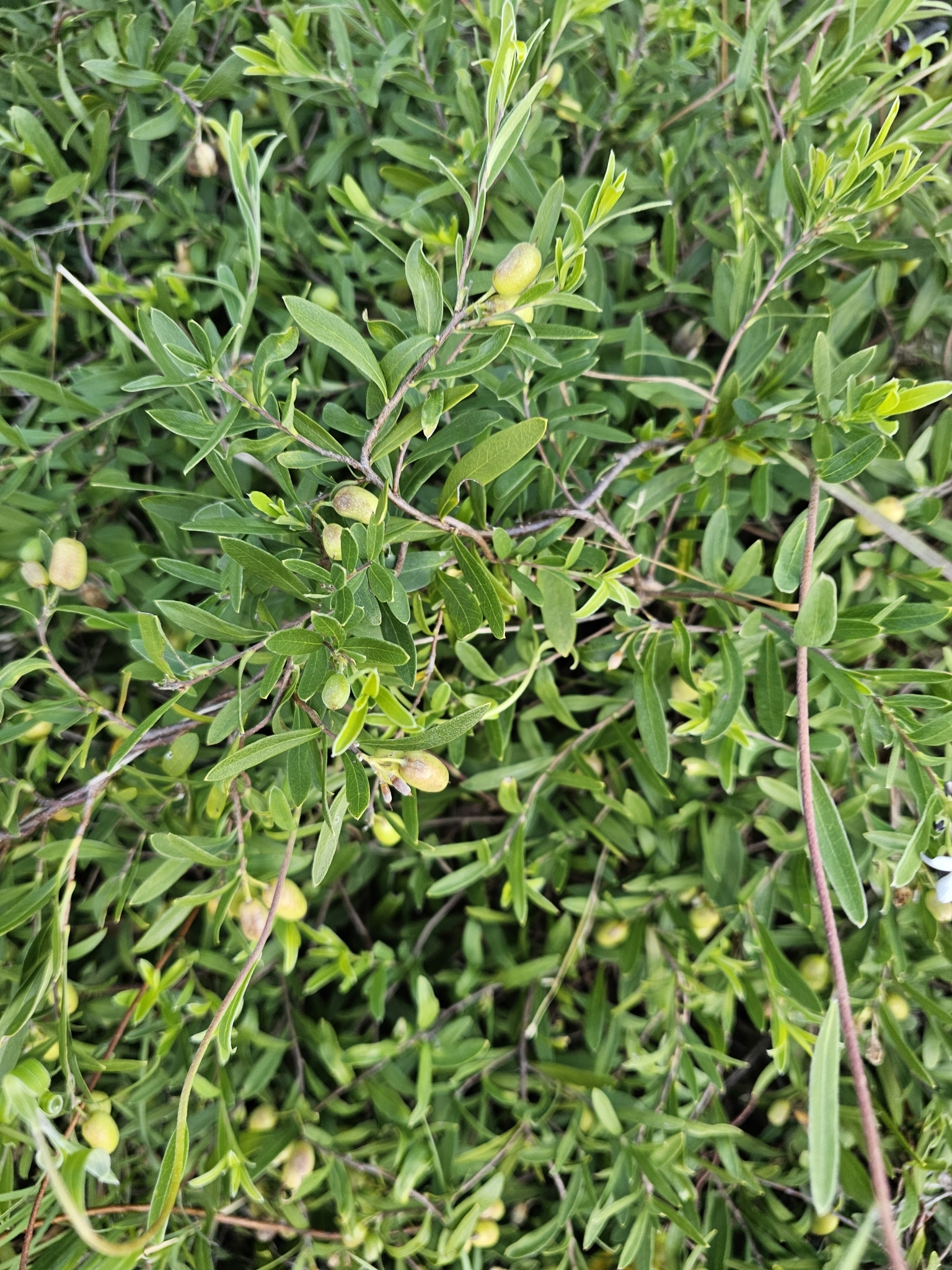
Catalog fields
- Genus
- Billardiera
- Photo
- photos/CAT-00131-A.jpg
- Edible
- Yes
- layout
- single
- Habitat
- Mallee and eucalypt woodland; never common.
- Published
- Yes
- Food group
- Fruit
- Latin name
- Billardiera cymosa
- Fruit photo
- photos/CAT-00131-F.jpg
- Plant title
- Sweet apple berry
- Source URLs
- https://profiles.ala.org.au/opus/foa/profile/Billardiera%20cymosa | https://www.anbg.gov.au/apu/plants/billscan.html Open source ↗ Open source 2 ↗
- Catalogue ID
- CAT-00131
- Mature width
- Depends on support
- Native range
- South Australia and western Victoria. Bird dispersal has further blurred distribution patterns this century.
- Plant family
- Pittosporaceae
- Supplier SKU
- Not recorded
- Listing group
- Regional / traditional food plant
- Mature height
- Climbing or scrambling to about 2 m
- Native states
- SA, VIC
- Original list
- No
- Research date
- 10/10/2026
- Research notes
- Profile enriched from botanical/nursery sources. Dimensions are unpruned regional estimates where available; missing measurements remain explicit. Seasons are regional guides and vary with climate, location, cultivar and plant maturity. Drought and cultivation guidance are qualitative garden inferences, not measured ratings.
- Evidence status
- Published food use; preparation detail review pending
- Fruiting season
- After flowering
- Background photo
- photos/CAT-00131-B.jpg
- Edible component
- Fully ripe fruit
- Flowering season
- Spring-early summer, sometimes sporadic.
- Brief description
- Slender climber or scrambling shrub with pale blue-pink flowers.
- Drought tolerance
- Moderate; water in dry weather.
- Preparation notes
- Confirm species identification, the specified edible part, ripeness and species-specific preparation before use.
- Flower description
- Pale-blue, pink or purple tubular flowers in clusters, with flared tips.
- General cultivation
- General guidance (qualitative): Trial a small support in sun or light shade with drainage.
- Botanical description
- Mostly a slender twiner; new shoots very slightly ridged, persisting softly hairy; older stems glabrous, red-brown. Younger developmental stage leaves with silky hairy midribs and margins, glabrescent. Adult leaves alternate, very shortly petiolate; lamina mostly narrowly elliptic to almost linear, 30–65 mm long, (3–) 6–13 mm wide, dark green, discolorous, margin thick and slightly down-turned, apex almost cuspidate; petiole (1–2 mm long). Inflorescences nearly sessile, corymbose, 10 or more almost rotate flowers; distinct rachis 6–10 mm long, peduncles less than 10 mm long; bracts and bracteoles all softly hairy, caducous. Sepals 2–3 mm long, yellow-green, noticeably unequal, green or colour matching petals, hairy on both surfaces, margins woolly. Petals 12–20 mm long, clawed, briefly cohering forming a narrow tube longer than the blade, apices reflexing, hairy. Colour changes: initially very pale blue or pale pink at anthesis, deepening with age and sex phase change, with contrasting deeper colouring spreading from the throat; never cream or yellow. Stamens free, filaments tapering to a wider base, anthers ovoid with a prominent mucro. Pistil with a wide, disc-like receptacle and basal nectary; ovary 3–4 mm long, silky hairy (subsp. cymosa) or glabrous (subsp. pseudocymosa); style can be as long as the ovary when fully extended. Fruit bilocular, berry-like with seeds in separate dry cells, slightly obovate, c. 12–15 mm long. Seeds numerous, discoidal, muricate.
- Other botanical names
- Not recorded
- Attracts birds and bugs
- Native bees and insects visit flowers; canopy shelters birds.
- Flora of Australia profile
- https://profiles.ala.org.au/opus/foa/profile/Billardiera%20cymosa Open source ↗
- Fruit type and description
- Small berry-like fruit to about 2 cm; reported ripe colour varies between sources.
- Flora of Australia citation
- Lindy W. Cayzer. Billardiera cymosa. Flora of Australia, Australian Biological Resources Study, Department of Climate Change, Energy, the Environment and Water, Canberra. https://profiles.ala.org.au/opus/foa/profile/Billardiera%20cymosa (accessed 2026-10-15). Copyright Commonwealth of Australia; CC BY 4.0 (https://creativecommons.org/licenses/by/4.0/). HTML formatting removed; species-level context added where noted. Open source ↗ Open source 2 ↗
- Flora of Australia retrieved
- 15/10/2026