CAT-00134
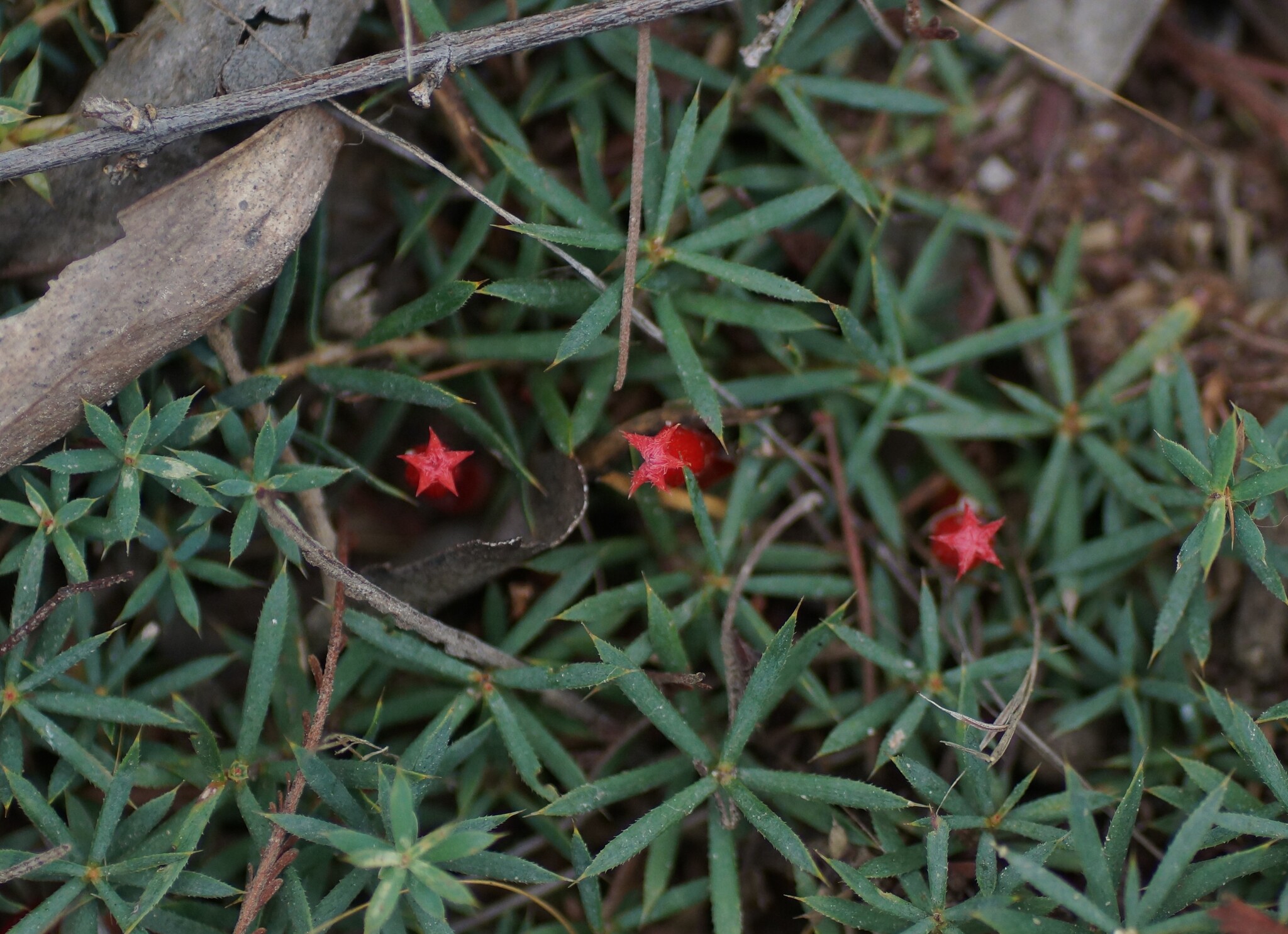
Native cranberry
Styphelia humifusa
Catalog fields
- Genus
- Styphelia
- Photo
- Not recorded
- Edible
- Yes
- layout
- single
- Habitat
- Occurs in grassland, heathland, shrubland, woodland, sclerophyll forests and dunes on sandy clayey to sandy soils derived from granite, ironstone, limestone, quartzite, sandstone and schist. At elevations from near sea level to 1090 m.
- Published
- Yes
- Food group
- Fruit
- Latin name
- Styphelia humifusa
- Fruit photo
- Not recorded
- Plant title
- Native cranberry
- Source URLs
- https://profiles.ala.org.au/opus/foa/profile/Styphelia%20humifusa | https://www.anbg.gov.au/apu/plants/astrhumi.html; https://powo.science.kew.org/taxon/urn%3Alsid%3Aipni.org%3Anames%3A325797-1; https://vicflora.rbg.vic.gov.au/flora/taxon/7875b303-cd9e-40dd-9894-304dbe0c29b9 Open source ↗ Open source 2 ↗ Open source 3 ↗ Open source 4 ↗
- Catalogue ID
- CAT-00134
- Mature width
- Not confirmed; allow spread appropriate to growth habit
- Native range
- New South Wales, Southern Australia, Victoria and Tasmania.
- Plant family
- Ericaceae
- Supplier SKU
- Not recorded
- Listing group
- Regional / traditional food plant
- Mature height
- Not confirmed; habit described in brief description
- Native states
- NSW, SA, TAS, VIC
- Original list
- No
- Research date
- 10/10/2026
- Research notes
- Profile enriched from botanical/nursery sources. Dimensions are unpruned regional estimates where available; missing measurements remain explicit. Seasons are regional guides and vary with climate, location, cultivar and plant maturity. Drought and cultivation guidance are qualitative garden inferences, not measured ratings.
- Evidence status
- Published food use; preparation detail review pending
- Fruiting season
- Species timing not verified.
- Background photo
- Not recorded
- Edible component
- Ripe fruit
- Flowering season
- January-July in VicFlora; winter peak in cultivation guidance, with variation by region.
- Brief description
- Low spreading heath shrub with tubular flowers.
- Drought tolerance
- Moderate once established in suitable soils.
- Preparation notes
- Confirm species identification, the specified edible part, ripeness and species-specific preparation before use.
- Flower description
- Red tubular flowers, often partly hidden among the leaves; the inner lobes are bearded.
- General cultivation
- General guidance (qualitative): Specialist heath-plant trial; excellent drainage and low-phosphorus native-plant nutrition.
- Botanical description
- Cushion to decumbent many-branched shrubs up to 50 cm tall. Multi-stemmed at ground level. Branchlets erect, glabrous to puberulent, reddish. Bark on older branches broadly fissured. Leaves at the upper part of branches or spread along branches, erect to spreading, occasionally twisted; lamina apex acuminate, pungent, straight, mucro long; base attenuate; thinly textured, linear to oblanceolate, 6–18 mm long, 0.6–3 mm wide, lamina flat to convex, concolourous and glaucous; glabrous to scabrid; abaxial surface striate, with midrib plus 4–7 raised primary veins; margins denticulate and ciliate. Inflorescence a solitary erect flower in the upper axils, pedicel straight, 0.6–0.83 mm long, glabrous. Flower bracts shorter than the flower, 0.5–2.4 mm long, 0.4–1.7 mm wide, ovate orbicular, glabrous, apex obtuse, margins entire and hyaline. Bracteoles tightly imbricate, broadly ovate to orbicular, 2.5–3.5 mm long, 1.8–2.5 mm wide, glabrous, margin entire and hyaline, apex obtuse. Sepals whitish to pink, 4.3–7 mm long, 1.7–2.6 mm wide, ovate elliptical to ovate, shorter than the corolla tube, glabrous, apex acute; margins entire and hyaline. Corolla persistent, longer than the sepals, corolla tube red, cylindrical, curved, 7–12 mm long, 4–5 mm wide, outside glabrous, inside hairy in the uppermost area, in the lower half and 5 tufts of long hairs above the ovary. Corolla lobes red to pink, shorter than the corolla tube, 3.7–5.3 mm long, 1.2–2 mm wide, spreading to recurved, narrowly triangular to triangular, adaxially densely hairy over the entire surface, apex acute. Stamens inserted near the throat of the corolla tube. Anthers partially exserted, attached to the filament above the midpoint, yellow, erect. Filament pink, flattened, thick and fleshy, glabrous. Ovary pale green, 5 -locular, ovoid to globose, 1–1.5 mm long, 0.9–1.55 mm wide, glabrous, apex tapering. Style 8.5–15 mm long, white, slender, glabrous, stigma above anthers, not distinct from style. Nectary scales annular, third to half of the ovary length, 0.4–0.8 mm long, and apex irregularly toothed. Fruit longer than persistent sepals, purplish to black, globose to ovoid, 4.9–10 mm long, 3.5–8 mm wide, glabrous, apex round, style persistent.
- Other botanical names
- Astroloma humifusum
- Attracts birds and bugs
- Native bees and insects visit flowers; canopy shelters birds.
- Flora of Australia profile
- https://profiles.ala.org.au/opus/foa/profile/Styphelia%20humifusa Open source ↗
- Fruit type and description
- Small fleshy drupe with a relatively large stone; ripe flesh is the recorded food.
- Flora of Australia citation
- S. Venter. Styphelia humifusa. Flora of Australia, Australian Biological Resources Study, Department of Climate Change, Energy, the Environment and Water, Canberra. https://profiles.ala.org.au/opus/foa/profile/Styphelia%20humifusa (accessed 2026-10-15). Copyright Commonwealth of Australia; CC BY 4.0 (https://creativecommons.org/licenses/by/4.0/). HTML formatting removed; species-level context added where noted. Open source ↗ Open source 2 ↗
- Flora of Australia retrieved
- 15/10/2026