CAT-00150
Old man banksia
Banksia serrata
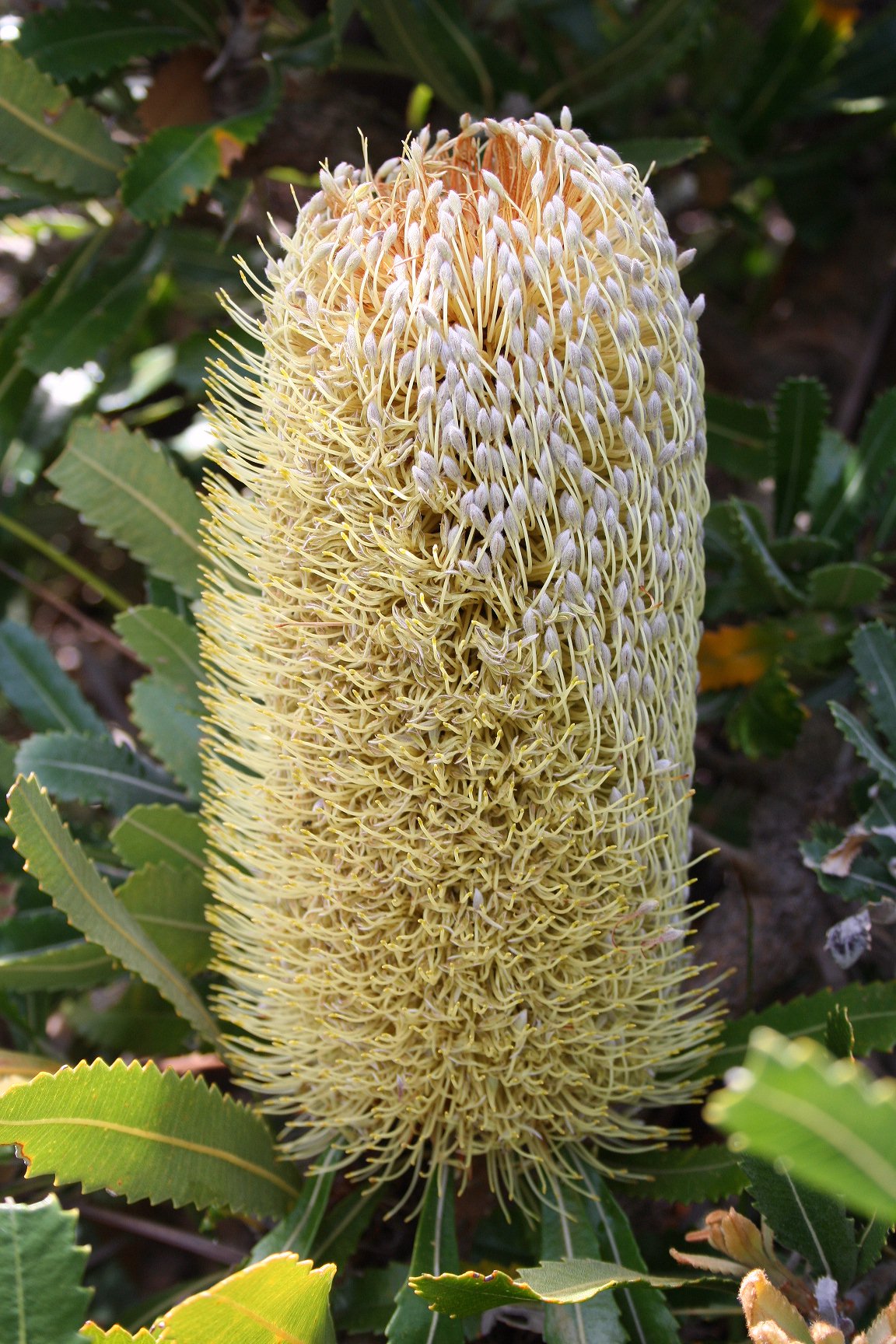
Catalog fields
- Genus
- Banksia
- Photo
- Not recorded
- Edible
- Yes
- layout
- single
- Habitat
- Grows on consolidated coastal dunes and in sand over sandstone on the coastal plain and in the Blue Mtns; usually in woodland, but also as a low shrub in tall shrubland.
- Published
- Yes
- Food group
- Nectar
- Latin name
- Banksia serrata
- Fruit photo
- Not recorded
- Plant title
- Old man banksia
- Source URLs
- https://profiles.ala.org.au/opus/foa/profile/Banksia%20serrata | https://www.anbg.gov.au/apu/plants/banksia.html; https://plantnet.rbgsyd.nsw.gov.au/cgi-bin/NSWfl.pl?lvl=sp&name=Banksia~serrata&page=nswfl Open source ↗ Open source 2 ↗ Open source 3 ↗
- Catalogue ID
- CAT-00150
- Mature width
- Not confirmed; allow spread appropriate to growth habit
- Native range
- A common, near-coastal species in eastern Australia, extending from Cooloola, Qld, south to Wilsons Promontory, Vic., with an outlying population at Sisters Ck in north-western Tas.
- Plant family
- Proteaceae
- Supplier SKU
- Not recorded
- Listing group
- Regional / traditional food plant
- Mature height
- Up to 16 m
- Native states
- NSW, QLD, TAS, VIC
- Original list
- No
- Research date
- 10/10/2026
- Research notes
- Profile enriched from botanical/nursery sources. Dimensions are unpruned regional estimates where available; missing measurements remain explicit. Seasons are regional guides and vary with climate, location, cultivar and plant maturity. Drought and cultivation guidance are qualitative garden inferences, not measured ratings.
- Evidence status
- Published food use; preparation detail review pending
- Fruiting season
- Woody follicles develop after flowering and persist.
- Background photo
- Not recorded
- Edible component
- Floral nectar traditionally made into a drink
- Flowering season
- January-June.
- Brief description
- Rough-barked banksia shrub or tree with toothed leaves.
- Drought tolerance
- Moderate to high once established.
- Preparation notes
- Traditional nectar use refers to flower nectar, not edible woody cones or seeds; confirm clean harvest method.
- Flower description
- Cream-grey, cylindrical flower spikes.
- General cultivation
- General guidance (qualitative): Promising sandy or raised-site trial; avoid waterlogging and high-phosphorus fertilisers.
- Botanical description
- Tree to 16 m, sometimes a robust shrub of 1-3 m, fire-tolerant. Bark thick, verrucose, friable, grey-brown. Stems tomentose and hirsute. Leaves: petiole commonly 1-2 cm long; lamina broadly oblong to narrowly obovate, 7-22 cm long, usually 2-4 cm wide, truncate, serrate; margins slightly recurved; both surfaces tomentose, glabrescent except pits in lower surface. Inflorescence terminal, 7-15 cm long; involucral bracts tomentose, falling early. Flowers creamy grey; styles cream. Perianth 38-42 mm long including limb of 7-8 mm, pubescent outside, glabrous inside. Pistil curved, 47-60 mm long, glabrous, or papillose towards base; pollen presenter fusiform with thickened base, 2.5-3 mm long, finely 8-ribbed. Old flowers persistent. Follicles up to 30, prominent, broadly elliptic, 25-35 mm long, 20-25 mm high, 15-22 mm wide, smooth, tomentose. Seed obovate, 30-34 mm long; seed body obovate, 10-12 mm long, 9-11 mm wide, shallowly pitted outside, verrucose inside.
- Other botanical names
- Not recorded
- Attracts birds and bugs
- Native bees and insects visit flowers; canopy shelters birds.
- Flora of Australia profile
- https://profiles.ala.org.au/opus/foa/profile/Banksia%20serrata Open source ↗
- Fruit type and description
- Woody cone-like structures with follicles; nectar is the recorded edible component.
- Flora of Australia citation
- A.S.George. Banksia serrata. Flora of Australia, Australian Biological Resources Study, Department of Climate Change, Energy, the Environment and Water, Canberra. https://profiles.ala.org.au/opus/foa/profile/Banksia%20serrata (accessed 2026-10-15). Copyright Commonwealth of Australia; CC BY 4.0 (https://creativecommons.org/licenses/by/4.0/). HTML formatting removed; species-level context added where noted. Open source ↗ Open source 2 ↗
- Flora of Australia retrieved
- 15/10/2026