CAT-00009
Blue tongue
Melastoma affine
Catalog fields
- Genus
- Melastoma
- Photo
- Not recorded
- Edible
- Yes
- layout
- double
- Habitat
- Grows in a wide range of habitats, but generally in wet areas; found in disturbed areas in rainforest, and swampy or wet areas in open forest, woodland or heath. Reproductive attributes for this species are provided by Gross (2005). Fruit eaten by Brush-turkeys, Double-eyed Fig-parrots and Lewin's Honeyeaters (Cooper & Cooper 2004: 282).
- Published
- Yes
- Food group
- Fruit
- Latin name
- Melastoma affine
- Fruit photo
- Not recorded
- Plant title
- Blue tongue
- Source URLs
- https://profiles.ala.org.au/opus/foa/profile/Melastoma%20affine | https://plantnet.rbgsyd.nsw.gov.au/cgi-bin/NSWfl.pl?lvl=sp&name=Melastoma~affine&page=nswfl | https://connected.pmhc.nsw.gov.au/bloged/native-plant-of-the-month-melastoma-affine/ Open source ↗ Open source 2 ↗ Open source 3 ↗
- Catalogue ID
- CAT-00009
- Mature width
- Not confirmed
- Native range
- Extends from the Kimberley, Western Australia, around the north and east coasts to near Kempsey, northern New South Wales. Also from India and southeast Asia through Malesia to New Guinea.
- Plant family
- Melastomataceae
- Supplier SKU
- MELAFF
- Listing group
- Original garden variety
- Mature height
- To 2 m
- Native states
- NSW, NT, QLD, WA
- Original list
- Yes
- Research date
- 10/10/2026
- Research notes
- Width unverified; nursery/PlantNET name retained; Australian range given, not complete global range. Seasons vary with climate, location, cultivar and plant maturity.
- Evidence status
- Nursery food-use source; preparation detail review pending
- Fruiting season
- After flowering; regional timing not yet confirmed
- Background photo
- Not recorded
- Edible component
- Ripe fruit pulp
- Flowering season
- Spring-summer
- Brief description
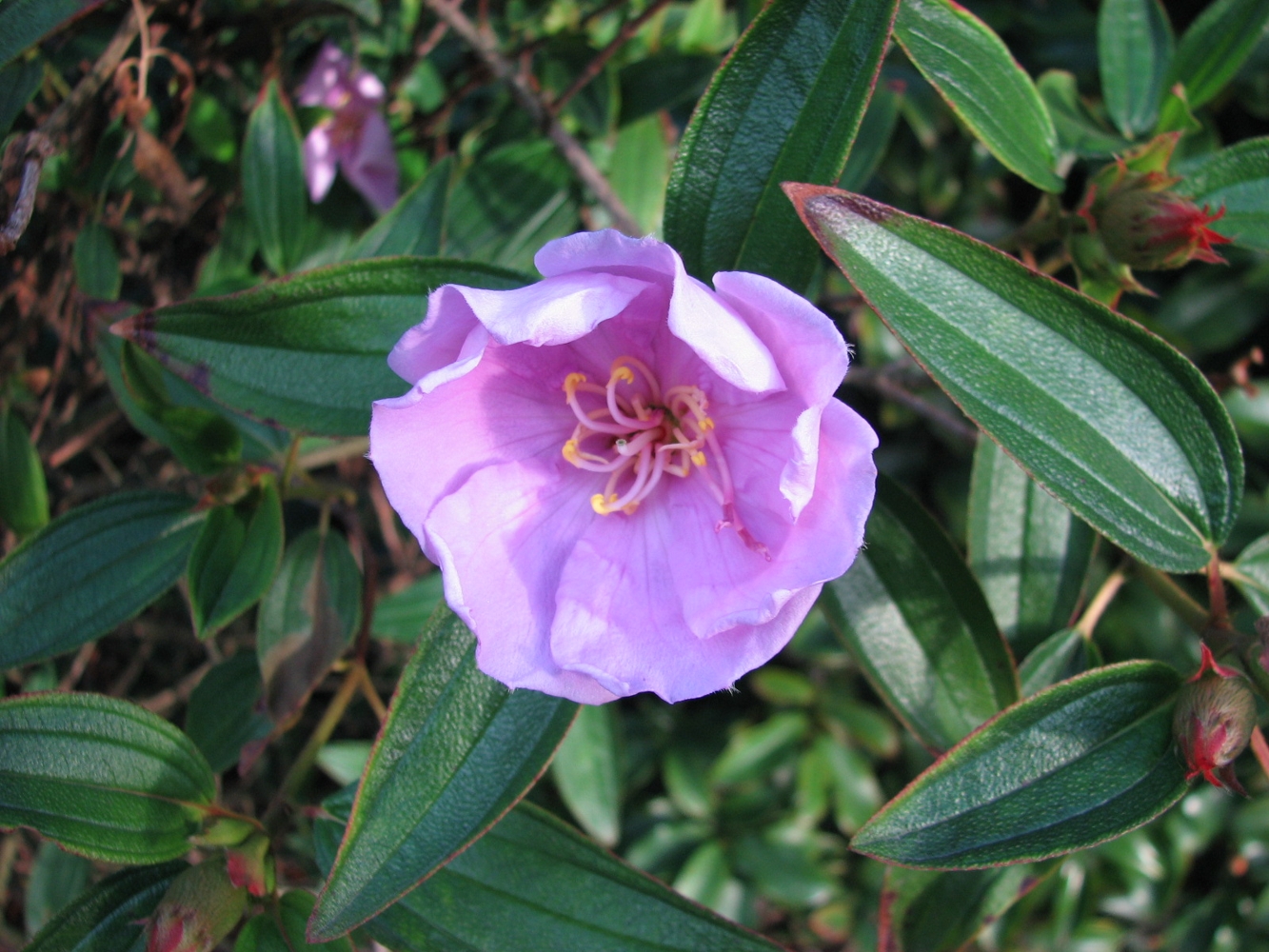
- Hairy prominently veined leaves; purple-mauve flowers.
- Drought tolerance
- Low (inferred); best with good water supply.
- Preparation notes
- Confirm species identification, the specified edible part, ripeness and species-specific preparation before use.
- Flower description
- Large mauve-purple flowers with prominent stamens; individual blooms are short-lived.
- General cultivation
- General guidance (qualitative): Sun with ample water for best flowering; avoid extended drying.
- Botanical description
- Bushy shrub to 3 m high. Leaves: lamina elliptic to ovate to narrowly ovate, 4–12 (–15) cm long, 1–6.5 cm wide, with stiff, ± appressed hairs, 3–5-veined; petiole 0.5–2 cm long. Inflorescence terminal or subterminal, cymose, fairly crowded, to 7-flowered, sometimes more. Hypanthium c. 5–7 mm long and 4–5 mm diam., densely covered with flattened often fimbriate scales 0.5–2.5 mm long. Calyx lobes triangular to lanceolate or oblanceolate, moderately to densely covered with scales and a few hairs, alternating with denticles. Petals purple to mauve (or white). Stamens 10; larger stamens with anthers 5–6 mm long, connective prolongation 6–7 mm long, and bilobed appendage 1–2 mm long; smaller stamens with anthers 5–6 mm long, connective prolongation less than 0.5 mm long, and bilobed appendage 0.5 mm long. Ovary summit densely pubescent. Fruit campanulate to urceolate, 8–14 mm long, 8–14 mm diam., pink or red, with stiff bristles or scales.
- Other botanical names
- Not recorded
- Attracts birds and bugs
- Native buzz-pollinating bees; pollen-rich flowers with no nectar.
- Flora of Australia profile
- https://profiles.ala.org.au/opus/foa/profile/Melastoma%20affine Open source ↗
- Fruit type and description
- Rounded semi-succulent fruit about 8 mm; dark pulp associated with tongue staining.
- Flora of Australia citation
- Trevor Whiffin, P.G. Kodela. Melastoma affine. Flora of Australia, Australian Biological Resources Study, Department of Climate Change, Energy, the Environment and Water, Canberra. https://profiles.ala.org.au/opus/foa/profile/Melastoma%20affine (accessed 2026-10-14). Copyright Commonwealth of Australia; CC BY 4.0 (https://creativecommons.org/licenses/by/4.0/). HTML formatting removed; species-level context added where noted. Open source ↗ Open source 2 ↗
- Flora of Australia retrieved
- 14/10/2026