CAT-00010
Pink midgen berry 'Blush'
Austromyrtus dulcis 'Blush'
Catalog fields
- Genus
- Austromyrtus
- Photo
- Not recorded
- Edible
- Yes
- layout
- single
- Habitat
- Species-level information for Austromyrtus dulcis, not a cultivar/form-specific description. Cultivated selections have no separate wild range. Coastal, in heath, scrub, open forest, dry sclerophyll forest, sometimes rainforest margins, usually in sandy soils.
- Published
- Yes
- Food group
- Fruit
- Latin name
- Austromyrtus dulcis 'Blush'
- Fruit photo
- photos/CAT-00010-F.jpg
- Plant title
- Pink midgen berry 'Blush'
- Source URLs
- https://profiles.ala.org.au/opus/foa/profile/Austromyrtus%20dulcis | https://www.australianplantsonline.com.au/austromyrtus-blush.html | https://www.anbg.gov.au/gnp/gnp12/austromyrtus-dulcis.html Open source ↗ Open source 2 ↗ Open source 3 ↗
- Catalogue ID
- CAT-00010
- Mature width
- About 1 m
- Native range
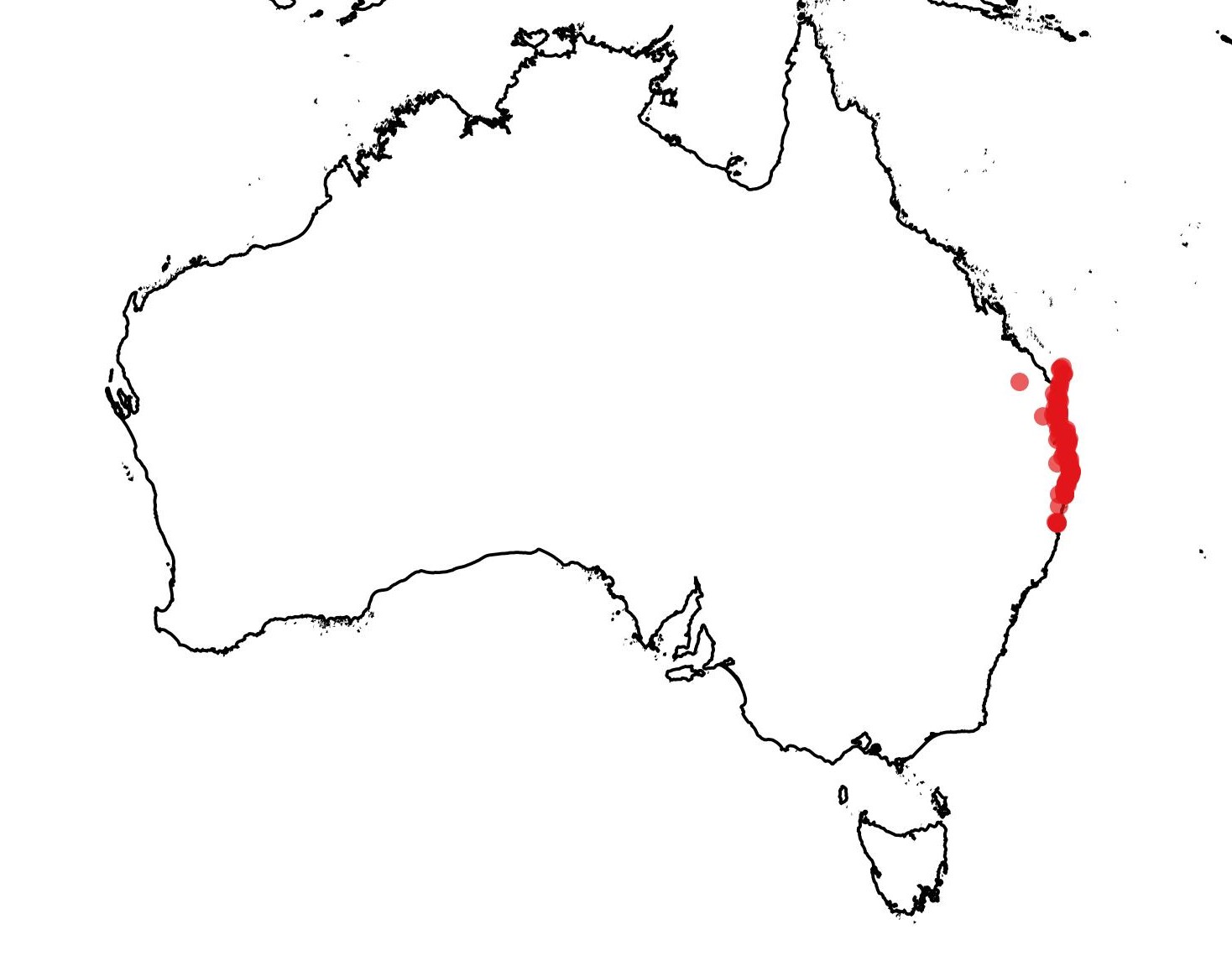
- Species-level information for Austromyrtus dulcis, not a cultivar/form-specific description. Cultivated selections have no separate wild range. Mostly coastal from Fraser Island (K'gari), Queensland, south to near Nambucca Heads, New South Wales.
- Plant family
- Myrtaceae
- Supplier SKU
- AUSBLU
- Listing group
- Original garden variety
- Mature height
- About 1 m
- Native states
- NSW, QLD
- Original list
- Yes
- Research date
- 10/10/2026
- Research notes
- Supplier fruiting statements conflict; timing is uncertain; avoid printing an exact season. Seasons vary with climate, location, cultivar and plant maturity. Native states refer to the parent species, or both parent species for the garden hybrid; the cultivated selection has no separate wild range. Flower descriptions use species-level information where cultivar-specific details are unavailable.
- Evidence status
- Original variety; food-use detail review pending
- Fruiting season
- Uncertain; supplier mentions spring/summer fruit and autumn ripening
- Background photo
- Not recorded
- Edible component
- Fleshy berries
- Flowering season
- Spring-summer expected from parent species
- Brief description
- Compact shrub; pink flowers; maroon-pink-peach new growth.
- Drought tolerance
- Moderate once established; water while fruit ripens.
- Preparation notes
- Confirm species identification, the specified edible part, ripeness and species-specific preparation before use.
- Flower description
- Pink flowers, as described for the cultivar.
- General cultivation
- General guidance (qualitative): Sun-part shade; freely draining soil; mulch; light frost tolerance once established.
- Botanical description
- Species-level information for Austromyrtus dulcis, not a cultivar/form-specific description. Cultivated selections have no separate wild range. Spreading often semi-prostrate shrub 0.2–1.5 m high. Leaf blades narrowly elliptic or narrowly ovate to lanceolate, sometimes slightly falcate, 10–30 (–38) mm long, (3–) 7–10 (–13) mm wide, tip mucronate, oil glands common above, lateral and intramarginal veins below obscured by hairs. Bracteoles 1.5–3.3 mm long. Hypanthium 1.5–2 mm long. Sepal lobes sparsely silky to tomentose above, silky below, especially on margins. Petals widely ovate to widely obovate, 2.5–4 mm long, 3–4 mm wide, white. Staminal disk short-villous; ovary apex densely short-hairy. Fruit 4–9 mm long, 3.8–10 mm wide, white to greyish with small dark spots, glabrous to densely silky; seeds 1–2 (–7).
- Other botanical names
- Not recorded
- Attracts birds and bugs
- Fruit-eating birds; native bees and hoverflies on pink flowers.
- Flora of Australia profile
- https://profiles.ala.org.au/opus/foa/profile/Austromyrtus%20dulcis Open source ↗
- Fruit type and description
- Sweet white berries; pink refers to flowers, not necessarily fruit.
- Flora of Australia citation
- N. Snow, P.G. Kodela. Austromyrtus dulcis. Flora of Australia, Australian Biological Resources Study, Department of Climate Change, Energy, the Environment and Water, Canberra. https://profiles.ala.org.au/opus/foa/profile/Austromyrtus%20dulcis (accessed 2026-10-14). Copyright Commonwealth of Australia; CC BY 4.0 (https://creativecommons.org/licenses/by/4.0/). HTML formatting removed; species-level context added where noted. Open source ↗ Open source 2 ↗
- Flora of Australia retrieved
- 14/10/2026