CAT-00047
Button grass
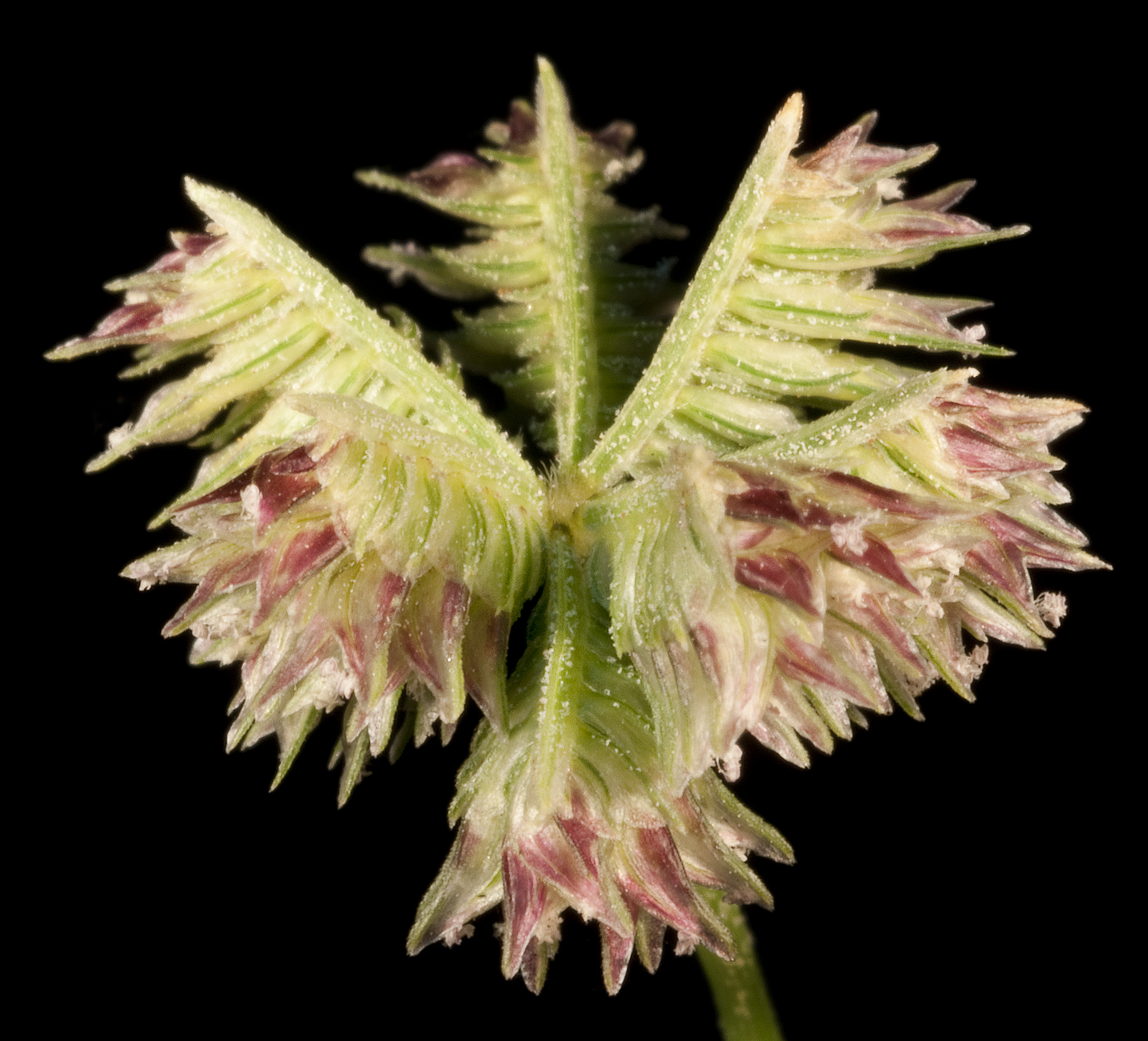
Dactyloctenium radulans
Catalog fields
- Genus
- Dactyloctenium
- Photo
- Not recorded
- Edible
- Yes
- layout
- single
- Habitat
- Recorded growing on many soil types but most often on sand and in seasonallywet areas such as creek banks and flood plains; tolerates saline and swampyconditions and appears after flooding; in grassland (sometimes with Astrebla) or shrubland, mulga, open forest, cleared land;erect when with other grasses, prostrate on bare ground.
- Published
- Yes
- Food group
- Grain
- Latin name
- Dactyloctenium radulans
- Fruit photo
- Not recorded
- Plant title
- Button grass
- Source URLs
- https://profiles.ala.org.au/opus/foa/profile/Dactyloctenium%20radulans | https://pmc.ncbi.nlm.nih.gov/articles/PMC10660417/; https://plantnet.rbgsyd.nsw.gov.au/cgi-bin/NSWfl.pl?lvl=sp&name=Dactyloctenium~radulans&page=nswfl Open source ↗ Open source 2 ↗ Open source 3 ↗
- Catalogue ID
- CAT-00047
- Mature width
- Not confirmed; allow spread appropriate to growth habit
- Native range
- Endemic. Distributed through inland areas of all mainland states, and occurring near to the coast and on off-shore islands above 24°S.
- Plant family
- Poaceae
- Supplier SKU
- Not recorded
- Listing group
- Regional / traditional food plant
- Mature height
- 0.2 m
- Native states
- NSW, NT, QLD, SA, VIC, WA
- Original list
- No
- Research date
- 10/10/2026
- Research notes
- Profile enriched from botanical/nursery sources. Dimensions are unpruned regional estimates where available; missing measurements remain explicit. Seasons are regional guides and vary with climate, location, cultivar and plant maturity. Drought and cultivation guidance are qualitative garden inferences, not measured ratings.
- Evidence status
- Published food use; preparation detail review pending
- Fruiting season
- Seeds mature after flowering; rainfall dependent.
- Background photo
- Not recorded
- Edible component
- Processed grain
- Flowering season
- Responds to rain.
- Brief description
- Low tufted annual or short-lived perennial grass with finger-like seed heads.
- Drought tolerance
- Avoids drought through seed survival; growth needs rainfall.
- Preparation notes
- Clean and process mature grain; milling and cooking methods require species-specific confirmation.
- Flower description
- Small grass flowers in spikelets arranged on several short finger-like spikes.
- General cultivation
- General guidance (qualitative): Possible warm-season grain trial; requires seed processing and reliable identification.
- Botanical description
- Ephemerals or annuals, erect and tufted or prostrate or geniculate, rhizomes and stolons absent. Flowering culms 7–33 cm high. Ligule a ciliate membrane, 0.5–1 mm long. Inflorescence branches (3–) 4–7 (–10), touching for most of length (when flattened) and forming a head-like structure, 0.5–1.5 cm long, 3.5–5 mm wide including the spikelets and awns; bare tip 0.5–2 mm long, 6–25% of total branch length. Spikelets ±obovate, 3–5 mm long, 2–4-flowered, with 1–2 closely overlapping bisexual florets. Glumes with the lower narrower than the upper; lower glume 1–2 mm long, muticous; upper glume oblong to elliptic, 1.5–3 mm long, with awn 0.5–2.5 mm long. Basal lemma 2.7–3.5 mm long, muticous or aristulate, scaberulous along entire midnerve. Palea flaps distinctly narrower than or ±as wide as body. Anthers 0.3–0.5 mm long, yellow. Caryopsis oblong to elliptic or ovate, truncate at base, obtuse at apex. Incomplete lemmas awnless.
- Other botanical names
- Not recorded
- Attracts birds and bugs
- Native bees and insects visit flowers; canopy shelters birds.
- Flora of Australia profile
- https://profiles.ala.org.au/opus/foa/profile/Dactyloctenium%20radulans Open source ↗
- Fruit type and description
- Small dry grains enclosed in spikelets.
- Flora of Australia citation
- M.E.Nightingale, C.M.Weiller. Dactyloctenium radulans. Flora of Australia, Australian Biological Resources Study, Department of Climate Change, Energy, the Environment and Water, Canberra. https://profiles.ala.org.au/opus/foa/profile/Dactyloctenium%20radulans (accessed 2026-10-14). Copyright Commonwealth of Australia; CC BY 4.0 (https://creativecommons.org/licenses/by/4.0/). HTML formatting removed; species-level context added where noted. Open source ↗ Open source 2 ↗
- Flora of Australia retrieved
- 14/10/2026