CAT-00048
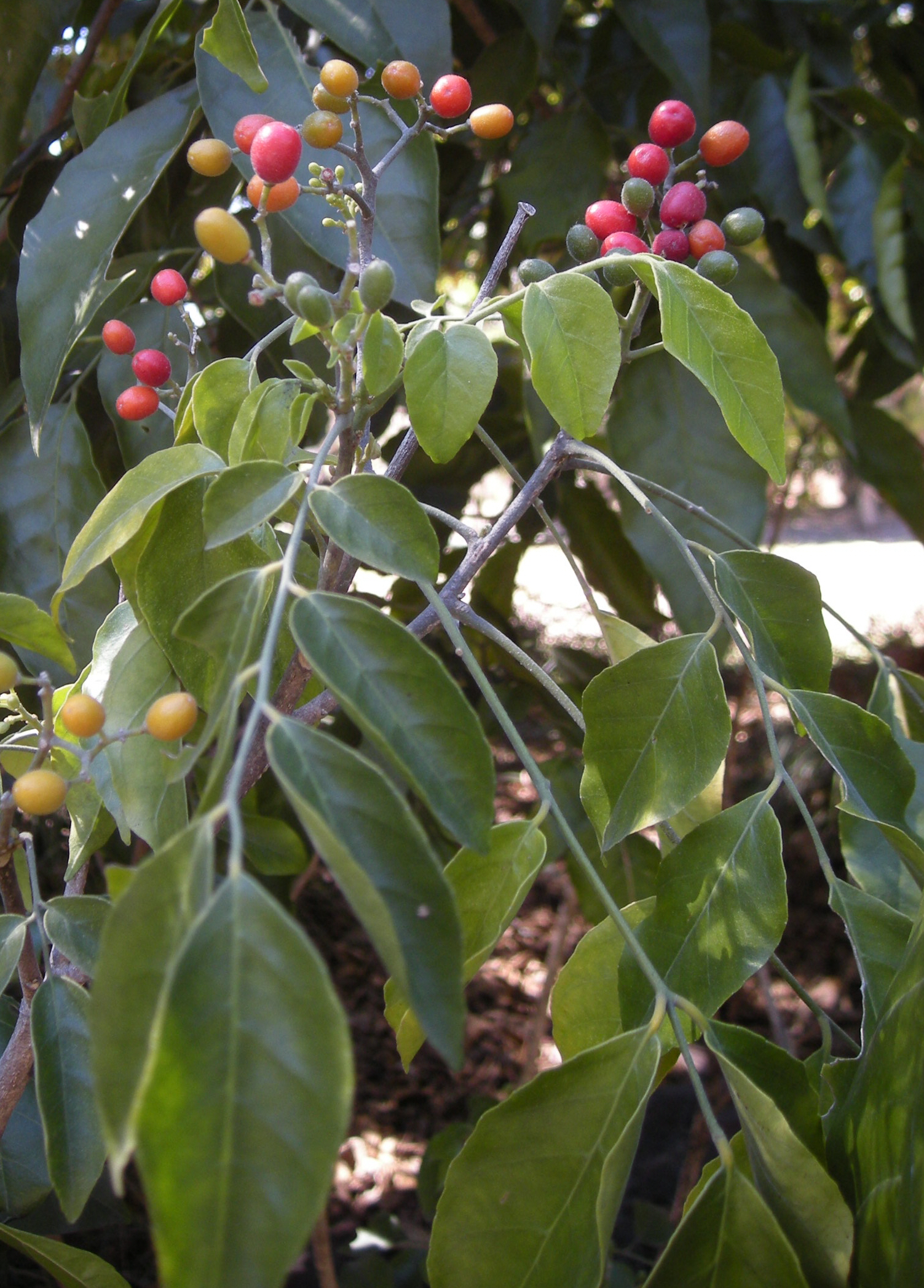
Lime berry
Micromelum minutum
Catalog fields
- Genus
- Micromelum
- Photo
- Not recorded
- Edible
- Yes
- layout
- single
- Habitat
- Found in usually coastal monsoon forest especially on dunes, coral or other limestones to 615 m altitude, often common as on the Great Barrier Reef, but also in sandstone gorges and on karst outcrops far inland. Not collected in New South Wales since 1911.
- Published
- Yes
- Food group
- Fruit
- Latin name
- Micromelum minutum
- Fruit photo
- Not recorded
- Plant title
- Lime berry
- Source URLs
- https://profiles.ala.org.au/opus/foa/profile/Micromelum%20minutum | https://tuckerbush.com.au/lime-berry-micromelum-minutum/; https://powo.science.kew.org/taxon/urn%3Alsid%3Aipni.org%3Anames%3A774392-1 Open source ↗ Open source 2 ↗ Open source 3 ↗
- Catalogue ID
- CAT-00048
- Mature width
- 2m
- Native range
- Found from Indomalesia to the western Pacific. Occurs in north tropical Australia from the Kimberley region in Western Australia, Northern Territory and Queensland, south to northern New South Wales.
- Plant family
- Rutaceae
- Supplier SKU
- Not recorded
- Listing group
- Nursery-listed / regional edible
- Mature height
- 2-4m
- Native states
- NSW, NT, QLD, WA
- Original list
- No
- Research date
- 10/10/2026
- Research notes
- Profile enriched from botanical/nursery sources. Dimensions are unpruned regional estimates where available; missing measurements remain explicit. Seasons are regional guides and vary with climate, location, cultivar and plant maturity. Drought and cultivation guidance are qualitative garden inferences, not measured ratings.
- Evidence status
- Nursery food-use source; preparation detail review pending
- Fruiting season
- After flowering.
- Background photo
- Not recorded
- Edible component
- Ripe fruit pulp
- Flowering season
- Can flower year-round in tropical sites
- Brief description
- Tropical citrus relative with divided aromatic leaves.
- Drought tolerance
- Low to moderate; water during dry periods.
- Preparation notes
- Use correctly identified ripe fruit pulp; remove seed and confirm species-specific preparation.
- Flower description
- Small fragrant white flowers in clusters.
- General cultivation
- General guidance (qualitative): Warm sheltered trial; particularly frost sensitive.
- Botanical description
- Tree to 10 (–20) m tall but often a scruffy shrub; bole to 15 cm diam. Leaves to 30 cm long, subglabrous to softly hairy adaxially; leaflets 7–15, ovate-lanceolate, 3–12 cm long, 1.5–6 cm wide, obtuse-asymmetric at base, entire to crenulate, attenuate-acuminate, coriaceous, often drying blackish, with axillary domatia at veins; petiolule to 5 mm long. Inflorescences 13–20 cm long, hairy, scented; bracts deltoid-linear; pedicels to 5 mm long. Sepals glabrous to shortly hairy. Petals 5–8 mm long, pale green or creamish. Filaments narrowed apically, white. Ovary c. 1.5 mm long, hairy at first; style subglabrous. Fruit ellipsoid, to 1 cm long, yellow to orange or red at maturity, glabrous. Cotyledons green.
- Other botanical names
- Not recorded
- Attracts birds and bugs
- Native bees and insects visit flowers; canopy shelters birds.
- Flora of Australia profile
- https://profiles.ala.org.au/opus/foa/profile/Micromelum%20minutum Open source ↗
- Fruit type and description
- Small orange-red berry-like fruit with sour pulp and a seed.
- Flora of Australia citation
- D.J. Mabberley. Micromelum minutum. Flora of Australia, Australian Biological Resources Study, Department of Climate Change, Energy, the Environment and Water, Canberra. https://profiles.ala.org.au/opus/foa/profile/Micromelum%20minutum (accessed 2026-10-14). Copyright Commonwealth of Australia; CC BY 4.0 (https://creativecommons.org/licenses/by/4.0/). HTML formatting removed; species-level context added where noted. Open source ↗ Open source 2 ↗
- Flora of Australia retrieved
- 14/10/2026