CAT-00067
Bush basil
Coleus graveolens
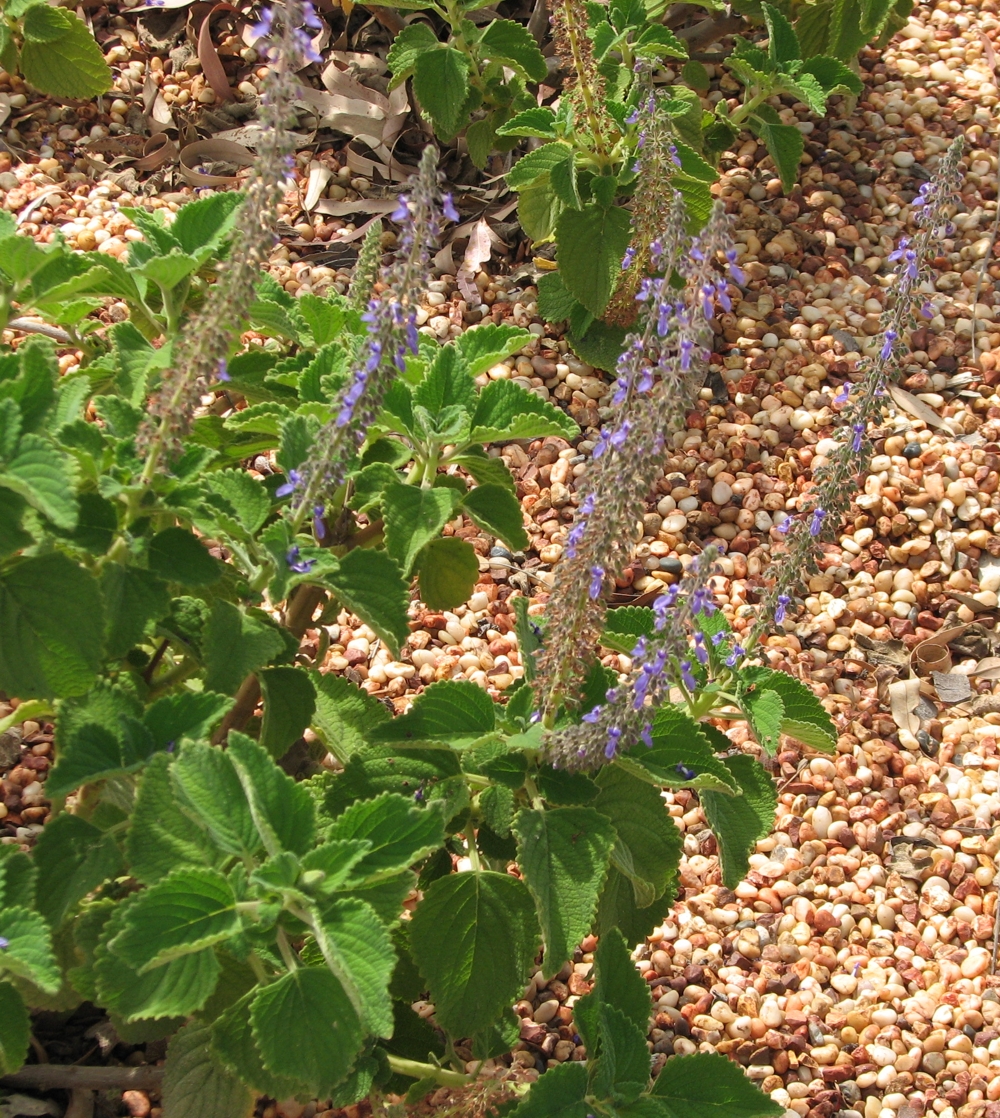
Catalog fields
- Genus
- Coleus
- Photo
- Not recorded
- Edible
- Yes
- layout
- single
- Habitat
- Usually grows in rocky areas in open forest but also found in monsoon forest and rain forest (Zich et al. 2020). Mainly in exposed rocky crevices and ledges (Conn 1992: 626). "Usually in dry, often rocky forest and woodlands in Gippsland between the New South Wales border and near Licola, with outlying and very localised occurrences on basalt cliffs of the Leigh and Moorabool Rivers near Geelong" (Walsh 2018).
- Published
- Yes
- Food group
- Herb / spice
- Latin name
- Coleus graveolens
- Fruit photo
- Not recorded
- Plant title
- Bush basil
- Source URLs
- https://profiles.ala.org.au/opus/foa/profile/Coleus%20graveolens | https://tuckerbush.com.au/bush-basil-plectranthus-graveolens/ ; https://powo.science.kew.org/taxon/urn%3Alsid%3Aipni.org%3Anames%3A77201091-1; https://tuckerbush.com.au/bush-basil-plectranthus-graveolens/ Open source ↗ Open source 2 ↗ Open source 3 ↗
- Catalogue ID
- CAT-00067
- Mature width
- 2m
- Native range
- Eastern Australia from Cape York Peninsula, Queensland, through eastern New South Wales to north-eastern Victoria (and with outlying and very localised occurrences further west near Geelong). Collected on Lord Howe Island by Maiden (1898), as Plectranthus parviflorus, but not collected since, presumably therefore extinct on the island.
- Plant family
- Lamiaceae
- Supplier SKU
- Not recorded
- Listing group
- Nursery-listed / regional edible
- Mature height
- 1.5m
- Native states
- NSW, QLD
- Original list
- No
- Research date
- 10/10/2026
- Research notes
- Profile enriched from botanical/nursery sources. Dimensions are unpruned regional estimates where available; missing measurements remain explicit. Seasons are regional guides and vary with climate, location, cultivar and plant maturity. Drought and cultivation guidance are qualitative garden inferences, not measured ratings.
- Evidence status
- Nursery food-use source; preparation detail review pending
- Fruiting season
- Dry fruits follow flowers.
- Background photo
- Not recorded
- Edible component
- Leaves for flavouring
- Flowering season
- Warmer months.
- Brief description
- Soft-leaved aromatic shrub with blue-purple flower spikes.
- Drought tolerance
- Moderate once established.
- Preparation notes
- Use correctly identified leaves as culinary flavouring.
- Flower description
- Tiny blue-purple flowers in slender clusters.
- General cultivation
- General guidance (qualitative): Promising in drainage and sun or light shade; protect young plants from frost.
- Botanical description
- Strongly and slightly unpleasantly aromatic, loosely branched, suberect to subprostrate shrub to c. 100 cm high; branches sparsely to densely covered with spreading to retrorse hairs and densely covered with gland-tipped hairs and/or sessile glands. Leaves with lamina very broadly ovate to ovate or elliptic, usually 4.5–10.5 cm long, 3.5–7.5 cm wide, subcordate to broadly cuneate at base, crenate-toothed margin with 10–19 pairs of teeth, acute to obtuse at apex, both surfaces densely hairy and densely covered with orange-red sessile glands; petiole 1–6 cm long. Calyx 1.6–2.3 mm long, elongating to 4–5 mm in fruit. Corolla 8–9 mm long, usually violet-blue; tube decurved at an angle of 90°–130°; lobes with sessile glands. (Conn 1992: 626). Subshrub to 1 m high, strongly aromatic. Stems densely glandular-pubescent and pilose. Leaves with lamina broadly ovate to ovate, 3–10 cm long, 2–7 cm wide, obtuse, truncate or rounded at base, evenly serrate-dentate margin, acute to obtuse at apex, densely villous on both surfaces and glandular below. Inflorescence terminal, racemose; verticillasters 5–12-flowered; pedicels 2–4 mm long. Calyx ± 2-lipped, zygomorphic, somewhat scoop-shaped, 1.5–2.5 mm long; lower teeth longest, accrescent. Corolla 8–9 mm long, violet-blue; tube deflexed, oblique at mouth; upper lobes deflexed; lower lip largest. Nutlets ovoid-globose, c. 1 mm long. (Green 1994: 318). See also Walsh (2018) for Victoria; Zich et al. (2020).
- Other botanical names
- Plectranthus graveolens
- Attracts birds and bugs
- Native bees and insects visit flowers; canopy shelters birds.
- Flora of Australia profile
- https://profiles.ala.org.au/opus/foa/profile/Coleus%20graveolens Open source ↗
- Fruit type and description
- Small dry nutlets; leaves used for flavouring.
- Flora of Australia citation
- P.G. Kodela. Coleus graveolens. Flora of Australia, Australian Biological Resources Study, Department of Climate Change, Energy, the Environment and Water, Canberra. https://profiles.ala.org.au/opus/foa/profile/Coleus%20graveolens (accessed 2026-10-14). Copyright Commonwealth of Australia; CC BY 4.0 (https://creativecommons.org/licenses/by/4.0/). HTML formatting removed; species-level context added where noted. Open source ↗ Open source 2 ↗
- Flora of Australia retrieved
- 14/10/2026