CAT-00076
Karkalla
Carpobrotus rossii
Catalog fields
- Genus
- Carpobrotus
- Photo
- Not recorded
- Edible
- Yes
- layout
- single
- Habitat
- Not recorded
- Published
- Yes
- Food group
- Fruit / vegetable
- Latin name
- Carpobrotus rossii
- Fruit photo
- Not recorded
- Plant title
- Karkalla
- Source URLs
- https://profiles.ala.org.au/opus/foa/profile/Carpobrotus%20rossii | https://tuckerbush.com.au/plants/vegetable-plants/; https://tuckerbush.com.au/karkalla-carpobrotus-virescens-bain/; https://powo.science.kew.org/taxon/urn%3Alsid%3Aipni.org%3Anames%3A360793-1 Open source ↗ Open source 2 ↗ Open source 3 ↗ Open source 4 ↗
- Catalogue ID
- CAT-00076
- Mature width
- 3m
- Native range
- Occurs primarily in coastal areas in South Australia, Victoria and Tasmania. S.T. Blake, Contr. Queensland Herb. 7: 27 (1969) also recorded this species on Nancy Peak in the Porongurup Range and south of Carnarvon in Western Australia, a considerable distance from the main distribution.
- Plant family
- Aizoaceae
- Supplier SKU
- Not recorded
- Listing group
- Nursery-listed / regional edible
- Mature height
- 0.3m
- Native states
- SA, TAS, VIC, WA
- Original list
- No
- Research date
- 10/10/2026
- Research notes
- Profile enriched from botanical/nursery sources. Dimensions are unpruned regional estimates where available; missing measurements remain explicit. Seasons are regional guides and vary with climate, location, cultivar and plant maturity. Drought and cultivation guidance are qualitative garden inferences, not measured ratings.
- Evidence status
- Nursery food-use source; preparation detail review pending
- Fruiting season
- After flowers
- Background photo
- Not recorded
- Edible component
- Ripe fruit pulp and leaves
- Flowering season
- Spring-summer.
- Brief description
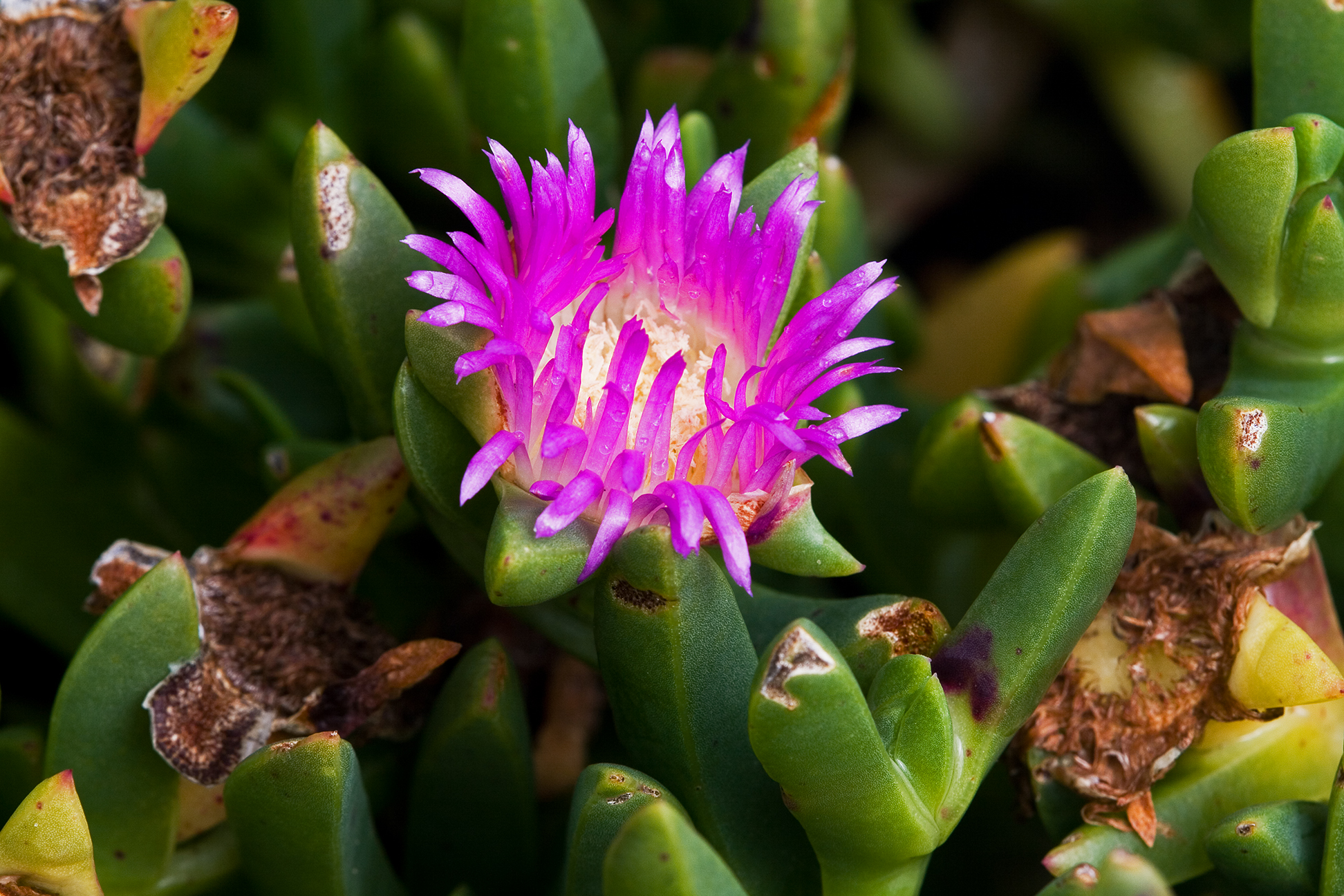
- Spreading succulent groundcover with large pink flowers.
- Drought tolerance
- High once established.
- Preparation notes
- Use fully ripe soft fruit pulp; confirm species-specific leaf preparation separately.
- Flower description
- Bright pink to magenta, many-rayed flowers resembling daisies.
- General cultivation
- General guidance (qualitative): Promising in full sun and drainage; avoid persistently wet roots.
- Botanical description
- Stems prostrate, to 1 m long. Leaves 3.5–10 cm long, 6–11 mm wide, not equilateral near middle, green or glaucous, sometimes tinged red; adaxial surface concave or flat; lateral surfaces slightly concave or flat; keel smooth, or crenulate in upper portion. Flowers 3.5–5.5 cm diam.; pedicels 5–28 mm long. Petal-like staminodes purple, white at base, streaked only near midline when dry; stamens 100–250, 3–4-seriate. Styles 6–10, free; ovary conical, compressed laterally, 2-ribbed, flat or slightly convex on top. See also Walsh (1996: 112–114) for Vic.
- Other botanical names
- Not recorded
- Attracts birds and bugs
- Native bees and insects visit flowers; canopy shelters birds.
- Flora of Australia profile
- https://profiles.ala.org.au/opus/foa/profile/Carpobrotus%20rossii Open source ↗
- Fruit type and description
- Fleshy fruit with sweet-salty pulp and many seeds.
- Flora of Australia citation
- J. Venning. Carpobrotus rossii. Flora of Australia, Australian Biological Resources Study, Department of Climate Change, Energy, the Environment and Water, Canberra. https://profiles.ala.org.au/opus/foa/profile/Carpobrotus%20rossii (accessed 2026-10-14). Copyright Commonwealth of Australia; CC BY 4.0 (https://creativecommons.org/licenses/by/4.0/). HTML formatting removed; species-level context added where noted. Open source ↗ Open source 2 ↗
- Flora of Australia retrieved
- 14/10/2026