CAT-00092
Cedar Bay cherry
Eugenia reinwardtiana
Catalog fields
- Genus
- Eugenia
- Photo
- Not recorded
- Edible
- Yes
- layout
- single
- Habitat
- Occurs frequently in littoral vegetation, also in monsoon forests and deciduous vine thickets. No particular substrate preference. Fruit eaten by Cassowaries (Cooper & Cooper 2004: 345).
- Published
- Yes
- Food group
- Fruit
- Latin name
- Eugenia reinwardtiana
- Fruit photo
- Not recorded
- Plant title
- Cedar Bay cherry
- Source URLs
- https://profiles.ala.org.au/opus/foa/profile/Eugenia%20reinwardtiana | https://www.daleysfruit.com.au/bushfoodintro.htm; https://anpsa.org.au/plant_profiles/eugenia-reinwardtiana/ Open source ↗ Open source 2 ↗ Open source 3 ↗
- Catalogue ID
- CAT-00092
- Mature width
- Not confirmed; allow spread appropriate to growth habit
- Native range
- In Australia, ranges from Torres Strait to Bundaberg on the east coast, Queensland, and on the western side of Cape York to near Edward River; also known from several collections in the Kimberley region of northern Western Australia, including near Mount Connelly, Middle Island in Admiralty Gulf just off the coast and near Broome. This species also occurs on some Southwest Pacific Islands and in Southeast Asia. From sea level to c. 500 m altitude.
- Plant family
- Myrtaceae
- Supplier SKU
- Not recorded
- Listing group
- Nursery-listed / regional edible
- Mature height
- Not confirmed; habit described in brief description
- Native states
- QLD
- Original list
- No
- Research date
- 10/10/2026
- Research notes
- Source is a nursery catalogue overview; detailed species verification remains. Profile enriched from botanical/nursery sources. Dimensions are unpruned regional estimates where available; missing measurements remain explicit. Seasons are regional guides and vary with climate, location, cultivar and plant maturity. Drought and cultivation guidance are qualitative garden inferences, not measured ratings.
- Evidence status
- Nursery food-use listing; species detail review pending
- Fruiting season
- Species-specific ripening period not yet confirmed.
- Background photo
- Not recorded
- Edible component
- Ripe fruit flesh
- Flowering season
- Species-specific flowering period not yet confirmed.
- Brief description
- Slow-growing evergreen shrub or small tree.
- Drought tolerance
- Low to moderate; assured moisture preferred.
- Preparation notes
- Confirm species identification, the specified edible part, ripeness and species-specific preparation before use.
- Flower description
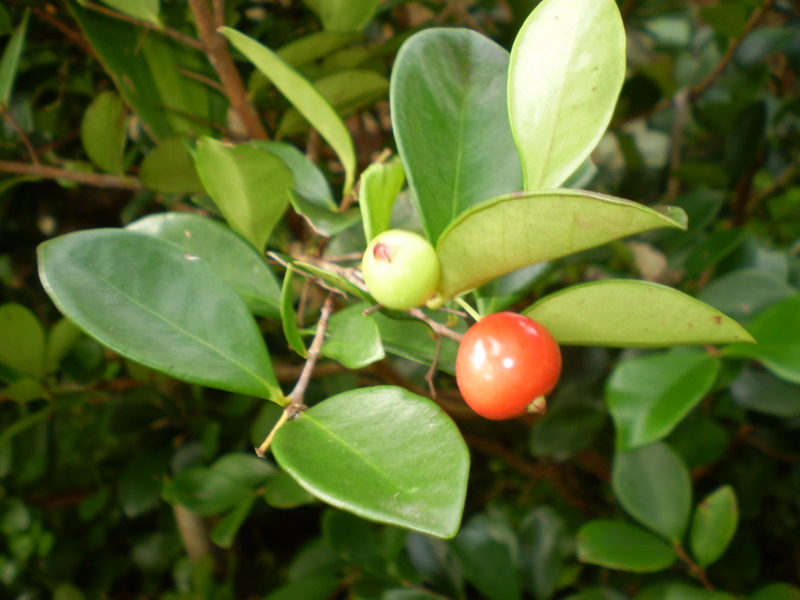
- Small white flowers.
- General cultivation
- General guidance (qualitative): Promising warm-site trial; protect from frost and maintain moisture.
- Botanical description
- Shrub or tree to 6 m high, branchlets hairy. Leaf lamina broadly to narrowly elliptic, ovate or obovate, 1.5–9.1 cm long, 0.9–4.7 cm wide, base narrowly cuneate or cuneate (rarely to truncate), apex short acuminate to obtuse (rarely to rounded), primary and secondary venation distinctly different, tertiary venation inconspicuous on both surfaces, intramarginal vein present and 0.4–3.2 mm from the margin, secondary intramarginal vein present or absent, oil glands visible to the unaided eye or with a 10 times hand lens in transmitted light and sparse to moderately dense. Inflorescences among to below the leaves, median axillary, proximal axillary or lateral. Flowers white or cream. Hypanthium hairy, stipitate, funnel-shaped, 2–4 mm long. Sepals dimorphic (inner lobes larger), persistent, inner sepals 2.5–3 mm long. Petals 4, deciduous, not coherent; oil glands 30–70 per petal. Style 2.5–5.5 mm long. Ovules 6–14 per locule, spreading, arranged irregularly. Mature fruit 13–23 mm long, red.
- Other botanical names
- Not recorded
- Attracts birds and bugs
- Native bees and insects visit flowers; canopy shelters birds.
- Flora of Australia profile
- https://profiles.ala.org.au/opus/foa/profile/Eugenia%20reinwardtiana Open source ↗
- Fruit type and description
- Red-orange fleshy fruit approximately 7-20 mm or more; flavour varies.
- Flora of Australia citation
- L.A. Craven, J.A. Matarczyk, P.G. Kodela. Eugenia reinwardtiana. Flora of Australia, Australian Biological Resources Study, Department of Climate Change, Energy, the Environment and Water, Canberra. https://profiles.ala.org.au/opus/foa/profile/Eugenia%20reinwardtiana (accessed 2026-10-14). Copyright Commonwealth of Australia; CC BY 4.0 (https://creativecommons.org/licenses/by/4.0/). HTML formatting removed; species-level context added where noted. Open source ↗ Open source 2 ↗
- Flora of Australia retrieved
- 14/10/2026