CAT-00100
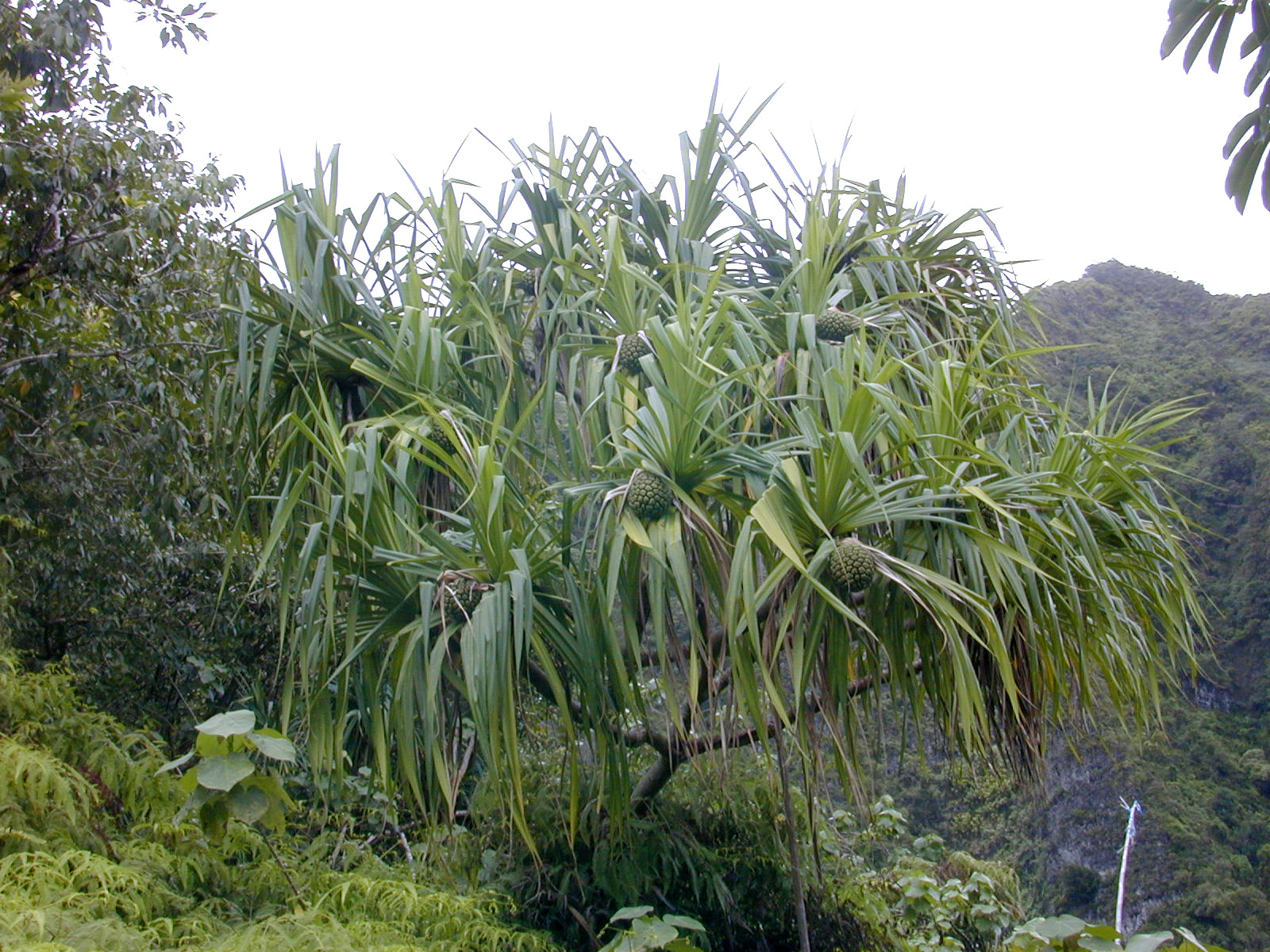
Native screw pine
Pandanus tectorius
Catalog fields
- Genus
- Pandanus
- Photo
- Not recorded
- Edible
- Yes
- layout
- single
- Habitat
- Found in coastal areas, on coral sands and rocky beaches and headlands, or on seaside fringes of forests coming down to the beach. On Cocos (Keeling) Islands occurs on the strand in white, coralline sand (Stone 1993: 436). For details on environmental preferences and tolerances (climate, soils, impacts of fire, waterlogging, wind, etc.), growth and development, propagation, genetics and many other features of the species see Thomson et al., Pandanus tectorius (Pandanus) (2006) and references therein. Has drift propagules with ability to colonise remote islands (sea-dispersed disseminule illustrated by Claussen (2005: 135). The tree is sand and salt tolerant (Beasley 2009: 195). The fruit is eaten by Palm Cockatoos (Cooper & Cooper 2004: 390).
- Published
- Yes
- Food group
- Fruit
- Latin name
- Pandanus tectorius
- Fruit photo
- Not recorded
- Plant title
- Native screw pine
- Source URLs
- https://profiles.ala.org.au/opus/foa/profile/Pandanus%20tectorius | https://www.daleysfruit.com.au/bushfoodintro.htm; https://plantnet.rbgsyd.nsw.gov.au/cgi-bin/NSWfl.pl?lvl=sp&name=Pandanus~tectorius&page=nswfl; https://powo.science.kew.org/taxon/urn%3Alsid%3Aipni.org%3Anames%3A895770-1 Open source ↗ Open source 2 ↗ Open source 3 ↗ Open source 4 ↗
- Catalogue ID
- CAT-00100
- Mature width
- Not confirmed; allow spread appropriate to growth habit
- Native range
- From the Torres Strait islands, Queensland, south along the east coast to northern New South Wales; also on Cocos (Keeling) Islands. Widely distributed in the Pacific Ocean and through coastal New Guinea and southeast Asia to the Indian Ocean.
- Plant family
- Pandanaceae
- Supplier SKU
- Not recorded
- Listing group
- Nursery-listed / regional edible
- Mature height
- Up to 5 m
- Native states
- NSW, QLD
- Original list
- No
- Research date
- 10/10/2026
- Research notes
- Source is a nursery catalogue overview; detailed species verification remains. Profile enriched from botanical/nursery sources. Dimensions are unpruned regional estimates where available; missing measurements remain explicit. Seasons are regional guides and vary with climate, location, cultivar and plant maturity. Drought and cultivation guidance are qualitative garden inferences, not measured ratings.
- Evidence status
- Nursery food-use listing; species detail review pending
- Fruiting season
- After pollination
- Background photo
- Not recorded
- Edible component
- Edible fruit portions; properly prepared kernels
- Flowering season
- Possibly throughout year in NSW flora.
- Brief description
- Branching palm-like coastal tree with prop roots and spiny leaf edges.
- Drought tolerance
- Moderate once established.
- Preparation notes
- Food use depends on local form and traditional preparation. Expert identification and preparation required.
- Flower description
- Male and female flowers occur on separate plants; male flowers in spikes, female flowers in dense heads.
- General cultivation
- General guidance (qualitative): Warm sheltered trial; allow space, protect from frost and confirm edible form.
- Botanical description
- Shrub or tree to 8 (–12) m high; prop roots usually numerous, to 1 (–1.7) m long; trunk and prop roots with warty nodules. Leaves erect, to 1.5 (–1.7) m long, (5–) 6–10 cm wide, sometimes glaucous; margins usually armed with prickles throughout, sometimes absent towards middle of leaf; midrib often without prickles in lower half, usually prickly above. Male flowers: stemonophores with c. 15 stamens; anthers c. 2 mm long. Fruiting head solitary, pendent, ellipsoid to broadly ovoid, 15–30 cm long, 10–20 cm diam., with up to 80 phalanges, orange-red. Phalanges with (5–) 8–15 (–20) carpels, ± globose, ± compressed, 3.8–6.5 cm long, 2–6.8 cm wide, (4–) 5 or 6 (–8)-angled, ± truncate to convex apically, smooth and ± shining on side faces, with sutures absent or sometimes visible in upper part. Carpel apices ± pyramidal, (0–) 2–6 (–8) mm high, ± equal or marginal ones larger; stigmas usually oblique. See also Stone (1993: 436), Cooper & Cooper (2004: 390), Thomson et al. (2006).
- Other botanical names
- Not recorded
- Attracts birds and bugs
- Native bees and insects visit flowers; canopy shelters birds.
- Flora of Australia profile
- https://profiles.ala.org.au/opus/foa/profile/Pandanus%20tectorius Open source ↗
- Fruit type and description
- Large compound fruit made of hard wedge-shaped segments; edible material varies by form.
- Flora of Australia citation
- A.J.G. Wilson, P.G. Kodela. Pandanus tectorius. Flora of Australia, Australian Biological Resources Study, Department of Climate Change, Energy, the Environment and Water, Canberra. https://profiles.ala.org.au/opus/foa/profile/Pandanus%20tectorius (accessed 2026-10-14). Copyright Commonwealth of Australia; CC BY 4.0 (https://creativecommons.org/licenses/by/4.0/). HTML formatting removed; species-level context added where noted. Open source ↗ Open source 2 ↗
- Flora of Australia retrieved
- 14/10/2026