CAT-00102
Pencil yam
Dioscorea transversa
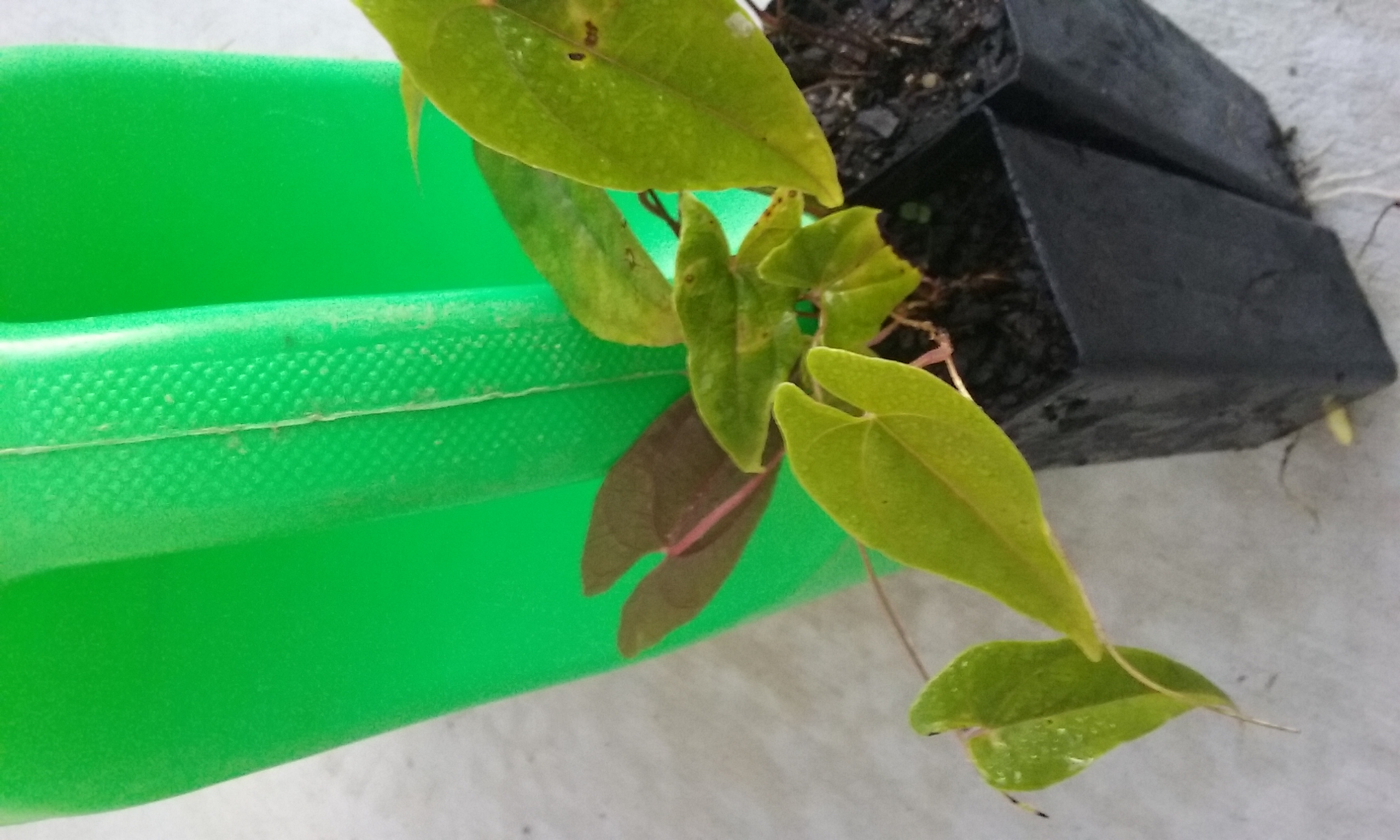
Catalog fields
- Genus
- Dioscorea
- Photo
- Not recorded
- Edible
- Yes
- layout
- single
- Habitat
- Grows in rainforest, wet eucalypt forest, gallery forest and occasionally in woodland. Coastal monsoon vine forest and thicket, often rambling into the surrounding open forest, streamline vegetation and vine forest in sandstone regions (Wightman & Andrews 1989: 122).
- Published
- Yes
- Food group
- Root / tuber
- Latin name
- Dioscorea transversa
- Fruit photo
- Not recorded
- Plant title
- Pencil yam
- Source URLs
- https://profiles.ala.org.au/opus/foa/profile/Dioscorea%20transversa | https://www.daleysfruit.com.au/bushfoodintro.htm; https://plantnet.rbgsyd.nsw.gov.au/cgi-bin/NSWfl.pl?lvl=sp&name=Dioscorea~transversa&page=nswfl Open source ↗ Open source 2 ↗ Open source 3 ↗
- Catalogue ID
- CAT-00102
- Mature width
- Depends on support
- Native range
- Widespread in coastal and near-coastal Australia from NW Kimberley region, Western Australia, through northern Northern Territory and eastern Queensland to Stanwell Park, New South Wales.
- Plant family
- Dioscoreaceae
- Supplier SKU
- Not recorded
- Listing group
- Nursery-listed / regional edible
- Mature height
- Twining stems 2-4 m
- Native states
- NSW, NT, QLD
- Original list
- No
- Research date
- 10/10/2026
- Research notes
- Source is a nursery catalogue overview; detailed species verification remains. Profile enriched from botanical/nursery sources. Dimensions are unpruned regional estimates where available; missing measurements remain explicit. Seasons are regional guides and vary with climate, location, cultivar and plant maturity. Drought and cultivation guidance are qualitative garden inferences, not measured ratings.
- Evidence status
- Nursery food-use listing; species detail review pending
- Fruiting season
- Capsules after flowers.
- Background photo
- Not recorded
- Edible component
- Cooked tuber
- Flowering season
- Spring.
- Brief description
- Perennial yam with annual twining stems and a deep narrow tuber.
- Drought tolerance
- Low during active growth.
- Preparation notes
- Use correctly identified underground food part; cooking and preparation need confirmation.
- Flower description
- Small greenish flowers; male flowers on spikes and female flowers in racemes.
- General cultivation
- General guidance (qualitative): Promising warm moist-site climber with support; species-specific tuber preparation needed.
- Botanical description
- Tuber conical to cylindroidal, to 45 cm long. Stems twining, to 4 m long, terete, striate, glabrous. Bulbils absent. Leaves: lamina ovate to broadly triangular, 4–13 cm long, 2–11 cm wide, usually cordate, rarely hastate or truncate at base, acuminate at apex, 5–9-veined, glabrous; petiole 1–9 cm long. Male flowers: spikes 1 or 2 per axil, to 6 cm long, often branched; sepals and petals orbicular, 1.5–2.5 mm long, pale green; stamens 6. Female flowers: racemes 1 or 2 per axil, to 20 cm long, sometimes branched; perianth slightly smaller than male; staminodes 6. Capsules suborbicular to broadly ovate in lateral view, obcordate at apex, 20–35 mm long; lobes 15–20 mm wide. Seeds 5–6 mm long; wing 3–12 mm wide.
- Other botanical names
- Not recorded
- Attracts birds and bugs
- Native bees and insects visit flowers; canopy shelters birds.
- Flora of Australia profile
- https://profiles.ala.org.au/opus/foa/profile/Dioscorea%20transversa Open source ↗
- Fruit type and description
- Three-lobed dry capsules with winged seeds; tuber is the food component.
- Flora of Australia citation
- I.R.H. Telford. Dioscorea transversa. Flora of Australia, Australian Biological Resources Study, Department of Climate Change, Energy, the Environment and Water, Canberra. https://profiles.ala.org.au/opus/foa/profile/Dioscorea%20transversa (accessed 2026-10-14). Copyright Commonwealth of Australia; CC BY 4.0 (https://creativecommons.org/licenses/by/4.0/). HTML formatting removed; species-level context added where noted. Open source ↗ Open source 2 ↗
- Flora of Australia retrieved
- 14/10/2026