CAT-00104
Coastal wattle
Acacia longifolia subsp. sophorae
Catalog fields
- Genus
- Acacia
- Photo
- Not recorded
- Edible
- Yes
- layout
- single
- Habitat
- Common on coastal dunes and headlands. Acacia longifolia subsp. sophorae is an important component of coastal vegetation involved in beach–dune processes and dynamics (playing a role in sand stabilisation, dune stability and ecosystems). It often forms a dense ±pure stand as a vegetation zonal band (as a secondary zone species) on foredunes behind the beach. Coastal Wattle is a potential weed in some circumstances (Richardson et al. 2006, 2016).
- Published
- Yes
- Food group
- Nut / seed
- Latin name
- Acacia longifolia subsp. sophorae
- Fruit photo
- Not recorded
- Plant title
- Coastal wattle
- Source URLs
- https://profiles.ala.org.au/opus/foa/profile/Acacia%20longifolia%20subsp.%20sophorae | https://www.fao.org/4/V5360E/v5360e0b.htm; https://anpsa.org.au/plant_profiles/acacia-longifolia/ Open source ↗ Open source 2 ↗ Open source 3 ↗
- Catalogue ID
- CAT-00104
- Mature width
- Not confirmed; allow spread appropriate to growth habit
- Native range
- Widespread principally in coastal tracts of southern and eastern continental Australia from the southern Eyre Peninsula in South Australia along the southern and eastern seaboards as far N as southeastern Queensland and S to the coasts of Tasmania, including the islands of Bass Strait. Naturalised in southwestern Western Australia, and parts of South Australia and Victoria.
- Plant family
- Fabaceae
- Supplier SKU
- Not recorded
- Listing group
- Regional / traditional food plant
- Mature height
- Prostrate to 2-3 m
- Native states
- NSW, QLD, SA, TAS, VIC
- Original list
- No
- Research date
- 10/10/2026
- Research notes
- Profile enriched from botanical/nursery sources. Dimensions are unpruned regional estimates where available; missing measurements remain explicit. Seasons are regional guides and vary with climate, location, cultivar and plant maturity. Drought and cultivation guidance are qualitative garden inferences, not measured ratings.
- Evidence status
- Published food use; preparation detail review pending
- Fruiting season
- Pods after flowering
- Background photo
- Not recorded
- Edible component
- Processed mature seeds
- Flowering season
- Late winter-spring.
- Brief description
- Low coastal wattle with oval phyllodes and yellow flower spikes.
- Drought tolerance
- High once established.
- Preparation notes
- Species-specific edible seed use; mature seeds generally processed/roasted. Do not generalise to other wattles.
- Flower description
- Bright-yellow flower spikes.
- General cultivation
- General guidance (qualitative): Promising full-sun shrub with drainage; manage self-seeding.
- Botanical description
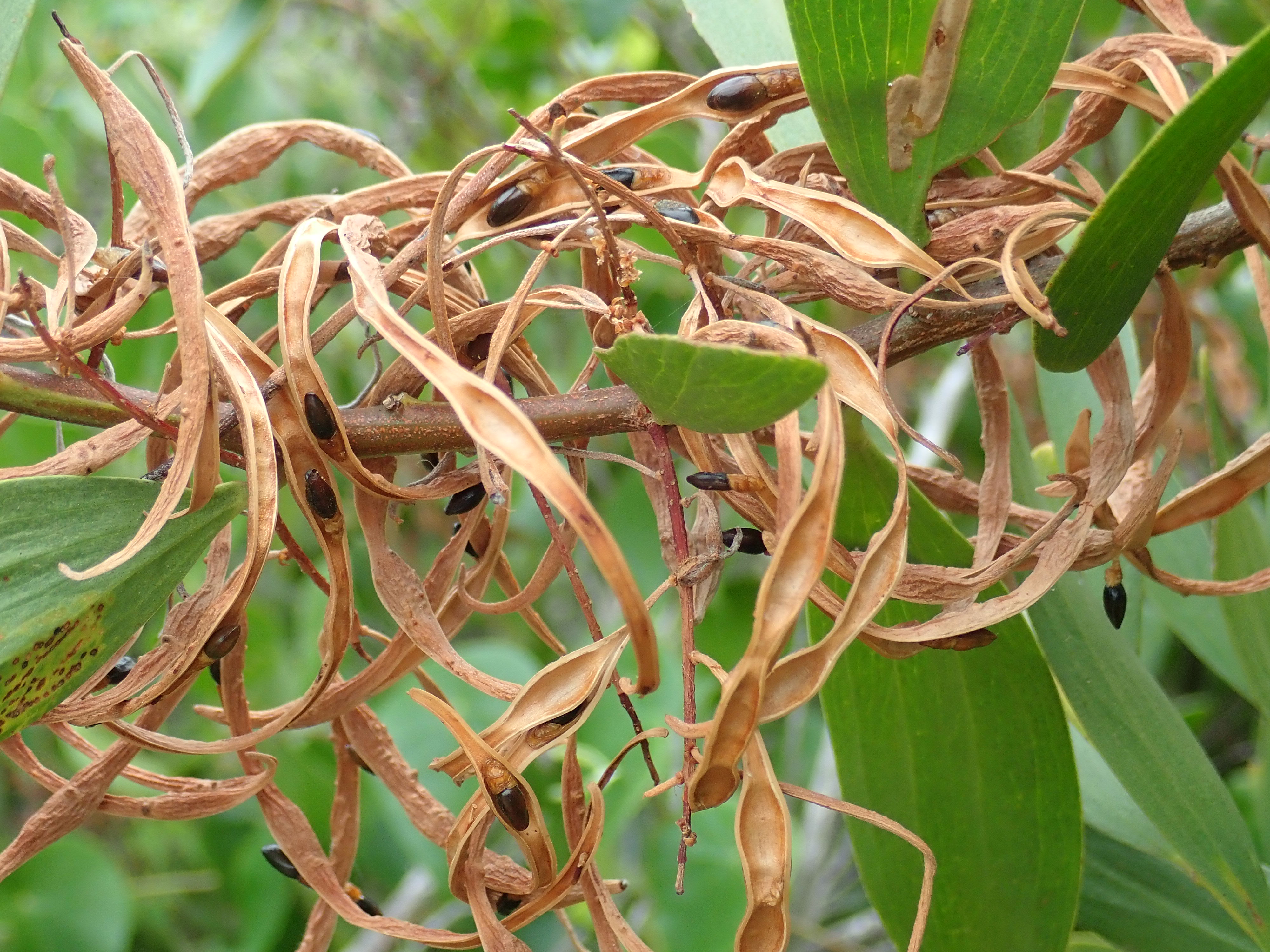
- Shrub to 5 m high (often low shrub, c. 0.5–3 m high, on exposed coastal foredunes), to 15 m or more wide, spreading, tangled, rarely erect. Phyllodes elliptic to narrowly elliptical (sometimes obovate to oblanceolate), 5–12 cm long, 10–30 mm wide, rounded obtuse or sometimes with a small mucronate point, subcoriaceous, sometimes fleshy, often yellowish green. Pods commonly coiled or contorted, sometimes drawn out into long beak, often firmly coriaceous.
- Other botanical names
- Not recorded
- Attracts birds and bugs
- Native bees and insects visit flowers; canopy shelters birds.
- Flora of Australia profile
- https://profiles.ala.org.au/opus/foa/profile/Acacia%20longifolia%20subsp.%20sophorae Open source ↗
- Fruit type and description
- Dry pods with seeds; mature seeds require species-specific processing.
- Flora of Australia citation
- A.B. Court, B.R. Maslin & P.G. Kodela. Acacia longifolia subsp. sophorae. Flora of Australia, Australian Biological Resources Study, Department of Climate Change, Energy, the Environment and Water, Canberra. https://profiles.ala.org.au/opus/foa/profile/Acacia%20longifolia%20subsp.%20sophorae (accessed 2026-10-14). Copyright Commonwealth of Australia; CC BY 4.0 (https://creativecommons.org/licenses/by/4.0/). HTML formatting removed; species-level context added where noted. Open source ↗ Open source 2 ↗
- Flora of Australia retrieved
- 14/10/2026