CAT-00106
Mulga
Acacia aneura
Catalog fields
- Genus
- Acacia
- Photo
- Not recorded
- Edible
- Yes
- layout
- double
- Habitat
- Recorded from a wide range of habitats.
- Published
- Yes
- Food group
- Nut / seed
- Latin name
- Acacia aneura
- Fruit photo
- Not recorded
- Plant title
- Mulga
- Source URLs
- https://profiles.ala.org.au/opus/foa/profile/Acacia%20aneura | https://www.fao.org/4/V5360E/v5360e0b.htm; https://plantnet.rbgsyd.nsw.gov.au/cgi-bin/NSWfl.pl?lvl=sp&name=Acacia~aneura&page=nswfl Open source ↗ Open source 2 ↗ Open source 3 ↗
- Catalogue ID
- CAT-00106
- Mature width
- Not confirmed; allow spread appropriate to growth habit
- Native range
- Widespread in all mainland States except Victoria.
- Plant family
- Fabaceae
- Supplier SKU
- Not recorded
- Listing group
- Regional / traditional food plant
- Mature height
- 5–10 m
- Native states
- NSW, NT, QLD, SA, WA
- Original list
- No
- Research date
- 10/10/2026
- Research notes
- Profile enriched from botanical/nursery sources. Dimensions are unpruned regional estimates where available; missing measurements remain explicit. Seasons are regional guides and vary with climate, location, cultivar and plant maturity. Drought and cultivation guidance are qualitative garden inferences, not measured ratings.
- Evidence status
- Published food use; preparation detail review pending
- Fruiting season
- Pods after flowering; rainfall dependent.
- Background photo
- Not recorded
- Edible component
- Processed mature seeds
- Flowering season
- Usually March-May in NSW; rainfall may affect timing.
- Brief description
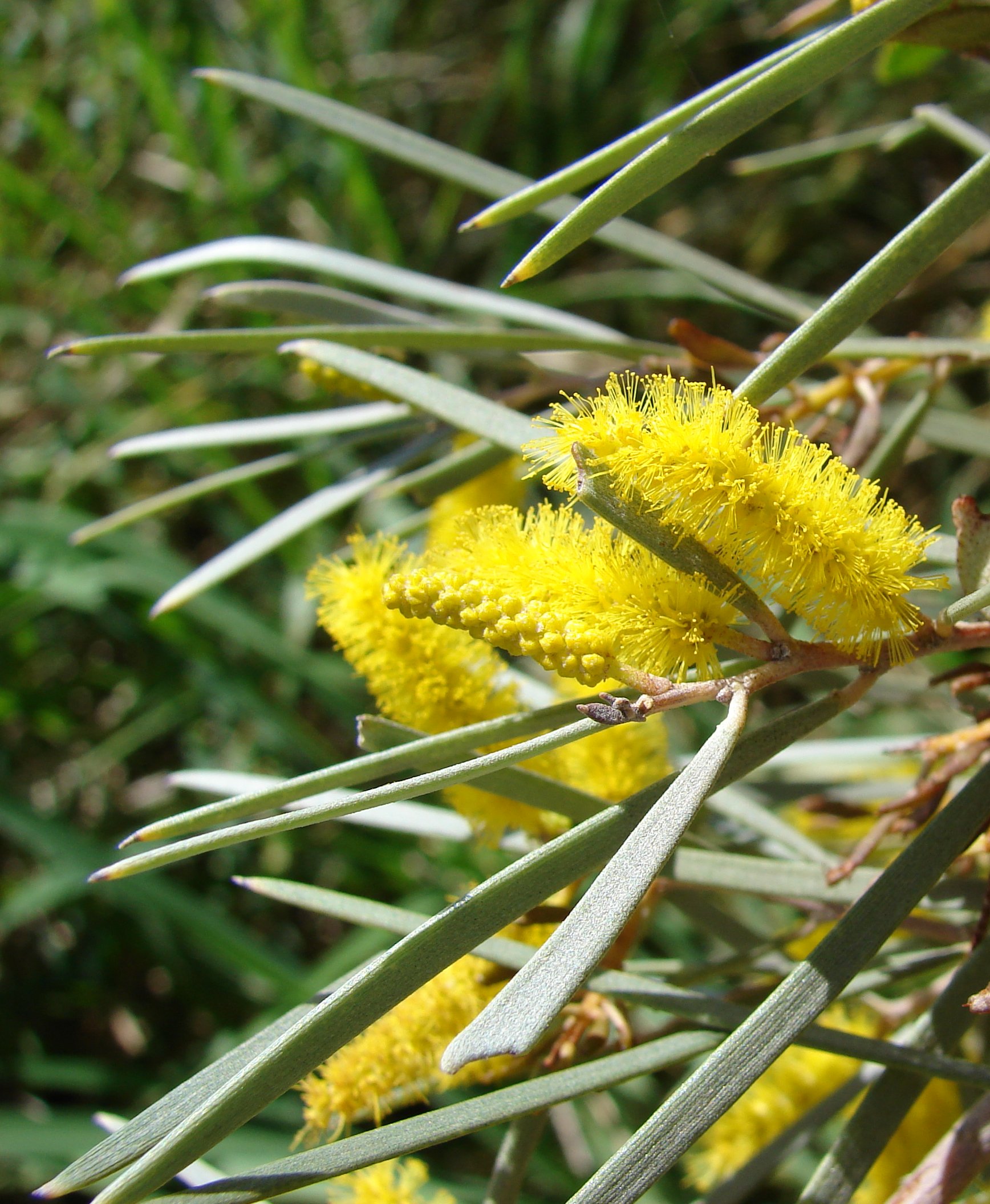
- Grey-green inland tree or shrub with yellow flower spikes.
- Drought tolerance
- High once established.
- Preparation notes
- Species-specific edible seed use; mature seeds generally processed/roasted. Do not generalise to other wattles.
- Flower description
- Bright-yellow flowers in short cylindrical spikes.
- General cultivation
- General guidance (qualitative): Specialist dry-site trial; wet humid summers may be difficult and mulga identity matters.
- Botanical description
- Shrub or tree 2.5–7 (–10 m) high, often multistemmed with bushy crowns, rarely with a conifer or pseudo-confier growth form. Branchlets obscurely ribbed or ribless, ribs not resinous or with a normally thin layer of translucent resin; new shoots resinous, with a dense layer of dark-coloured glandular hairlets. Phyllodes narrowly linear to linear-elliptic, mostly shallowly incurved, not rigid, flat, 4–12 (–18) cm long, (1–) 1.5–3 (–4) mm wide, 2–3 cm long and clustered in groups of 2 or 3 on juvenile plants, glabrous or obscurely appressed-hairy between veins, normally grey-green to subglaucous and often with a silvery sheen, longitudinal veins numerous and very fine, margins not resinous; gland 0–1 (–3) mm above pulvinus. Inflorescences mostly simple; peduncles 4–10 (–15) mm long, sparsely to ± densely sericeous with commonly some red-brown glandular hairlets; spikes (10–) 15–30 (–40) mm long. Flowers 5-merous; sepals free, ½–¾ length of petals, normally linear-spathulate. Pods mostly straight-edged, flat, (1–) 1.5–4 cm long, (6–) 7–15 mm wide including the wing 0.4–1 (–2) mm wide, chartaceous to firmly chartaceous, normally brown to grey-brown, glabrous or sparsely appressed puberulous, obscurely reticulate; margins winged or rarely bevel-edged, often shiny-resinous. Seeds transverse to oblique, 3.5–5 mm long, 2.5–3 (–3.5) mm wide, elliptic to oblong or ovate; aril small, whitish or cream.
- Other botanical names
- Not recorded
- Attracts birds and bugs
- Native bees and insects visit flowers; canopy shelters birds.
- Flora of Australia profile
- https://profiles.ala.org.au/opus/foa/profile/Acacia%20aneura Open source ↗
- Fruit type and description
- Flat dry seed pods; processed seed is the food component.
- Flora of Australia citation
- B.R. Maslin. Acacia aneura. Flora of Australia, Australian Biological Resources Study, Department of Climate Change, Energy, the Environment and Water, Canberra. https://profiles.ala.org.au/opus/foa/profile/Acacia%20aneura (accessed 2026-10-14). Copyright Commonwealth of Australia; CC BY 4.0 (https://creativecommons.org/licenses/by/4.0/). HTML formatting removed; species-level context added where noted. Open source ↗ Open source 2 ↗
- Flora of Australia retrieved
- 14/10/2026