CAT-00107
Cole's wattle
Acacia colei
Catalog fields
- Genus
- Acacia
- Photo
- Not recorded
- Edible
- Yes
- layout
- single
- Habitat
- Dense regrowth populations often develop in disturbed sites such as road verges, gravel pits and burnt areas. Details on the habitat and ecology of Acacia colei are provided by J.C. Doran et al., in J.C. Doran & J.W. Turnbull (eds), Australian Trees and Shrubs: Species for Land Rehabilitation and Farm Planting in the Tropics 128–131 (1997).
- Published
- Yes
- Food group
- Nut / seed
- Latin name
- Acacia colei
- Fruit photo
- Not recorded
- Plant title
- Cole's wattle
- Source URLs
- https://profiles.ala.org.au/opus/foa/profile/Acacia%20colei | https://www.fao.org/4/x0963e/x0963e0c.htm Open source ↗ Open source 2 ↗
- Catalogue ID
- CAT-00107
- Mature width
- Not confirmed; allow spread appropriate to growth habit
- Native range
- Widespread in northern Australia between latitudes 16° and 22°S, extending from the Pilbara region of Western Australia through the Northern Territory to northwestern Queensland.
- Plant family
- Fabaceae
- Supplier SKU
- Not recorded
- Listing group
- Regional / traditional food plant
- Mature height
- Not confirmed; habit described in brief description
- Native states
- NT, QLD, WA
- Original list
- No
- Research date
- 10/10/2026
- Research notes
- Profile enriched from botanical/nursery sources. Dimensions are unpruned regional estimates where available; missing measurements remain explicit. Seasons are regional guides and vary with climate, location, cultivar and plant maturity. Drought and cultivation guidance are qualitative garden inferences, not measured ratings.
- Evidence status
- Published food use; preparation detail review pending
- Fruiting season
- Species-specific period not yet confirmed.
- Background photo
- Not recorded
- Edible component
- Processed mature seeds
- Flowering season
- Species-specific period not yet confirmed.
- Brief description
- Fast-growing inland wattle with broad pale phyllodes.
- Drought tolerance
- High once established.
- Preparation notes
- Species-specific edible seed use; mature seeds generally processed/roasted. Do not generalise to other wattles.
- Flower description
- Flower appearance not yet confirmed from the reviewed species-specific sources.
- General cultivation
- General guidance (qualitative): Trial in full sun and drainage; establish with water and confirm seed identity.
- Botanical description
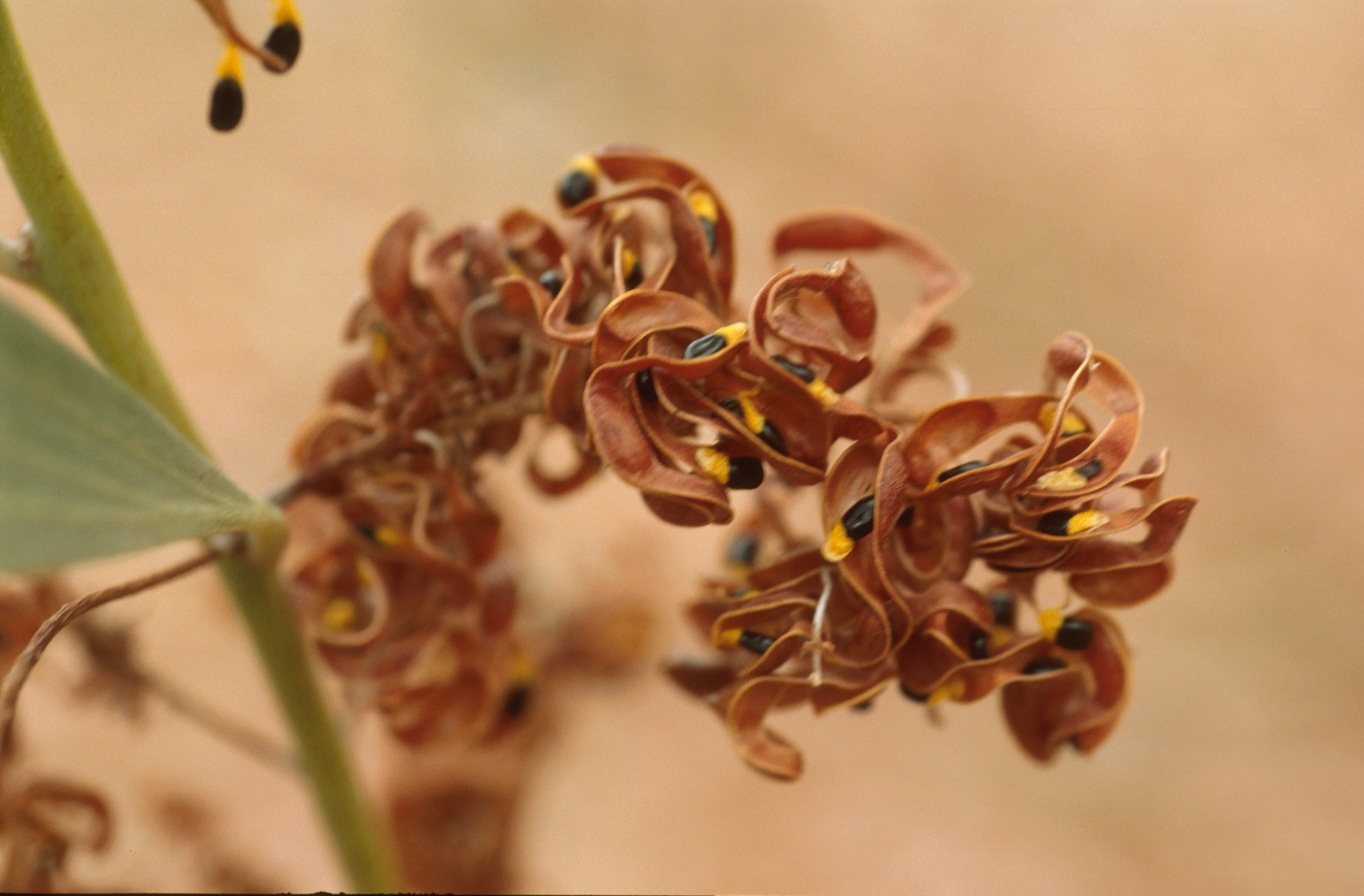
- Spreading shrub 2–4 m high; occasionally a tree to 9 m high. New shoots sericeous; hairs pale yellow-brown, soon ageing silvery. Branchlets acutely angled, silvery-sericeous. Phyllodes normally obliquely narrowly elliptic, ± straight but commonly shallowly recurved at apices, mostly ascending to erect, 7–23 (–25) mm long, 10–45 (–55) mm wide, with knob-like mucro, silvery green, grey-green or bluish, sericeous but indumentum sparse on oldest phyllodes; main veins 3 or 4 per face, some confluent and ± contiguous with the lower margin at base; minor veins forming an obvious longitudinally orientated reticulum; gland absent from apex of phyllodes. Inflorescences rudimentary 2-headed racemes with axes to 0.5 mm long; peduncles (2–) 3–5 (–10) mm long, appressed-puberulous to sericeous, with indumentum sometimes sparse; spikes 3–7 cm long, golden. Flowers 5-merous; sepals united; petals hairy. Pods openly and strongly curved (var. colei) or tightly coiled (var. ileocarpa), with dehisced valves somewhat twisted, entangled and persisting as conspicuous clumps following dehiscence, 3.5–4 mm wide, thinly coriaceous-crustaceous, glabrous or subglabrous. Seeds longitudinal, normally oblong, 3–4 mm long, glossy, very dark brown to black; aril bright yellow.
- Other botanical names
- Not recorded
- Attracts birds and bugs
- Native bees and insects visit flowers; canopy shelters birds.
- Flora of Australia profile
- https://profiles.ala.org.au/opus/foa/profile/Acacia%20colei Open source ↗
- Fruit type and description
- Dry pods with edible seed after appropriate processing.
- Flora of Australia citation
- B.R. Maslin. Acacia colei. Flora of Australia, Australian Biological Resources Study, Department of Climate Change, Energy, the Environment and Water, Canberra. https://profiles.ala.org.au/opus/foa/profile/Acacia%20colei (accessed 2026-10-14). Copyright Commonwealth of Australia; CC BY 4.0 (https://creativecommons.org/licenses/by/4.0/). HTML formatting removed; species-level context added where noted. Open source ↗ Open source 2 ↗
- Flora of Australia retrieved
- 14/10/2026