CAT-00124
Spiny-headed mat-rush
Lomandra longifolia
Catalog fields
- Genus
- Lomandra
- Photo
- Not recorded
- Edible
- Yes
- layout
- single
- Habitat
- Grows in a variety of habitats.
- Published
- Yes
- Food group
- Vegetable
- Latin name
- Lomandra longifolia
- Fruit photo
- Not recorded
- Plant title
- Spiny-headed mat-rush
- Source URLs
- https://profiles.ala.org.au/opus/foa/profile/Lomandra%20longifolia | https://www.anbg.gov.au/apu/plants/lomalong.html; https://plantnet.rbgsyd.nsw.gov.au/cgi-bin/NSWfl.pl?lvl=sp&name=Lomandra~longifolia&page=nswfl; https://powo.science.kew.org/taxon/urn%3Alsid%3Aipni.org%3Anames%3A443678-1 Open source ↗ Open source 2 ↗ Open source 3 ↗ Open source 4 ↗
- Catalogue ID
- CAT-00124
- Mature width
- Not confirmed; allow spread appropriate to growth habit
- Native range
- Occurs in eastern parts of eastern Australia, from Lizard Is. in N Qld to the Mt Gambier and Millicent area of S.A., and eastern and northern Tas.
- Plant family
- Asparagaceae
- Supplier SKU
- Not recorded
- Listing group
- Regional / traditional food plant
- Mature height
- About 1 m
- Native states
- NSW, QLD, SA, TAS, VIC
- Original list
- No
- Research date
- 10/10/2026
- Research notes
- Profile enriched from botanical/nursery sources. Dimensions are unpruned regional estimates where available; missing measurements remain explicit. Seasons are regional guides and vary with climate, location, cultivar and plant maturity. Drought and cultivation guidance are qualitative garden inferences, not measured ratings.
- Evidence status
- Published food use; preparation detail review pending
- Fruiting season
- Capsules follow flowering.
- Background photo
- Not recorded
- Edible component
- Tender white leaf bases; seeds reported
- Flowering season
- Spring.
- Brief description
- Tough clumping strappy-leaved perennial with scented flowers.
- Drought tolerance
- High once established.
- Preparation notes
- Confirm species identification, the specified edible part, ripeness and species-specific preparation before use.
- Flower description
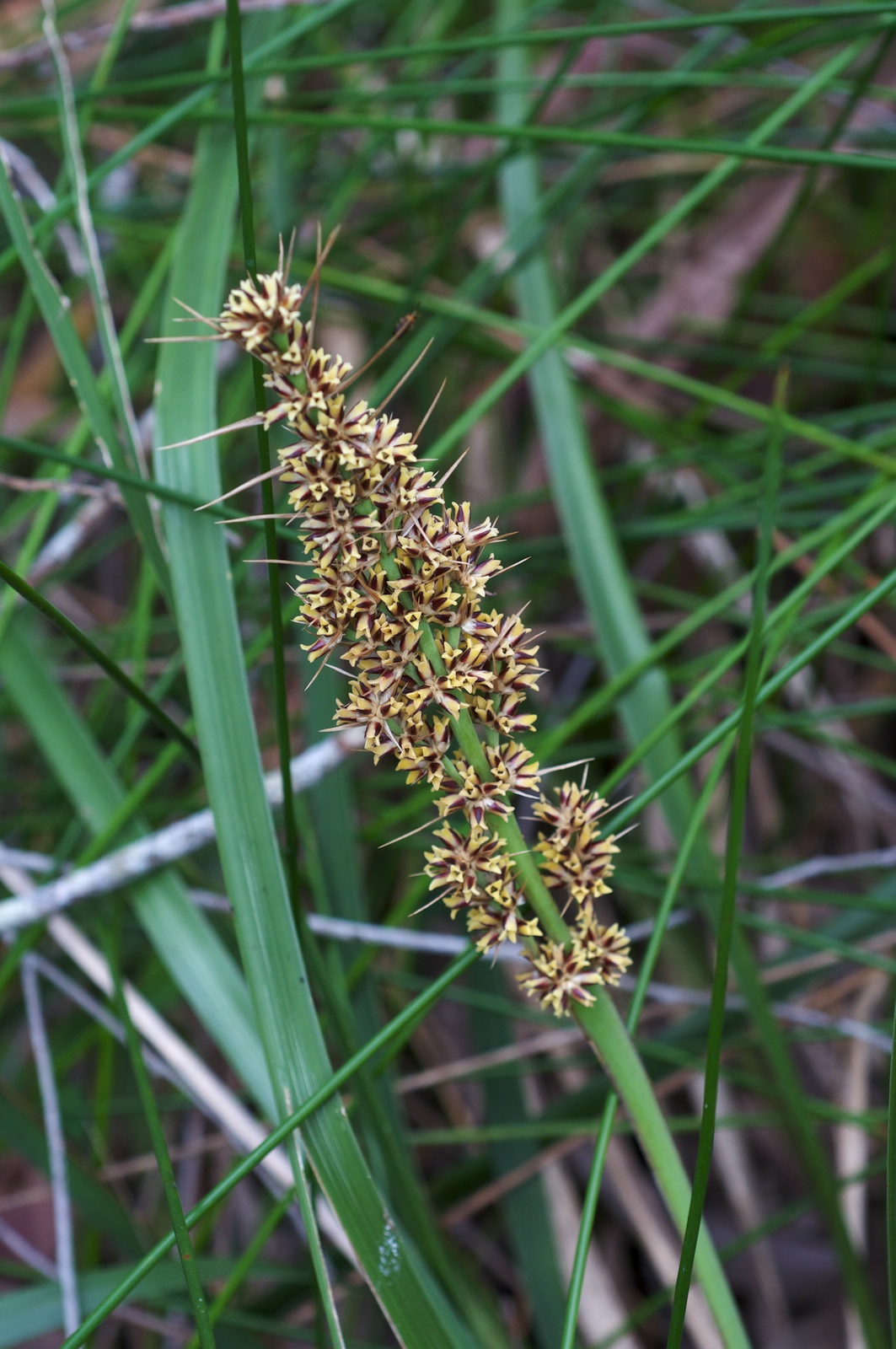
- Small flowers in dense clusters protected by spiny bracts.
- General cultivation
- General guidance (qualitative): Good low-maintenance prospect in sun or part shade; use correct edible part.
- Botanical description
- Plant tufted. Leaves flat or slightly concavo-convex, occasionally rolled, usually 50-100 cm long and 4.5-7.5 mm wide, glabrous; apex 2- or 3-toothed, central tooth in pronounced sinus or longer than laterals; sheath margins intact or coarsely split, brown, orange-brown or reddish brown, occasionally white. Male and female inflorescences similar, simple or branched; all branches or when many the larger branches often 2 per node, distichous, from under 8 cm up to 15 cm long; scape distinct, much shorter to much longer than rachis, flattened; flower clusters whorled. Cluster bracts conspicuous, longer to much longer than flowers, pungent; bract and inner bract shorter than flower, truncate, whitish. Flowers ellipsoidal or cylindrical, sessile; male flowers 3-3.5 mm long, females c. 4.5 mm long. Sepals shiny, scarious, purplish or yellow. Petals dull, fleshy, yellow or cream.
- Other botanical names
- Not recorded
- Attracts birds and bugs
- Native bees and insects visit flowers; canopy shelters birds.
- Flora of Australia profile
- https://profiles.ala.org.au/opus/foa/profile/Lomandra%20longifolia Open source ↗
- Fruit type and description
- Dry capsules containing seeds; leaf bases and processed seeds are recorded food parts.
- Flora of Australia citation
- Alma T. Lee, T.D. Macfarlane. Lomandra longifolia. Flora of Australia, Australian Biological Resources Study, Department of Climate Change, Energy, the Environment and Water, Canberra. https://profiles.ala.org.au/opus/foa/profile/Lomandra%20longifolia (accessed 2026-10-15). Copyright Commonwealth of Australia; CC BY 4.0 (https://creativecommons.org/licenses/by/4.0/). HTML formatting removed; species-level context added where noted. Open source ↗ Open source 2 ↗
- Flora of Australia retrieved
- 15/10/2026