CAT-00080
Seablite
Suaeda australis
Catalog fields
- Genus
- Suaeda
- Photo
- Not recorded
- Edible
- Yes
- layout
- single
- Habitat
- Not recorded
- Published
- Yes
- Food group
- Leaf vegetable
- Latin name
- Suaeda australis
- Fruit photo
- Not recorded
- Plant title
- Seablite
- Source URLs
- https://profiles.ala.org.au/opus/foa/profile/Suaeda%20australis | https://tuckerbush.com.au/plants/vegetable-plants/; https://tuckerbush.com.au/seablite-suaeda-australis/; https://powo.science.kew.org/taxon/urn%3Alsid%3Aipni.org%3Anames%3A167416-1 Open source ↗ Open source 2 ↗ Open source 3 ↗ Open source 4 ↗
- Catalogue ID
- CAT-00080
- Mature width
- 1m
- Native range
- Found around the west, south and east coasts of Australia, from the Abrolhos Islands in W.A. to near Townsville in Qld; and around the eastern and southern coast to S.A. and Tas. Also sometimes inland in wet, somewhat saline areas.
- Plant family
- Amaranthaceae
- Supplier SKU
- Not recorded
- Listing group
- Nursery-listed / regional edible
- Mature height
- 20-50cm
- Native states
- NSW, NT, QLD, SA, TAS, VIC, WA
- Original list
- No
- Research date
- 10/10/2026
- Research notes
- Profile enriched from botanical/nursery sources. Dimensions are unpruned regional estimates where available; missing measurements remain explicit. Seasons are regional guides and vary with climate, location, cultivar and plant maturity. Drought and cultivation guidance are qualitative garden inferences, not measured ratings.
- Evidence status
- Nursery food-use source; preparation detail review pending
- Fruiting season
- After flowering.
- Background photo
- Not recorded
- Edible component
- Leaves and shoots
- Flowering season
- Summer-early winter reported by nursery.
- Brief description
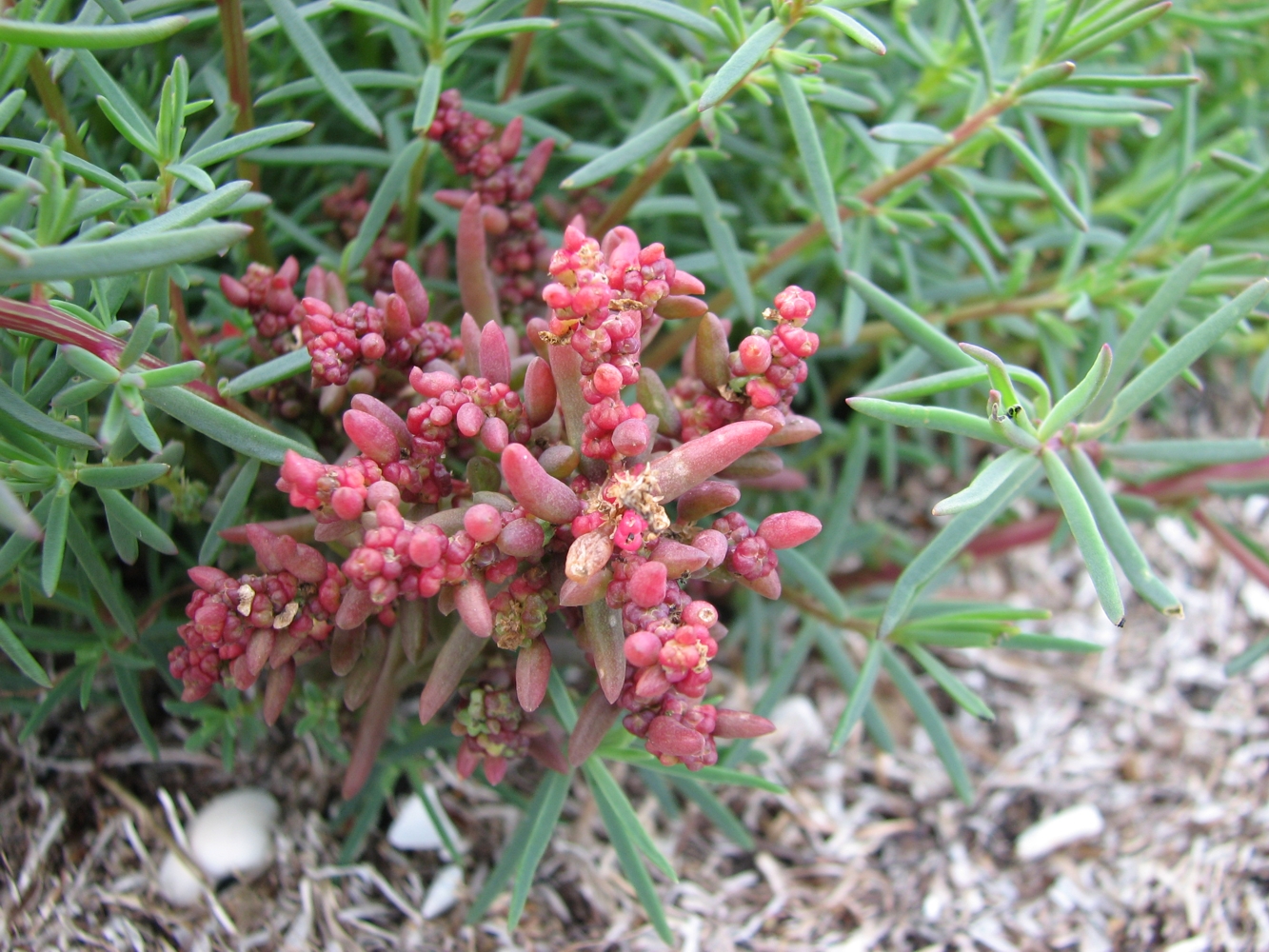
- Succulent saltmarsh shrub with narrow leaves.
- Drought tolerance
- Low to moderate; naturally favours moist soils.
- Preparation notes
- Use correctly identified tender shoots; salty foliage may be blanched.
- Flower description
- Tiny clustered flowers, sometimes pink-tinged.
- General cultivation
- General guidance (qualitative): Trial a moist contained bed or pot; salt tolerance does not mean salt is essential.
- Botanical description
- Rounded perennial branching from base, glabrous. Leaves slender and semiterete, c. 30 mm long, to thick and fusiform, c. 10 mm long, acute or obtuse, succulent, without a pellucid margin. Flowers bisexual, in axillary clusters. Fruiting perianth divided to near base, depressed-spherical, c. 3 mm diam.; lobes succulent, rounded on back; ovary free, depressed-globular, passing into a stout style, c. 0.5 mm long; stigmas 2 or 3, slender. Seed horizontal, lenticular, c. 1 mm diam.; testa smooth, glossy, reddish brown; perisperm slight on upper and lower side of embryo. See also Curtis (1967: 580), Ross (1983: 127), Wilson (1986: 309–310), Rye (1987: 91), Jacobs (1990: 247), Walsh (1996: 196–197).
- Other botanical names
- Not recorded
- Attracts birds and bugs
- Native bees and insects visit flowers; canopy shelters birds.
- Flora of Australia profile
- https://profiles.ala.org.au/opus/foa/profile/Suaeda%20australis Open source ↗
- Fruit type and description
- Small dry one-seeded fruits; tender shoots are the food crop.
- Flora of Australia citation
- Paul G. Wilson, P.G. Kodela. Suaeda australis. Flora of Australia, Australian Biological Resources Study, Department of Climate Change, Energy, the Environment and Water, Canberra. https://profiles.ala.org.au/opus/foa/profile/Suaeda%20australis (accessed 2026-10-14). Copyright Commonwealth of Australia; CC BY 4.0 (https://creativecommons.org/licenses/by/4.0/). HTML formatting removed; species-level context added where noted. Open source ↗ Open source 2 ↗
- Flora of Australia retrieved
- 14/10/2026