CAT-00094
Zigzag vine
Uvaria leichhardtii
Catalog fields
- Genus
- Uvaria
- Photo
- Not recorded
- Edible
- Yes
- layout
- single
- Habitat
- Found in most rainforest types, except those at high altitude, and also adjacent eucalypt forest. Host to the 4 Barred Swordtail and Spotted Triangle butterflies (Beasley 2009: 129).
- Published
- Yes
- Food group
- Fruit
- Latin name
- Uvaria leichhardtii
- Fruit photo
- Not recorded
- Plant title
- Zigzag vine
- Source URLs
- https://profiles.ala.org.au/opus/foa/profile/Uvaria%20leichhardtii | https://www.daleysfruit.com.au/bushfoodintro.htm; https://powo.science.kew.org/taxon/urn%3Alsid%3Aipni.org%3Anames%3A77105413-1; https://apps.lucidcentral.org/rainforest/text/entities/uvaria_leichhardtii.htm Open source ↗ Open source 2 ↗ Open source 3 ↗ Open source 4 ↗
- Catalogue ID
- CAT-00094
- Mature width
- Not confirmed; allow spread appropriate to growth habit
- Native range
- Occurs from Papua New Guinea and Torres Strait, Queensland, to Dorrigo, New South Wales.
- Plant family
- Annonaceae
- Supplier SKU
- Not recorded
- Listing group
- Nursery-listed / regional edible
- Mature height
- Not confirmed; habit described in brief description
- Native states
- NSW, NT, QLD
- Original list
- No
- Research date
- 10/10/2026
- Research notes
- Source is a nursery catalogue overview; detailed species verification remains. Profile enriched from botanical/nursery sources. Dimensions are unpruned regional estimates where available; missing measurements remain explicit. Seasons are regional guides and vary with climate, location, cultivar and plant maturity. Drought and cultivation guidance are qualitative garden inferences, not measured ratings.
- Evidence status
- Nursery food-use listing; species detail review pending
- Fruiting season
- Species-specific ripening period not yet confirmed.
- Background photo
- Not recorded
- Edible component
- Ripe fruit pulp
- Flowering season
- Species-specific flowering period not yet confirmed.
- Brief description
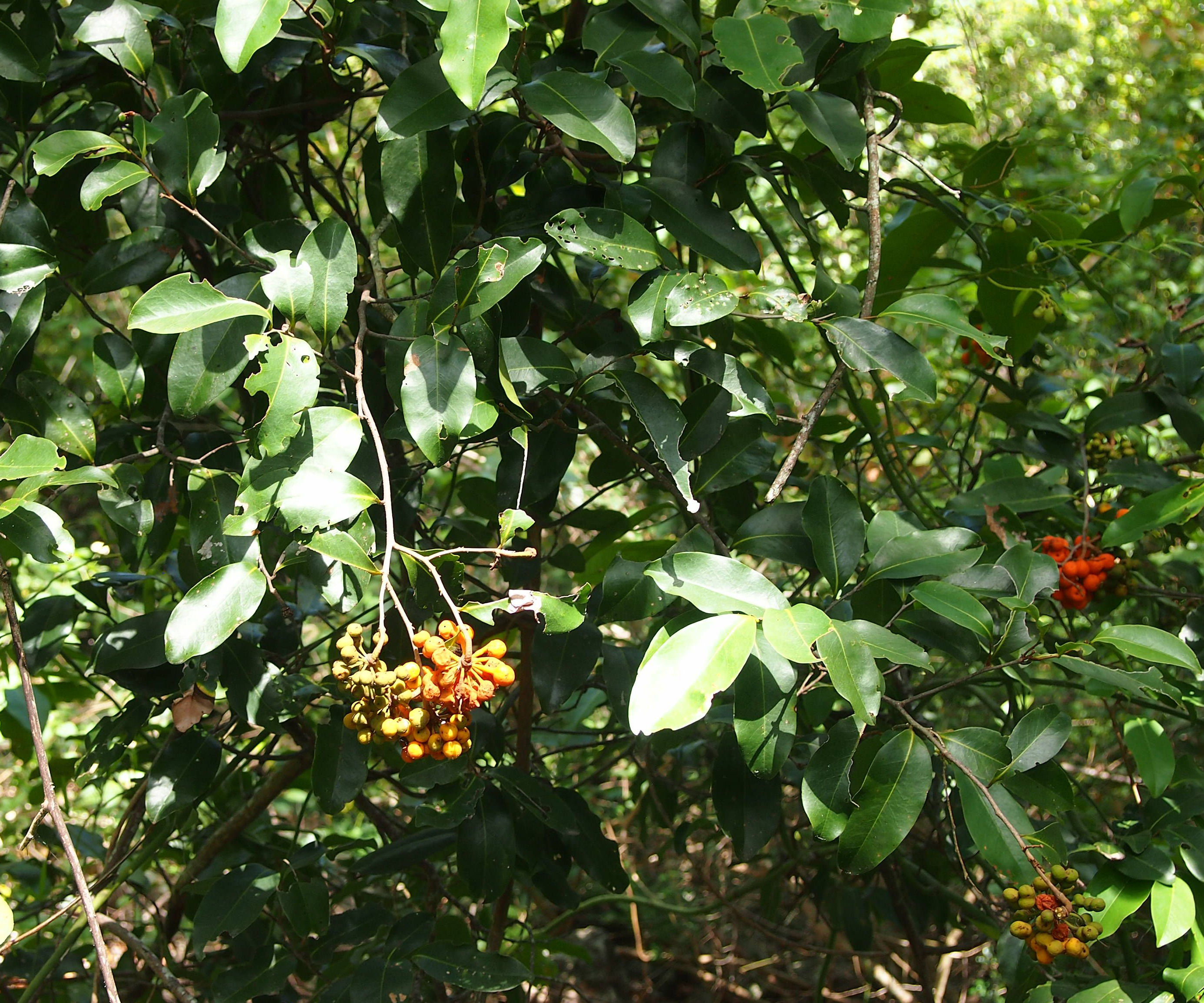
- Woody rainforest climber with fleshy orange fruit clusters.
- Drought tolerance
- Low to moderate; keep moist.
- Preparation notes
- Confirm species identification, the specified edible part, ripeness and species-specific preparation before use.
- Flower description
- Flowers with six thick, fleshy petals, arranged as three outer and three inner petals.
- General cultivation
- General guidance (qualitative): Trial a sheltered site with strong support and reliable moisture.
- Botanical description
- Tall liana. Branchlets glabrescent. Leaves: petiole 3–5 mm long; lamina ovate, elliptic or narrowly obovate, 4–14 cm long, 1.2–5 cm wide, acute at base and apex, glabrous above, glabrescent below; secondary veins 9–13 pairs. Cyme with 1 or 2 flowers. Pedicel 1.3–2 cm long, sparsely pubescent; bracts 4 mm long. Sepals depressed-ovate, 4 mm long, 5 mm wide, pubescent. Petals yellow-brown. Outer petals broadly ovate, pubescent outside, concave and shallowly, medially grooved inside and glabrous at base, 11–20 mm long, 8–15 mm wide. Inner petals rhombic, 8–15 mm long, 7–12 mm wide; claw half as long as blade. Stamens c. 150, 1.8 mm long. Carpels 18–25; ovary 1.8 mm long; ovules 4 or 5; stigma subcylindrical, minutely warty. Apocarps ellipsoidal or obloid, oblique, often torulose, 0.7–5 cm long, 0.9–1.5 cm wide, glabrescent; stipe 1–2 cm long. Seeds 1–4.
- Other botanical names
- Not recorded
- Attracts birds and bugs
- Native bees and insects visit flowers; canopy shelters birds.
- Flora of Australia profile
- https://profiles.ala.org.au/opus/foa/profile/Uvaria%20leichhardtii Open source ↗
- Fruit type and description
- Clustered orange fleshy monocarps around hard seeds.
- Flora of Australia citation
- L.W. Jessup, P.G. Kodela. Uvaria leichhardtii. Flora of Australia, Australian Biological Resources Study, Department of Climate Change, Energy, the Environment and Water, Canberra. https://profiles.ala.org.au/opus/foa/profile/Uvaria%20leichhardtii (accessed 2026-10-14). Copyright Commonwealth of Australia; CC BY 4.0 (https://creativecommons.org/licenses/by/4.0/). HTML formatting removed; species-level context added where noted. Open source ↗ Open source 2 ↗
- Flora of Australia retrieved
- 14/10/2026