CAT-00101
Dorrigo pepper
Tasmannia stipitata
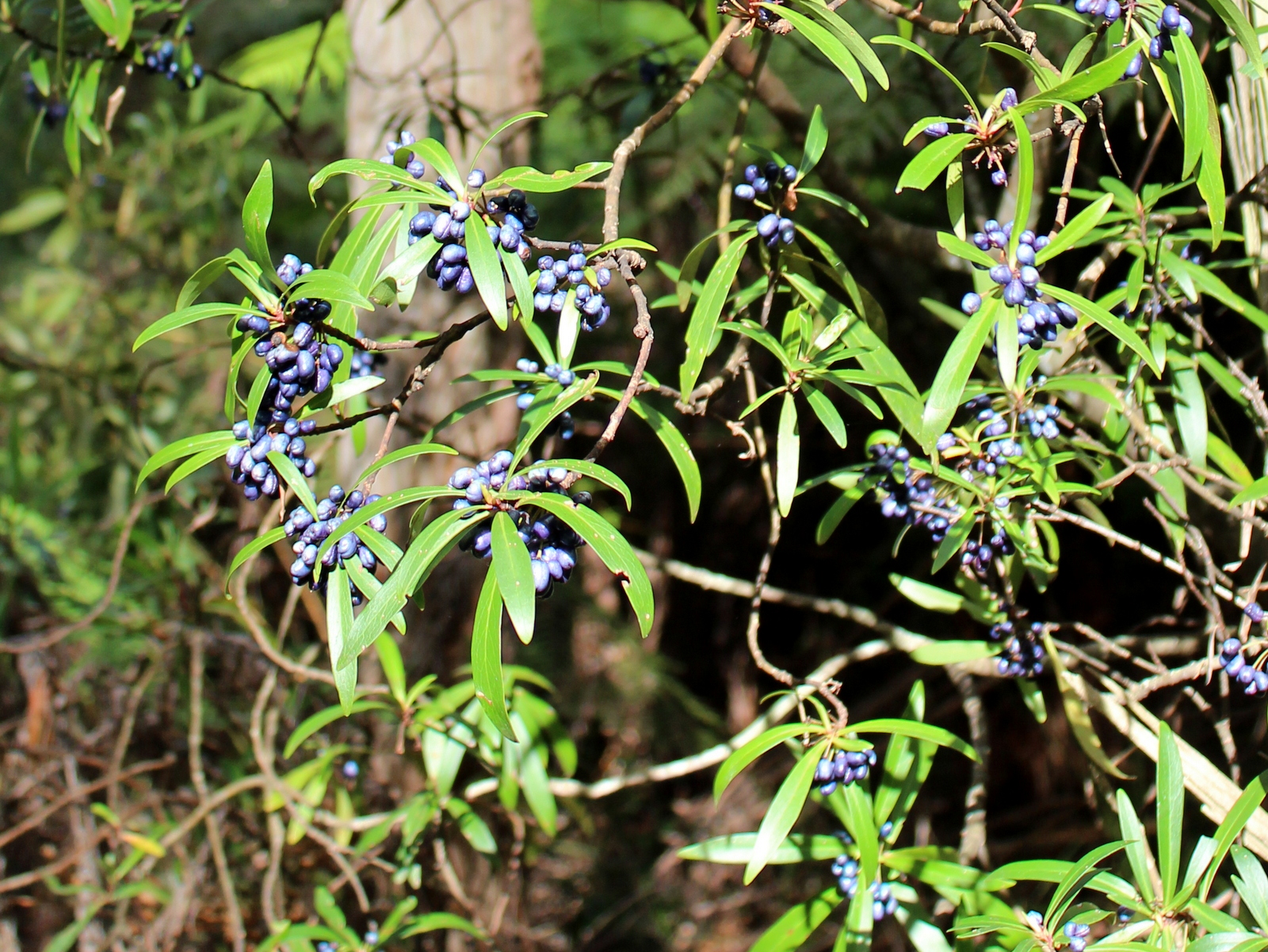
Catalog fields
- Genus
- Tasmannia
- Photo
- Not recorded
- Edible
- Yes
- layout
- single
- Habitat
- Grows in moist eucalypt forest and in temperate rainforest, especially Nothofagus moorei communities, usually above 1000 m alt.
- Published
- Yes
- Food group
- Herb / spice
- Latin name
- Tasmannia stipitata
- Fruit photo
- Not recorded
- Plant title
- Dorrigo pepper
- Source URLs
- https://profiles.ala.org.au/opus/foa/profile/Tasmannia%20stipitata | https://www.daleysfruit.com.au/bushfoodintro.htm; https://plantnet.rbgsyd.nsw.gov.au/cgi-bin/NSWfl.pl?lvl=sp&name=Tasmannia~stipitata&page=nswfl Open source ↗ Open source 2 ↗ Open source 3 ↗
- Catalogue ID
- CAT-00101
- Mature width
- Not confirmed; allow spread appropriate to growth habit
- Native range
- Girraween National Park, southeastern Queensland, to Barrington Tops, northeastern New South Wales.
- Plant family
- Winteraceae
- Supplier SKU
- Not recorded
- Listing group
- Nursery-listed / regional edible
- Mature height
- 1–2.5 m
- Native states
- NSW, QLD
- Original list
- No
- Research date
- 10/10/2026
- Research notes
- Source is a nursery catalogue overview; detailed species verification remains. Profile enriched from botanical/nursery sources. Dimensions are unpruned regional estimates where available; missing measurements remain explicit. Seasons are regional guides and vary with climate, location, cultivar and plant maturity. Drought and cultivation guidance are qualitative garden inferences, not measured ratings.
- Evidence status
- Nursery food-use listing; species detail review pending
- Fruiting season
- After flowering
- Background photo
- Not recorded
- Edible component
- Leaves and ripe berries
- Flowering season
- September-November.
- Brief description
- Aromatic shrub of cool high-elevation forests.
- Drought tolerance
- Low; needs a cool moist root zone.
- Preparation notes
- Culinary leaf/rhizome flavouring; use a species-specific recipe.
- Flower description
- Small white flowers, usually with two petals.
- General cultivation
- General guidance (qualitative): Prefers cool conditions; provide shade and consistent moisture. Hot climates may be difficult.
- Botanical description
- Shrub 1–3 m high; branchlets smooth, slightly glaucous, dull purplish. Leaves: petiole absent or to 2 mm long; lamina linear-lanceolate to linear-obovate, 5–13 cm long, 0.7–2 cm wide, cuneate base, acute apex, paler below. Petals (1–) 2 (–6), 5–15 mm long, ovate. Male flowers: pedicels 12–20 mm long; stamens 21–65; sterile carpel 1 (or 2). Female flowers: pedicels 17–30 mm long; carpels 2–9, with stipes 1.5–2 mm long; ovules 13–22. Apocarps oblong to ovoid, 5–7 mm long, blue-violet; transversely septate pulpa present; stipes 4–8 mm long. Seeds 12–15, strongly curved, 2.3–2.6 mm long, 1.8–2.1 mm wide.
- Other botanical names
- Not recorded
- Attracts birds and bugs
- Native bees and insects visit flowers; canopy shelters birds.
- Flora of Australia profile
- https://profiles.ala.org.au/opus/foa/profile/Tasmannia%20stipitata Open source ↗
- Fruit type and description
- Small blue-mauve peppery berries about 4-8 mm.
- Flora of Australia citation
- G.P. Guymer. Tasmannia stipitata. Flora of Australia, Australian Biological Resources Study, Department of Climate Change, Energy, the Environment and Water, Canberra. https://profiles.ala.org.au/opus/foa/profile/Tasmannia%20stipitata (accessed 2026-10-14). Copyright Commonwealth of Australia; CC BY 4.0 (https://creativecommons.org/licenses/by/4.0/). HTML formatting removed; species-level context added where noted. Open source ↗ Open source 2 ↗
- Flora of Australia retrieved
- 14/10/2026