CAT-00105
Elegant wattle
Acacia victoriae
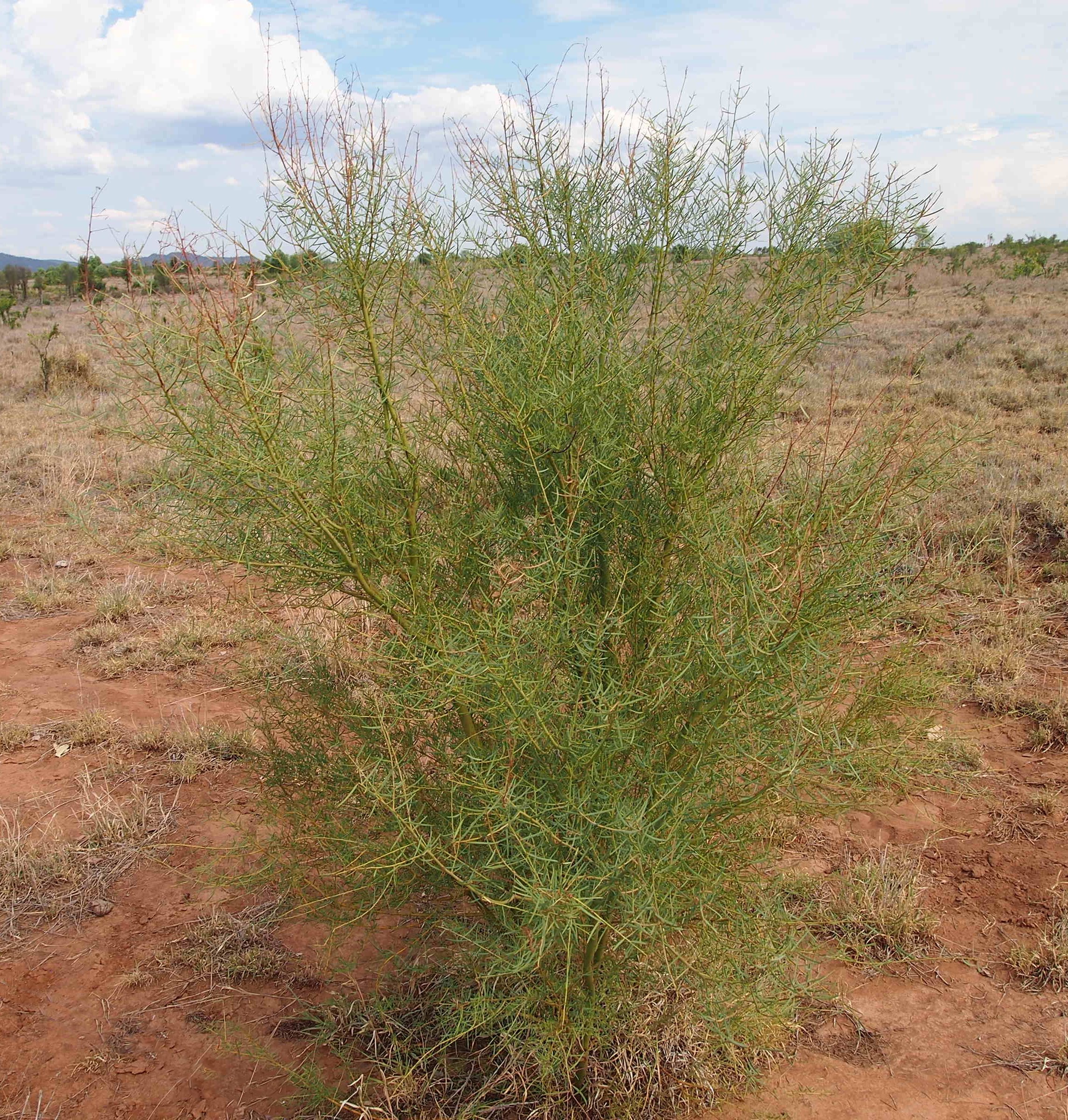
Catalog fields
- Genus
- Acacia
- Photo
- photos/CAT-00105-A.jpg
- Edible
- Yes
- layout
- double
- Habitat
- Arid and subtropical areas in a variety of habitats but commonly in clay or loam on alluvial flats, and (especially plants identified as subsp. arida) in sand. The ecology of the species is discussed in J.W. Turnbull (ed.), Multipurpose Australian Trees and Shrubs 210–213 (1986), B.R. Maslin & M.W. McDonald, AcaciaSearch: Evaluation of Acacia as a woody crop option for southern Australia, RIRDC Publication No. 30/017, 222–226 (2004) and D.J. Boland et al., Forest Trees of Australia 5th edn, 188–189 (2006).
- Published
- Yes
- Food group
- Nut / seed
- Latin name
- Acacia victoriae
- Fruit photo
- photos/CAT-00105-F.jpg
- Plant title
- Elegant wattle
- Source URLs
- https://profiles.ala.org.au/opus/foa/profile/Acacia%20victoriae | https://www.fao.org/4/V5360E/v5360e0b.htm; https://plantnet.rbgsyd.nsw.gov.au/cgi-bin/NSWfl.pl?lvl=sp&name=Acacia~victoriae&page=nswfl Open source ↗ Open source 2 ↗ Open source 3 ↗
- Catalogue ID
- CAT-00105
- Mature width
- Not confirmed; allow spread appropriate to growth habit
- Native range
- Widespread in all mainland states except Victoria where it occurs only in the far northwest.
- Plant family
- Fabaceae
- Supplier SKU
- Not recorded
- Listing group
- Common bush-food crop
- Mature height
- 2–7 m
- Native states
- NSW, NT, QLD, SA, VIC, WA
- Original list
- No
- Research date
- 10/10/2026
- Research notes
- Profile enriched from botanical/nursery sources. Dimensions are unpruned regional estimates where available; missing measurements remain explicit. Seasons are regional guides and vary with climate, location, cultivar and plant maturity. Drought and cultivation guidance are qualitative garden inferences, not measured ratings.
- Evidence status
- Published food use; preparation detail review pending
- Fruiting season
- Pods after flowering.
- Background photo
- Not recorded
- Edible component
- Processed mature seeds
- Flowering season
- September-December.
- Brief description
- Spreading inland wattle, often with prickly stipules.
- Drought tolerance
- High once established.
- Preparation notes
- Species-specific edible seed use; mature seeds generally processed/roasted. Do not generalise to other wattles.
- Flower description
- Pale-yellow to cream flowers in rounded heads.
- General cultivation
- General guidance (qualitative): Trial sunny well-drained soil; adapted to drier climate.
- Botanical description
- Shrub or tree 2–5 m high, sometimes to 9 m. Branchlets often pruinose, glabrous, sometimes hairy. Stipules spinose, commonly only bases persisting at mature nodes, 2–12 mm long. Phyllodes variable, linear to narrowly oblong, lanceolate or narrowly elliptic, straight or incurved, (1.4–) 2–5 (–10) cm long, 2–8 mm wide, l: w = 2–13 (–25), green to grey-green or glaucous, usually glabrous; midrib prominent; lateral veins usually obscure; gland ± basal, obscure or prominent. Inflorescences normally racemose but peduncles sometimes subtended by a secondary phyllode; raceme axes 1–10 cm long, slender; peduncles mostly twinned, 6–18 mm long, slender, glabrous, sometimes hairy; heads prolific, globular, 15–30-flowered, creamy white to pale lemon-yellow. Flowers 5-merous; sepals free, narrowly spathulate. Pods narrowly oblong, to 8 cm long, 9–16 mm wide, chartaceous, glabrous. Seeds transverse, ± globose, 4–6 mm long, brown, mottled blackish; funicle short, thick, scarcely arillate.
- Other botanical names
- Not recorded
- Attracts birds and bugs
- Native bees and insects visit flowers; canopy shelters birds.
- Flora of Australia profile
- https://profiles.ala.org.au/opus/foa/profile/Acacia%20victoriae Open source ↗
- Fruit type and description
- Papery dry pods with seeds used after processing.
- Flora of Australia citation
- B.R. Maslin & P.G. Kodela. Acacia victoriae. Flora of Australia, Australian Biological Resources Study, Department of Climate Change, Energy, the Environment and Water, Canberra. https://profiles.ala.org.au/opus/foa/profile/Acacia%20victoriae (accessed 2026-10-14). Copyright Commonwealth of Australia; CC BY 4.0 (https://creativecommons.org/licenses/by/4.0/). HTML formatting removed; species-level context added where noted. Open source ↗ Open source 2 ↗
- Flora of Australia retrieved
- 14/10/2026