CAT-00138
Broad-leaved geebung
Persoonia levis
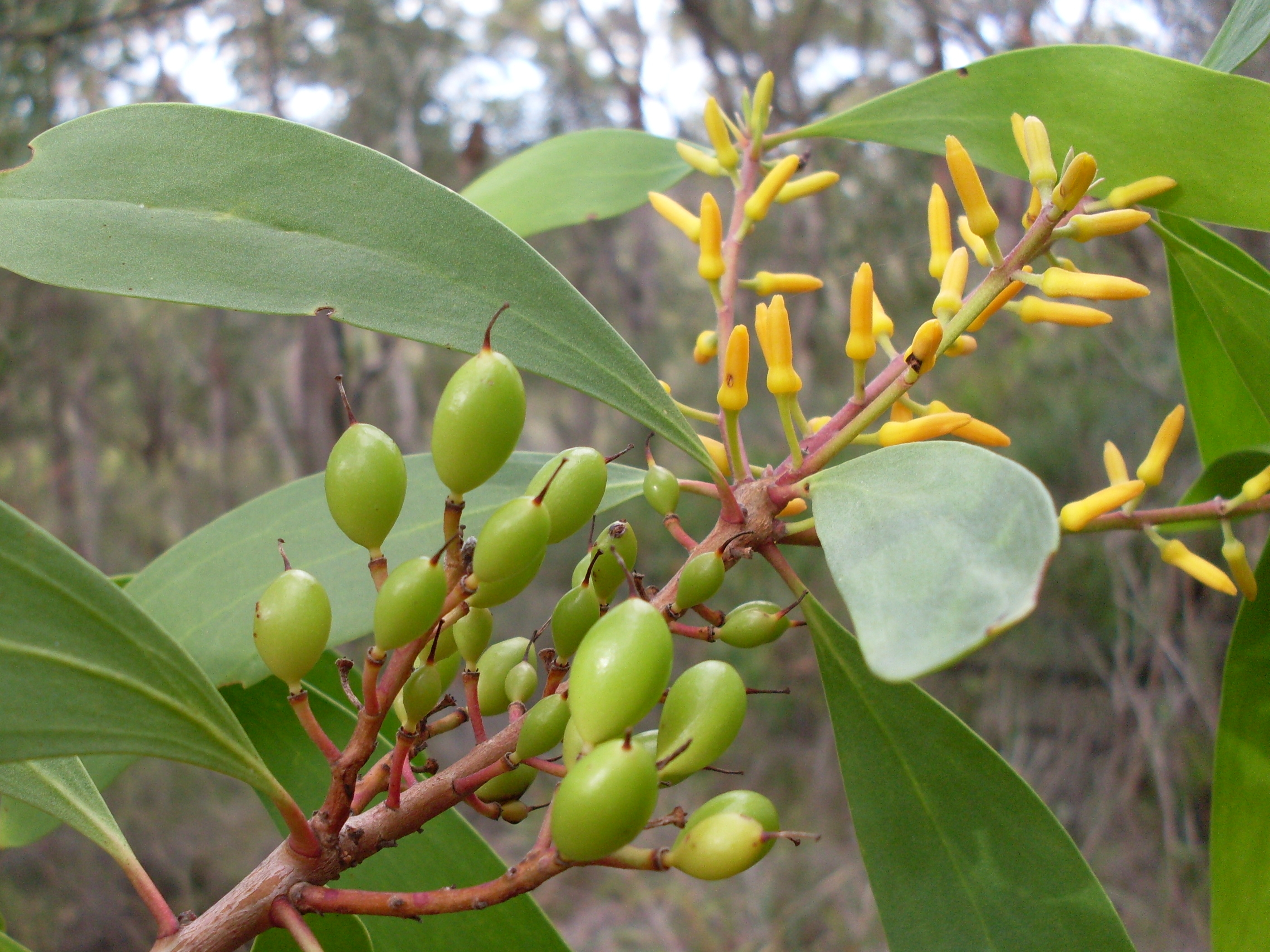
Catalog fields
- Genus
- Persoonia
- Photo
- Not recorded
- Edible
- Yes
- layout
- single
- Habitat
- Grows in heath to dry sclerophyll forest, in coastal sand and on sandstone, from sea level to 1000 m alt.
- Published
- Yes
- Food group
- Fruit
- Latin name
- Persoonia levis
- Fruit photo
- Not recorded
- Plant title
- Broad-leaved geebung
- Source URLs
- https://profiles.ala.org.au/opus/foa/profile/Persoonia%20levis | https://www.anbg.gov.au/apu/plants/persooni.html; https://plantnet.rbgsyd.nsw.gov.au/cgi-bin/NSWfl.pl?lvl=sp&name=Persoonia~levis&page=nswfl; https://resources.austplants.com.au/plant/persoonia-levis/; https://apps.lucidcentral.org/plants_se_nsw/text/entities/persoonia_levis.htm Open source ↗ Open source 2 ↗ Open source 3 ↗ Open source 4 ↗ Open source 5 ↗
- Catalogue ID
- CAT-00138
- Mature width
- Not confirmed; allow spread appropriate to growth habit
- Native range
- Occurs east of the Great Dividing Range between the Macleay River in N.S.W. and Cann River in eastern Vic.
- Plant family
- Proteaceae
- Supplier SKU
- Not recorded
- Listing group
- Regional / traditional food plant
- Mature height
- Up to about 5 m
- Native states
- NSW, VIC
- Original list
- No
- Research date
- 10/10/2026
- Research notes
- Profile enriched from botanical/nursery sources. Dimensions are unpruned regional estimates where available; missing measurements remain explicit. Seasons are regional guides and vary with climate, location, cultivar and plant maturity. Drought and cultivation guidance are qualitative garden inferences, not measured ratings.
- Evidence status
- Published food use; preparation detail review pending
- Fruiting season
- Season not verified.
- Background photo
- Not recorded
- Edible component
- Soft ripe fruit flesh
- Flowering season
- Spring-autumn in south-eastern NSW flora; regional timing varies.
- Brief description
- Shrub or small tree with broad leaves and flaky bark.
- Drought tolerance
- Moderate once established.
- Preparation notes
- Wait until fallen fruit is soft; eat pulp and discard skin and stone.
- Flower description
- Yellow tubular flowers with four tepals, in elongated clusters.
- General cultivation
- General guidance (qualitative): Specialist sandy-soil trial with drainage; confirm edible ripe stage.
- Botanical description
- Erect to spreading shrubs or trees 1-5 m tall. Bark lamellose-flaky. Hairs greyish, appressed to antrorse. Young branchlets glabrous to moderately hairy. Leaves oblanceolate to narrowly oblong to obovate to narrowly elliptic to spathulate, 6-14 cm long, 1.3-8 cm wide, flat, spreading to suberect, falcate, twisted at base through 90°, innocuous, concolorous, not glaucous, glabrous to sparsely hairy when immature, glabrescent, smooth. Inflorescence usually auxotelic, 4-34-flowered; rachis 0.8-15 cm long. Flowers mostly subtended by scale leaves; pedicels 3-8 mm long, erect to spreading, sparsely to moderately hairy; tepals 10-14 mm long, apiculate, glabrous to sparsely hairy on outside. Ovary glabrous; ovules 2.
- Other botanical names
- Not recorded
- Attracts birds and bugs
- Native bees and insects visit flowers; canopy shelters birds.
- Flora of Australia profile
- https://profiles.ala.org.au/opus/foa/profile/Persoonia%20levis Open source ↗
- Fruit type and description
- Fleshy drupe with a hard stone and fibrous edible pulp.
- Flora of Australia citation
- P.H.Weston. Persoonia levis. Flora of Australia, Australian Biological Resources Study, Department of Climate Change, Energy, the Environment and Water, Canberra. https://profiles.ala.org.au/opus/foa/profile/Persoonia%20levis (accessed 2026-10-15). Copyright Commonwealth of Australia; CC BY 4.0 (https://creativecommons.org/licenses/by/4.0/). HTML formatting removed; species-level context added where noted. Open source ↗ Open source 2 ↗
- Flora of Australia retrieved
- 15/10/2026