CAT-00139
Hairy geebung
Persoonia mollis
Catalog fields
- Genus
- Persoonia
- Photo
- Not recorded
- Edible
- Yes
- layout
- single
- Habitat
- Not recorded
- Published
- Yes
- Food group
- Fruit
- Latin name
- Persoonia mollis
- Fruit photo
- Not recorded
- Plant title
- Hairy geebung
- Source URLs
- https://profiles.ala.org.au/opus/foa/profile/Persoonia%20mollis | https://anpsa.org.au/wp-content/uploads/checklist1991.pdf; https://plantnet.rbgsyd.nsw.gov.au/cgi-bin/NSWfl.pl?lvl=sp&name=Persoonia~mollis&page=nswfl; https://resources.austplants.com.au/plant/persoonia-mollis/ Open source ↗ Open source 2 ↗ Open source 3 ↗ Open source 4 ↗
- Catalogue ID
- CAT-00139
- Mature width
- Up to several metres; subspecies-dependent
- Native range
- Occurs in an area roughly bounded by the Blue Mountains, Bulli, Durras Lake, Monga and Goulburn, with a disjunct occurrence in the Hornsby area in central-eastern N.S.W.
- Plant family
- Proteaceae
- Supplier SKU
- Not recorded
- Listing group
- Regional / traditional food plant
- Mature height
- Prostrate forms to shrubs up to 5 m; subspecies-dependent
- Native states
- NSW
- Original list
- No
- Research date
- 10/10/2026
- Research notes
- Do not use this provisional entry as an eating guide. Profile enriched from botanical/nursery sources. Dimensions are unpruned regional estimates where available; missing measurements remain explicit. Seasons are regional guides and vary with climate, location, cultivar and plant maturity. Drought and cultivation guidance are qualitative garden inferences, not measured ratings.
- Evidence status
- Published species food-use report; ripe-stage and preparation review pending
- Fruiting season
- After flowering
- Background photo
- Not recorded
- Edible component
- Soft ripe fruit flesh
- Flowering season
- Late December-May in NSW profile.
- Brief description
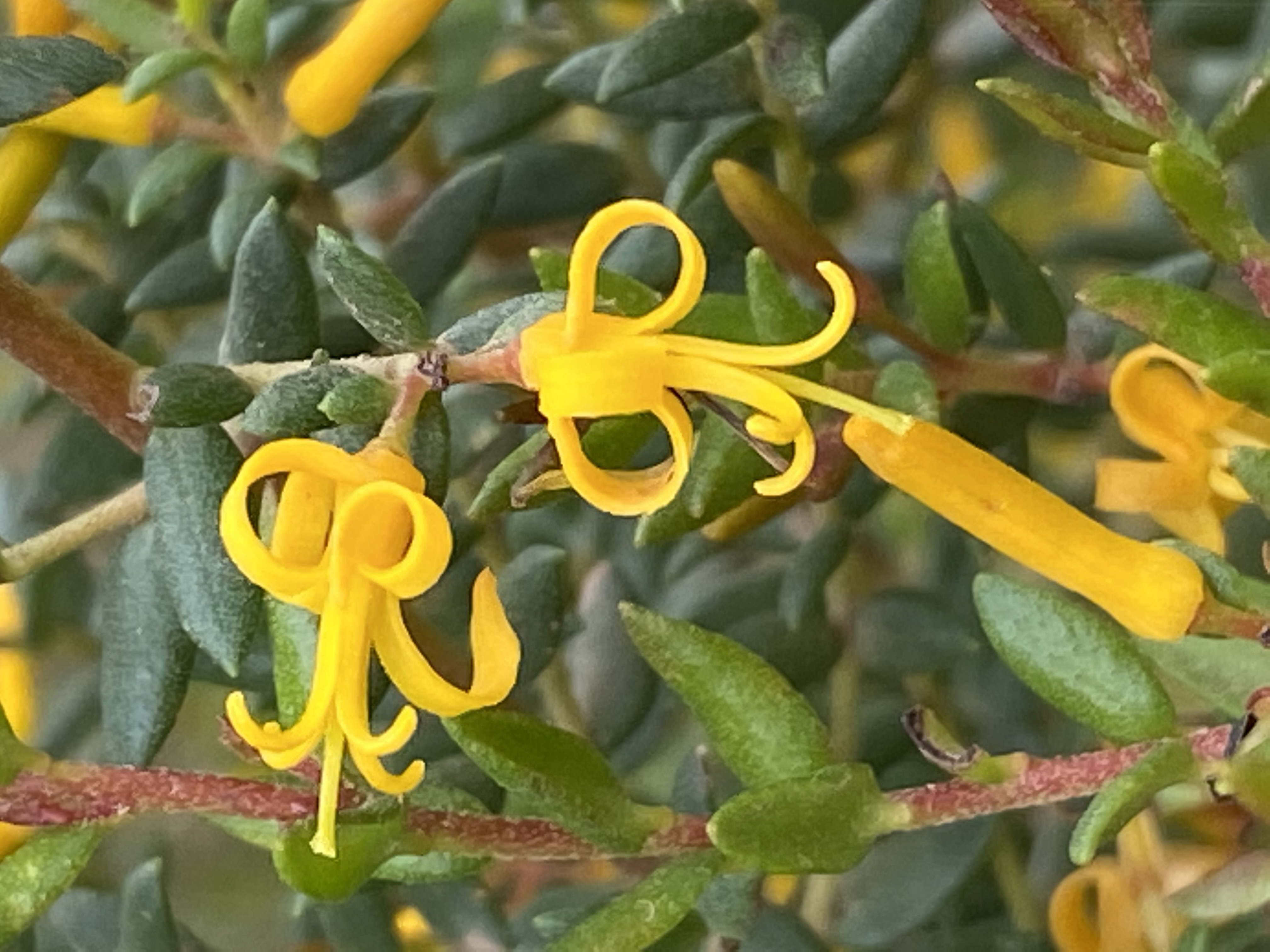
- Variable prostrate to tall shrub with hairy young growth and yellow flowers.
- Drought tolerance
- Moderate in suitable habitat; exact rating not verified.
- Preparation notes
- APS reports ripe pulp edible raw or cooked; fibrous and astringent. Confirm identification, subspecies and ripeness; hard stone is not the pulp.
- Flower description
- Yellow flowers in elongated clusters.
- General cultivation
- General guidance (qualitative): Specialist trial; subspecies determines size and heat response.
- Botanical description
- Erect to prostrate shrubs 0.2–5 m tall. Bark smooth. Hairs greyish to ferruginous, appressed to patent. Young branchlets moderately to densely hairy. Leaves linear to oblong to elliptic to lanceolate to spathulate or narrowly so, 1.5–12 cm long, 0.8–17 mm wide, flat or convex, with recurved to revolute margins, sometimes incurved, spreading to suberect, straight, innocuous, strongly discolorous, sometimes glaucous, sparsely to moderately hairy when immature, glabrescent to sparsely hairy when mature, smooth to scaberulous. Inflorescence usually auxotelic, 1–30-flowered; rachis 0–15 cm long. Flowers mostly subtended by leaves; pedicels 1–3 mm long, erect, moderately to densely hairy; tepals 8–11.5 mm long, obtuse to caudate, moderately to densely hairy on outside. Ovary glabrous; ovules 2.
- Other botanical names
- Not recorded
- Attracts birds and bugs
- Native bees and insects visit flowers; canopy shelters birds.
- Flora of Australia profile
- https://profiles.ala.org.au/opus/foa/profile/Persoonia%20mollis Open source ↗
- Fruit type and description
- Green drupe about 8 mm with fibrous, sometimes astringent edible pulp around a stone.
- Flora of Australia citation
- P.H. Weston. Persoonia mollis. Flora of Australia, Australian Biological Resources Study, Department of Climate Change, Energy, the Environment and Water, Canberra. https://profiles.ala.org.au/opus/foa/profile/Persoonia%20mollis (accessed 2026-10-15). Copyright Commonwealth of Australia; CC BY 4.0 (https://creativecommons.org/licenses/by/4.0/). HTML formatting removed; species-level context added where noted. Open source ↗ Open source 2 ↗
- Flora of Australia retrieved
- 15/10/2026