CAT-00122
Water ribbons
Cycnogeton procerum
Catalog fields
- Genus
- Cycnogeton
- Photo
- Not recorded
- Edible
- Yes
- layout
- single
- Habitat
- Common in still to slow-flowing fresh water to 2 m deep mostly in permanent swamps, lagoons and streams, but withstands stranding for extensive periods. Abundant in Eucalyptus camaldulensis sites. Sometimes in brackish water (eastern variant).
- Published
- Yes
- Food group
- Root / tuber
- Latin name
- Cycnogeton procerum
- Fruit photo
- Not recorded
- Plant title
- Water ribbons
- Source URLs
- https://profiles.ala.org.au/opus/foa/profile/Cycnogeton%20procerum | https://www.anbg.gov.au/apu/plants/trigproc.html; https://plantnet.rbgsyd.nsw.gov.au/cgi-bin/NSWfl.pl?lvl=sp&name=Cycnogeton~procerum&page=nswfl Open source ↗ Open source 2 ↗ Open source 3 ↗
- Catalogue ID
- CAT-00122
- Mature width
- Colony spread varies; rhizomatous
- Native range
- Occurring from Kangaroo Island and southeastern South Australia, through most of Victoria and E coastal New South Wales and Queensland as far N as near Rockhampton; also widespread in Tasmania.
- Plant family
- Juncaginaceae
- Supplier SKU
- Not recorded
- Listing group
- Regional / traditional food plant
- Mature height
- Leaves to 2 m; emergent aquatic
- Native states
- NSW, QLD, SA, TAS, VIC
- Original list
- No
- Research date
- 10/10/2026
- Research notes
- Profile enriched from botanical/nursery sources. Dimensions are unpruned regional estimates where available; missing measurements remain explicit. Seasons are regional guides and vary with climate, location, cultivar and plant maturity. Drought and cultivation guidance are qualitative garden inferences, not measured ratings.
- Evidence status
- Published food use; preparation detail review pending
- Fruiting season
- After flowers.
- Background photo
- Not recorded
- Edible component
- Cooked tubers
- Flowering season
- Warmer months.
- Brief description
- Emergent freshwater perennial with ribbon leaves and tuberous root tips.
- Drought tolerance
- None for dry soil; aquatic habitat required.
- Preparation notes
- Cook tubers; source uses older name Triglochin procera. Collect only from clean water.
- Flower description
- Very small flowers densely packed on long upright spikes.
- General cultivation
- General guidance (qualitative): Suitable only in a pond or consistently wet contained growing bed.
- Botanical description
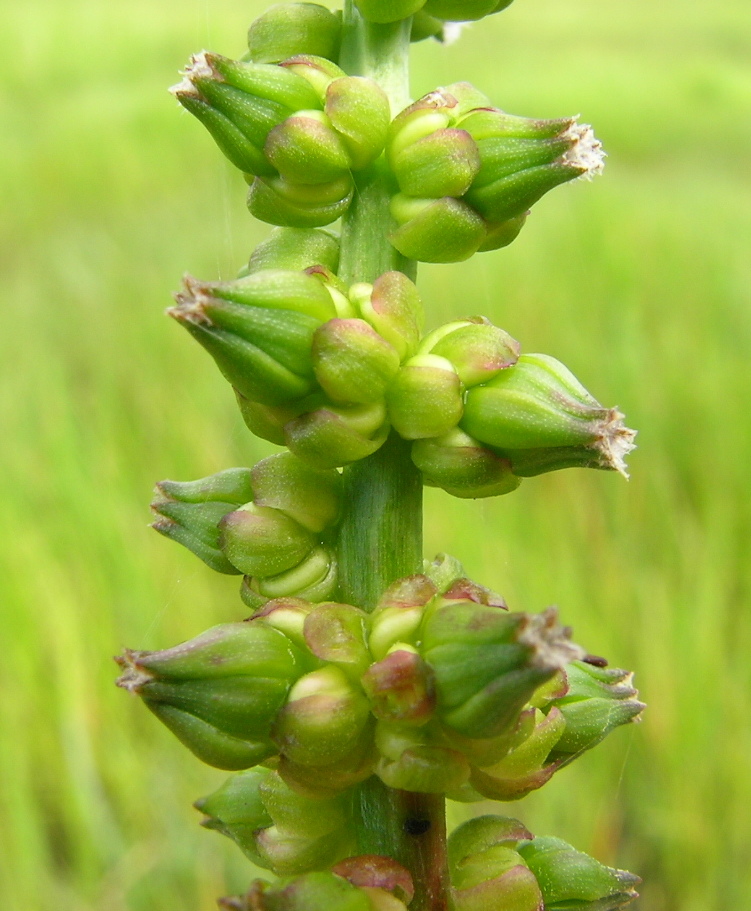
- Usually robust, sometimes slender, perennial, aquatic herb. Rhizome woody, fibre-covered, 7–18 (–30) mm thick. Tubers usually elongated, 20–145 mm long, 4.5–13 mm diam.; terminating long roots c. 3.5–20 cm long. Leaves ± flat and strap-like, floating to erect, glossy above, to 350 cm long and 5–41 (–150 in western variant) mm wide, spongy basally; basal sheath tapered; T.S. c. 3 cm below sheath summit ± elliptic, with width of spongy portion c. 2.2–5.5 times its thickness and with sheath margins not or just meeting across blade face (but see note below on an eastern variant). Scape at fruiting c. 27–145 cm long, 4–23 mm diam. Infructescence a raceme, 6–51 (–144 in western variant) cm long, 17–29 (–42 in western variant) mm diam.; pedicels 2–5 mm long. Fruits c. 52–320 per infructescence, ± globular to broadly obovoid to ellipsoid, 6.8–14.4 mm long, 6.8–10.9 mm diam. Carpels 3–6 (–7), all maturing or 1 or 2 (–5) aborting; central axis absent; mature carpels attached along 45%–80% of length, straight to twisted around each other, with a broad-convex dorsal ridge and usually 2 broad lateral ridges, lacking projections except short stylar beak.
- Other botanical names
- Triglochin procera
- Attracts birds and bugs
- Native bees and insects visit flowers; canopy shelters birds.
- Flora of Australia profile
- https://profiles.ala.org.au/opus/foa/profile/Cycnogeton%20procerum Open source ↗
- Fruit type and description
- Small rounded segmented dry fruits; underground tubers are the food crop.
- Flora of Australia citation
- Helen I. Aston. Cycnogeton procerum. Flora of Australia, Australian Biological Resources Study, Department of Climate Change, Energy, the Environment and Water, Canberra. https://profiles.ala.org.au/opus/foa/profile/Cycnogeton%20procerum (accessed 2026-10-15). Copyright Commonwealth of Australia; CC BY 4.0 (https://creativecommons.org/licenses/by/4.0/). HTML formatting removed; species-level context added where noted. Open source ↗ Open source 2 ↗
- Flora of Australia retrieved
- 15/10/2026